
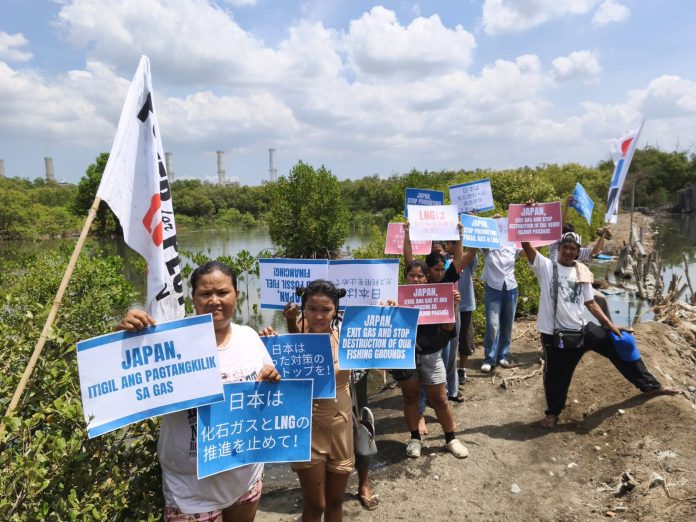
Civil society groups on Thursday blamed Japan-backed liquefied natural gas expansion for what they said is a deepening energy crisis in the Philippines, as Japanese lawmakers prepared to visit gas facilities in Batangas.
The visit by a parliamentary delegation led by former Japanese Prime Minister Fumio Kishida comes as energy prices rise amid escalating tensions in the Middle East, which groups said have exposed the country’s dependence on imported fossil fuels.
Gerry Arances, executive director of the Center for Energy, Ecology, and Development (CEED), said the surge in global LNG prices is already affecting Filipino consumers, warning that reliance on gas leaves the country vulnerable to external shocks.
“The 91% rise in LNG prices in the first month alone of the US-Israel war on Iran is now draining the pockets of ordinary Filipinos,” Arances said, adding that “LNG and fossil fuels have always been volatile and susceptible to global price shocks.”
He said Japan’s backing of LNG infrastructure, including the Ilijan terminal, “brought this vulnerability to the energy crisis directly to our doorsteps.”
Japan’s export credit agency, the Japan Bank for International Cooperation, together with Osaka Gas, invested $100 million in 2019 to develop the Philippines’ first LNG import terminal.
The Ilijan gas hub and related projects are located in Batangas City, along the Verde Island Passage, a marine corridor known for its rich biodiversity.
Environmental groups and coastal communities have opposed the concentration of LNG projects in the area, citing risks to livelihoods and marine ecosystems. In 2023, groups filed a complaint against the Japanese bank over its role in financing LNG developments.
Fr. Edwin Gariguez, lead convenor of the Protect Verde Island Passage campaign network, said the expansion of gas infrastructure threatens both communities and the environment, rejecting claims that LNG is a cleaner alternative.
“Gas development has endangered our Amazon of the Oceans, with host communities and critical ecosystems confronting threats to their livelihood and well-being,” Gariguez said, adding that communities “have long rejected LNG and its pretense of being a cleaner alternative to coal.”
Japan has also promoted LNG and other fossil fuel technologies in Southeast Asia through the Asia Zero Emission Community, or AZEC, a regional platform that aims to support decarbonization.
But Hozue Hatae, campaigner for Friends of the Earth Japan, warned that such initiatives risk prolonging fossil fuel dependence.
She said the planned visit by the AZEC parliamentary group “raises serious alarm, as it may further promote gas development in Southeast Asia,” adding that Japanese public and private actors “have already financed projects, with significant impacts on the livelihoods of local communities, including fisherfolk who depend on the VIP.”
She added that “AZEC further burdens communities already struggling with the energy crisis by compounding climate, environmental, and social impacts, as well as rising electricity costs.”
Residents from coastal barangays in Batangas staged protests ahead of the visit, calling on Japanese investors to divest from gas projects in the province.
At the same time, church groups, communities, and civil society organizations are advancing renewable energy initiatives in the Verde Island Passage and nearby areas, including efforts in Oriental Mindoro aimed at accelerating the transition to clean energy.
Gariguez said communities are pushing alternatives to fossil fuels, noting that “our parishes are awarding contracts for solar rooftop systems that will benefit our communities,” while local groups are “championing clean energy through collective ownership and management.” He added: “renewable energy is the path forward for Filipinos.”
Japanese officials and the Japan Bank for International Cooperation have yet to respond to the groups’ statements.