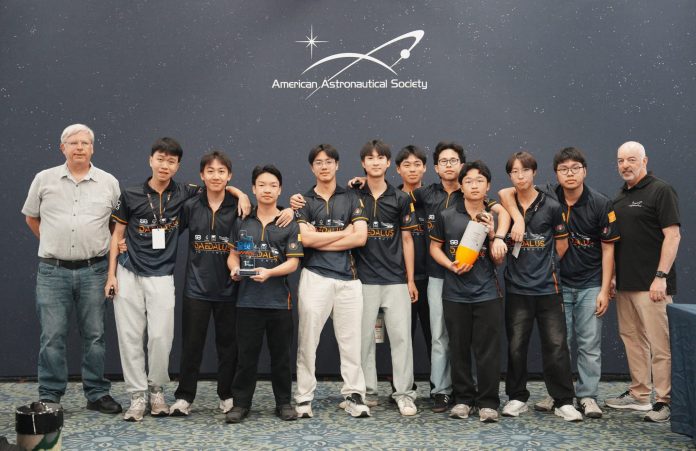
In a historic feat of youthful ingenuity, Team DAEDALUS from the Aerospace Technology Institute of Assumption College has claimed the world championship at the prestigious Annual CanSat Competition 2026.
Held from June 4–7 in Monterey, Virginia, the victory marks a watershed moment for Thailand’s emerging generation of scientists and engineers.
The scale of the competition makes the achievement even more remarkable.
Navigating a fiercely contested field of 36 elite teams representing 23 countries, the Bangkok-based cohort was the sole high school team to qualify for the finals. Competing against premier universities and technical institutions from across the globe, they ultimately secured the global title with a remarkable score of 93.0778 out of 100 points.
Organized by the American Astronautical Society (AAS) and the NASA Goddard Space Flight Center, the annual event simulates the rigorous, end-to-end lifecycle of a complex aerospace project. The competition provides students with critical, hands-on experience by challenging them to design and build an operational simulation of a real satellite.
The catch? The entire system must be miniaturized to fit precisely within the volume and shape of a soft drink can.
The Anatomy of a Perfect Flight
The technical foundation of CanSat closely mirrors the cutting-edge technology used in modern, full-scale miniaturized satellites.
While these student prototypes do not enter orbit, they undergo a true atmospheric trial—launched by rocket to an altitude of approximately one kilometer before being released to execute their missions.
To achieve this, the 11-student team from Grades 11 and 12 had to master an array of multidisciplinary skills. The project required them to acquire and strengthen fundamental concepts in advanced technology, physics, and programming while navigating the realities of project coordination, budget management, teamwork, and international communication.
The intense multi-day competition pushed the team through an exhaustive aerospace gauntlet divided into three phases: a Flight Readiness Review (FRR), the rocket launch itself, and a concluding Post-Flight Review (PFR).
This year’s mission, dubbed the Paraglider Instrument Delivery mission, required teams to engineer a system capable of safely delivering delicate scientific instruments to a designated drop zone. The CanSat was required to deploy its payload container at exactly 80% of its maximum altitude before beginning its autonomous descent.
“This mission was extremely challenging due to several uncontrollable environmental factors, particularly erratic wind directions and shifting velocities that directly threatened our flight path and landing accuracy,” explained Pachara Phumiprathet, the team’s faculty advisor, in an interview with LiCAS News.
“Our students had to rely heavily on predictive design, meticulous planning, and exhaustive pre-flight testing to maximize our margins of safety.”
The challenge did not end when the capsule reached the ground.
“After the rocket test, we had to prepare and present a Post-Flight Review summarizing the mission results, analyzing flight data, identifying problems, and outlining areas for improvement to the judging panel,” the teacher noted.
Engineering Dreams from a Historic Foundation
The victory is a testament to the rigorous academic tradition of Assumption College, a premier Catholic institution along the Chao Phraya River near the historic Assumption Cathedral of the Bangkok Archdiocese.
Founded in 1885 by Fr. Emile-August Colombet, who invited the Brothers of St. Gabriel from France to help educate Thailand’s youth, the school has long been known for producing leaders in public life, business, and the professions. Its alumni include incumbent Prime Minister Anutin Charnvirakul, three former prime ministers, and 15 privy counselors.
Now, that legacy has reached the field of aerospace engineering.
“Over the past several months, every member has dedicated countless hours and effort to designing, building, testing, and developing the CanSat mission,” the teacher said.
“Every point earned reflects not only engineering capability. It also reflects the determination, perseverance, and the spirit of Thai youth who never give up on their dreams.”
As Team DAEDALUS prepares to return to Thailand on June 15, its members come home not merely as students but as pioneers. Their victory bridges the gap between classrooms in Bangkok and the frontier of international aerospace engineering, demonstrating that vision, discipline, and technical excellence are not limited by age.