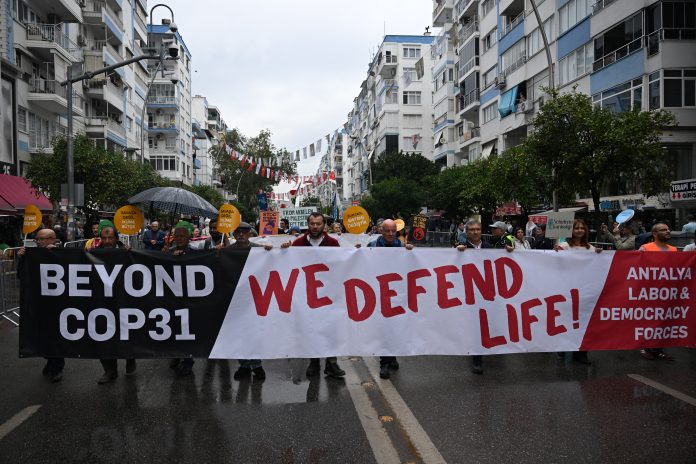
A Catholic bishop and climate advocates have warned that a draft agreement at the United Nations climate summit could prolong dependence on fossil fuels after negotiators omitted an explicit commitment to move away from coal, oil and gas.
Bishop Gerardo Alminaza of San Carlos, president of Caritas Philippines, criticized the November 19 draft cover decision at COP31 in Antalya, Türkiye, saying it could weaken commitments made at previous climate summits.
“The latest COP31 draft cover decision risks undermining the world’s commitment to transition away from fossil fuels. As negotiations enter their final days, we cannot afford an agreement that fails to confront our continued dependence on coal, oil, and gas,” said Bishop Alminaza.
The nine-page draft, released under the COP31 presidency’s consultations, contains no explicit call to transition away from fossil fuels, although it refers to implementing the outcome of the first global stocktake adopted at COP28.
At that summit, governments agreed to transition away from fossil fuels in energy systems.
The November 19 text also proposes increasing electricity’s share of global final energy consumption to 35 percent by 2035, alongside efforts to triple renewable energy capacity and double the annual rate of energy efficiency improvements by 2030.
However, paragraph 36(d) does not explicitly require the additional electricity to come from renewable sources.
Türkiye earlier reported that 75 countries had backed the electrification pledge.
Alminaza welcomed efforts to expand electricity access but warned that the absence of a clear renewable energy requirement could allow continued reliance on coal and gas.
“Electrification must help end fossil fuel dependence, not give it a new lease on life,” he said.
Gerry Arances, executive director of the Center for Energy, Ecology, and Development (CEED), raised similar concerns, saying the proposed target could allow fossil fuel companies to benefit from an initiative intended to advance climate action.
“Without such certainty, the language risks providing fossil fuel players and backers with electrification as a shiny new cover to hide under, even as global warming breaches the 1.5C climate goal,” said Arances.
He said governments should uphold the COP28 commitment, particularly after an energy crisis that exposed the vulnerability of economies dependent on fossil fuels.
International climate campaign group 350.org also criticized the removal of explicit fossil fuel transition language.
Andreas Sieber, the group’s head of political strategy, accused the COP31 presidencies of failing to advance plans to reduce global dependence on coal, oil and gas.
“We are on the brink of an outrageous and utterly embarrassing lack of leadership by the COP31 presidencies,” said Sieber.
He called for continued work on global and national roadmaps for transitioning away from fossil fuels, building on efforts initiated at COP30.
The draft also drew criticism over its treatment of carbon capture, utilization and storage and carbon dioxide removal technologies.
Paragraph 34 welcomes efforts to accelerate their development and deployment, while paragraph 36(h) proposes expanding carbon capture capacity by 2035.
The text also recognizes that carbon removal should complement, rather than replace or delay, deep emissions reductions.
Alminaza warned that the technologies could nevertheless be used to justify continued fossil fuel extraction.
“These costly and uncertain approaches must not be used to justify continued fossil fuel extraction or delay the deployment of renewable energy,” he said.
The bishop linked the negotiations to the difficulties faced by communities struggling with expensive and unreliable electricity.
In remarks at COP31, he cited fishing families in Negros, an island in the central Philippines, whose livelihoods depend on electricity to preserve their catch.
“Can they afford the ice that keeps their catch fresh until market day? When the power goes out, who bears the loss?” he asked.
He also cited figures showing that 655 million people worldwide remain without electricity, including more than 560 million in sub-Saharan Africa.
Rukiya Khamis, 350.org’s East Africa lead, warned that electrification without a firm commitment to renewable energy could deepen fossil fuel dependence in countries already struggling with energy poverty.
“Africa needs to electrify with renewables to keep people safe, lower bills, and create green jobs and industries,” said Khamis.
Climate finance also remained a major point of contention in the negotiations.
The November 19 draft reaffirmed efforts to at least triple adaptation finance by 2035 but deferred agreement on the baseline and implementation pathway.
It proposed an Antalya-to-Addis Ababa Roadmap on Adaptation and Resilience Finance to identify additional funding sources and improve access to financial support.
However, the text did not specify the USD 120 billion by 2035 adaptation finance figure sought by climate advocates.
Khamis criticized wealthy countries for failing to provide adequate funding to help developing nations respond to worsening climate impacts.
“Developing countries and frontline communities don’t need another process, they need the money,” she said.
Fenton Lutunatabua, 350.org’s Pacific and Caribbean lead, warned that weakening fossil fuel commitments would place additional pressure on vulnerable island communities.
“Every year above 1.5°C puts more pressure on Pacific ecosystems, infrastructure and lives,” said Lutunatabua.
The draft itself acknowledges that global peak warming is projected to exceed 1.5 degrees Celsius above preindustrial levels and recognizes that every additional increment of warming increases the risks of loss and damage.
Alminaza called for adequate, accessible and predictable financing to help developing countries shift to renewable energy, including grants and affordable financing for community-owned renewable energy projects, battery storage and local electricity grids.
He said wealthy nations and historically major polluters have a greater responsibility to support the transition.
“Developing countries cannot be expected to undertake this transition without the resources to deliver it,” he said.
The bishop also stressed the Church’s responsibility to defend communities affected by the climate crisis.
“The Church cannot remain silent when decisions made in international negotiations threaten the lives, livelihoods, and dignity of the poor,” he said.
Citing Pope Francis’ encyclical Laudato Si’, Alminaza emphasized the responsibility to protect creation and communities bearing the greatest burden of environmental destruction.
Alminaza and CEED also expressed solidarity with Panama, which has demanded limits on oil production, renewable-based electrification and financing for developing countries.
Arances urged developing nations to support those demands and resist efforts to weaken the transition away from fossil fuels.
Alminaza called on COP31 negotiators to restore explicit language on transitioning away from fossil fuels and ensure that expanded electrification is powered by renewable energy.
“The transition away from fossil fuels is not negotiable. Neither is the right of every person to affordable, reliable, and renewable energy,” he said.
“World leaders must not leave Antalya with an agreement that protects fossil fuel interests while abandoning the communities suffering from the climate crisis.”