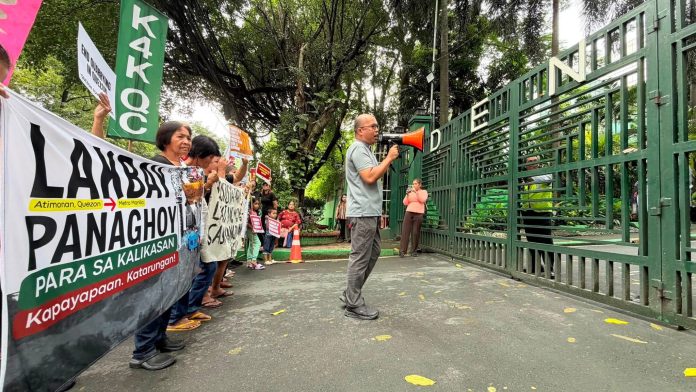
A Catholic priest and environmental advocates brought community concerns over coal, land disputes and projects they said threaten livelihoods and ecosystems to national government agencies in Metro Manila on Oct. 12, concluding an eight-day pilgrimage through Quezon and Laguna.
Fr. Warren Puno of the Diocese of Lucena joined faith-based and environmental groups in protest actions at the Department of Agriculture, Department of Environment and Natural Resources, Department of Agrarian Reform and Department of Energy.
The “Lakbay Panaghoy para sa Kalikasan, Kapayapaan at Katarungan” was initiated by Puno to raise concerns over ecological destruction and land rights issues faced by communities in Quezon and Laguna.
“Communities are suffering because of dangerous infrastructures and projects, including fossil fuel plants, quarrying, and deforestation. This pilgrimage is our message to the government of the grievances of communities against the harm to their health, their livelihoods, and to nature,” said Puno, convenor of Quezon for Environment and director of the Ministry of Ecology of the Diocese of Lucena.
Among the issues raised was the long-running opposition to the proposed 1,200-megawatt Atimonan One Energy coal plant in Atimonan, Quezon.
Puno questioned the continued use of the project’s environmental impact assessment, which he said was already 12 years old.
“Why did the government allow A1E to establish a coal plant even though their environment impact assessment (EIA) is 12 years old? Because of the worsening climate crisis and pollution, it is time for a new EIA, based on new standards for genuine ecological protection,” Puno said.
The mobilization also raised land concerns involving farmers in Sariaya, Quezon.
“We have endured a long-standing fight for our lands in Sariaya, Quezon for the livelihood, homes, and food of the community. If the government is genuinely following their mandate of public service, then they must respect our rights to our lands. Because if we have no lands, then we have no livelihoods and no future,” said Jansept Geronimo, secretary general of the Kilusan para sa Repormang Agraryo at Katarungang Panlipunan.
The groups also linked the pilgrimage to wider calls for climate justice.
“Over a decade ago, advocates went on a People’s Pilgrimage to climate disaster-prone regions. Yet it is saddening that even today, advocates are pushed towards walking miles upon miles to demand justice for climate-prone communities,” said Yeb Saño, chairperson of Laudato Si’ Movement.
The Power for People Coalition also raised concerns over energy projects in Quezon and Laguna, including large renewable energy developments that it said could harm mountain ranges, bodies of water, biodiversity and local communities.
“When the government and private companies neglect their responsibilities and ignore the impacts of their projects to ecosystems and communities, then they give only environmentally-disruptive projects under the guise of ‘renewable energy.’ When we transition towards renewable energy, it must always have at its heart the protection of all peoples, all lands, and all seas,” said Krishna Ariola, campaigner for the Power for People Coalition.