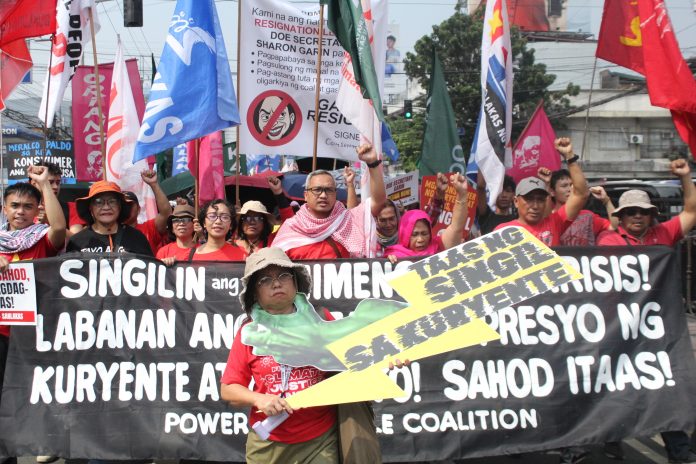
Labor, consumer and climate groups renewed calls for Energy Secretary Sharon Garin to resign Sept. 30, blaming the government’s continued reliance on coal and gas for rising electricity costs and prolonged outages in parts of the country.
The Power for People Coalition said consumers continue to face higher power bills and rotating brownouts more than six months after the declaration of a national energy emergency.
The coalition blamed the country’s dependence on imported coal and gas for soaring electricity rates and accused the government of failing to shield consumers from rising generation costs.
P4P said fossil gas, which accounts for half of Meralco’s electric capacity, reached a weighted average rate of P12.11 per kilowatt-hour in September, up from P9.14 in March.
Aaron Pedrosa, secretary general of Sanlakas, said higher electricity charges were forcing households to sacrifice other basic needs to keep their lights on.
“In Visayas and Mindanao, consumers endure outages that run up to 20 hours in a day. Filipinos pay a premium for unreliable electricity. These struggles are direct consequences of government incompetence,” Pedrosa said.
The groups took their protest to the streets in Manila, bringing a “wheel of misfortune” depicting provinces they said could face further power outages.
P4P said at least 150 red and yellow alerts were recorded in the Visayas from May to early September. It cited repeated forced outages at coal-fired power plants as a major factor behind the supply problems.
According to the coalition, the two units of Aboitiz-owned Therma Visayas Inc. recorded a combined 208 forced outages, while Panay Energy Development Corp. and Cebu Energy Development Corp. recorded 74 and 13, respectively.
The coalition said the average rate in the Visayas spot market was P5.22 per kilowatt-hour before the alerts began in May and rose to P11.56 afterward.
“These coal plants rob millions of Filipinos of their access to electricity while draining their pockets with higher costs,” P4P campaigner Krishna Ariola said.
Ariola criticized the Energy Department for continuing to push coal and gas as consumers grapple with higher prices and unreliable supply.
“The DOE’s push for expensive, unreliable electricity just shows how blind it is to the suffering of consumers while it is busy bowing to the whims of fossil fuel companies. Secretary Garin must resign, because her “service” is not for people, but for profit,” Ariola said.
The protest included groups from the labor, urban poor, youth, consumer and climate sectors, among them Sanlakas, Bukluran ng Manggagawang Pilipino, Oriang, Partido Lakas ng Masa, Philippine Movement for Climate Justice, Alma Kuryente and several community organizations.
The groups also pressed the administration to fulfill its commitment to remove the system loss charge and address other costs passed on to electricity consumers.
Flora Santos, president of Oriang, questioned whether the promised removal of the system loss charge would become another unfulfilled government commitment. She said consumers should no longer be made to shoulder system losses and called on the government to investigate generation costs and other charges added to monthly power bills.
P4P warned that high electricity costs and unreliable supply could further deepen economic hardship as the country braces for what the coalition described as a looming Super El Niño.
Luke Espiritu, president of Bukluran ng Manggagawang Pilipino, said rising electricity and commodity prices were putting greater pressure on workers whose wages have failed to keep pace.
“The government is condemning the people to starvation. They are letting costs of electricity and basic commodities reach record highs, while refusing to let workers’ wages catch up by even a fraction,” Espiritu said.
He said extreme heat would compound the burden on consumers already facing unreliable electricity.
“If we let the government and the companies they are in cahoots with go their merry way with business-as-usual energy pricing, sourcing from fossil fuels, and flickering electricity supply for consumers as if they’re on Christmas lights in sweltering heat–that’s simply a death sentence,” Espiritu said.