Civic space in the Philippines remains “repressed” more than four years into President Ferdinand Marcos Jr.’s administration, with activists, journalists and protesters continuing to face arrests, red-tagging and anti-terrorism cases, according to a new report by global civil society alliance CIVICUS.
The CIVICUS Monitor, which tracks freedoms of association, expression and peaceful assembly, places the Philippines in its second-worst civic space category. The country was also added to the monitor’s watchlist in March 2026.
“Since coming to power, the government has sustained a systematic pattern of repression against activists, harassing those who defend human rights with the use of trumped-up charges or anti-terror laws. This crackdown on freedoms must stop. The government must reverse course to protect the rights of activists and allow them to work without fear, interference or retaliation,” said Josef Benedict, CIVICUS Asia researcher.
The research brief, released Sept. 30, documented arrests, detention, harassment and intimidation of activists over the past two years, including human rights defenders, Indigenous activists, trade union organizers and students.
CIVICUS said activists have faced charges including murder, illegal possession of firearms, rebellion and terrorism, some of which the alliance described as fabricated or baseless.
Among those cited in the report was Indigenous activist Michelle Campos, a Lumad leader arrested in Agusan del Sur in March 2025. CIVICUS said Campos faces at least seven charges, including murder, and was hospitalized for injuries sustained during her arrest and detention before being transferred to Butuan City Jail.
The report also cited the case of environmental activist and student leader Angel Lopez, who CIVICUS said was interrogated during a community immersion in mining-affected communities in Nueva Vizcaya in June 2026 and repeatedly pressured to admit membership in underground organizations, including the New People’s Army.
In early September, human rights group Karapatan reported that at least 259 people had been charged under the Anti-Terrorism Act of 2020 and the Terrorism Financing Prevention and Suppression Act of 2012, according to the brief.
CIVICUS also raised concern over continued red-tagging, in which activists and civil society organizations are labeled as “terrorists” or “communist fronts.”
The report noted that the Supreme Court ruled in May 2024 that red-tagging threatened a person’s life, liberty and security. It also cited concerns raised by the U.N. Human Rights Committee and other rights organizations over the practice.
The brief documented cases involving environmental and land defenders, including Indigenous communities resisting mining projects.
On Aug. 28, police dispersed a barricade maintained by Indigenous communities in Kasibu, Nueva Vizcaya, and arrested 11 protesters opposing exploration activities by North Luzon Mineral Resources Corp., according to CIVICUS.
The protesters were charged with grave coercion and resistance and disobedience to persons in authority before being released on bail. Two community leaders and two lawyers were also facing cyberlibel complaints filed by the company, the report said.
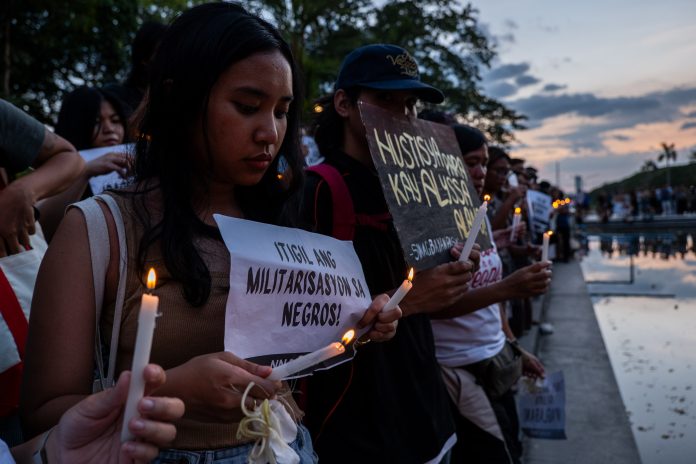
CIVICUS said restrictions on peaceful assembly have increased under the current administration, citing arrests and reports of excessive force during demonstrations.
During anti-corruption protests in September 2025, Amnesty International reported that police used unnecessary and excessive force and arbitrarily arrested and detained more than 200 people, including 91 children.
Those arrested included bystanders, construction workers, delivery riders, people with disabilities, students and vendors, according to the report.
“The authorities must respect the right to protest and ensure that when arbitrary arrests occur or excessive force is used, that the perpetrators are held to account. The government must also stop targeting journalists and withdraw the Digital Media Anti-False Information Act, which is inconsistent with international law and standards,” Benedict said.
Journalists also continue to face killings, attacks, arrests, red-tagging and terrorism-related charges, CIVICUS said.
The report cited the January 2026 conviction of journalist Frenchie Mae Cumpio on terrorism-financing charges. Cumpio, who spent almost six years in pretrial detention, was sentenced to at least 12 years in prison.
Before her arrest in February 2020, Cumpio was a news anchor with Aksyon Radyo Tacloban and executive director of Eastern Vista, an independent news website affiliated with the Altermidya network. CIVICUS said she and her colleagues had been subjected to red-tagging.
The brief also cited the killings of radio journalists Maria Vilma Rodriguez, Erwin Labitad Segovia and Noel Bellen Samar between October 2024 and October 2025.
CIVICUS raised further concerns over the proposed Digital Media Anti-False Information Act, which the House of Representatives passed in June 2026.
The alliance said the measure contains vague and overly broad language that government officials could use to suppress criticism. The bill would criminalize publishing, disseminating or assisting in the dissemination of false information under certain circumstances.
Publishing false information with “intent to cause verifiable public harm or a serious threat to national security” could carry a prison sentence of six to 12 years and a fine of 500,000 pesos to 2 million pesos, according to the report.
CIVICUS said the documented restrictions run counter to the Philippines’ obligations under the International Covenant on Civil and Political Rights, which the country ratified in 2007.
The alliance said the government has also failed to fully implement recommendations it accepted during its 2022 Universal Periodic Review before the U.N. Human Rights Council, including calls to ensure a safe environment for civil society and human rights defenders, end red-tagging and protect freedom of expression, peaceful assembly and the media.
CIVICUS called on the government to investigate attacks, harassment and intimidation against activists and journalists, end red-tagging and refrain from using counterterrorism laws to restrict civic freedoms.
It also urged authorities to enact a Human Rights Defenders Protection Act, amend the Public Assembly Act of 1985, investigate allegations of excessive force during protests and withdraw the proposed Digital Media Anti-False Information Act.