
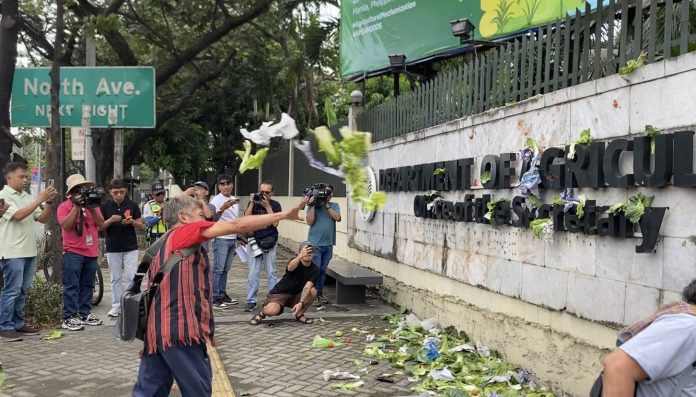
Indigenous vegetable farmers from the northern Philippines threw rotten produce at the Department of Agriculture on Nov. 10 to protest falling farmgate prices, competition from imported vegetables, and what they described as inadequate government support for local producers.
Farmers from the Cordillera region, a mountainous area in northern Luzon, gathered outside the agency’s office in Quezon City to submit a petition signed by thousands, demanding government action to address rising production costs and declining farm incomes.
The protest involved members of the Kanatengan Network, Apit Tako, the Cordillera Peoples Alliance and KATRIBU, along with vegetable growers from Mountain Province.
Organizers said the rotten vegetables thrown at the agriculture office were produce that farmers could no longer sell amid falling prices and competition from imported vegetables.
The Kilusang Magbubukid ng Pilipinas (KMP), a national farmers’ organization, backed the petition and urged the government to protect domestic vegetable production and reduce dependence on imports.
“Cordillera vegetable farmers help feed millions of Filipinos, yet they are left to compete with imported produce while shouldering the rising costs and risks of production. They are forced to sell their harvest at prices that often do not even cover their expenses. This is the result of the government’s importation policies that have consistently failed to protect and support local producers,” KMP said in a Nov. 10 statement.
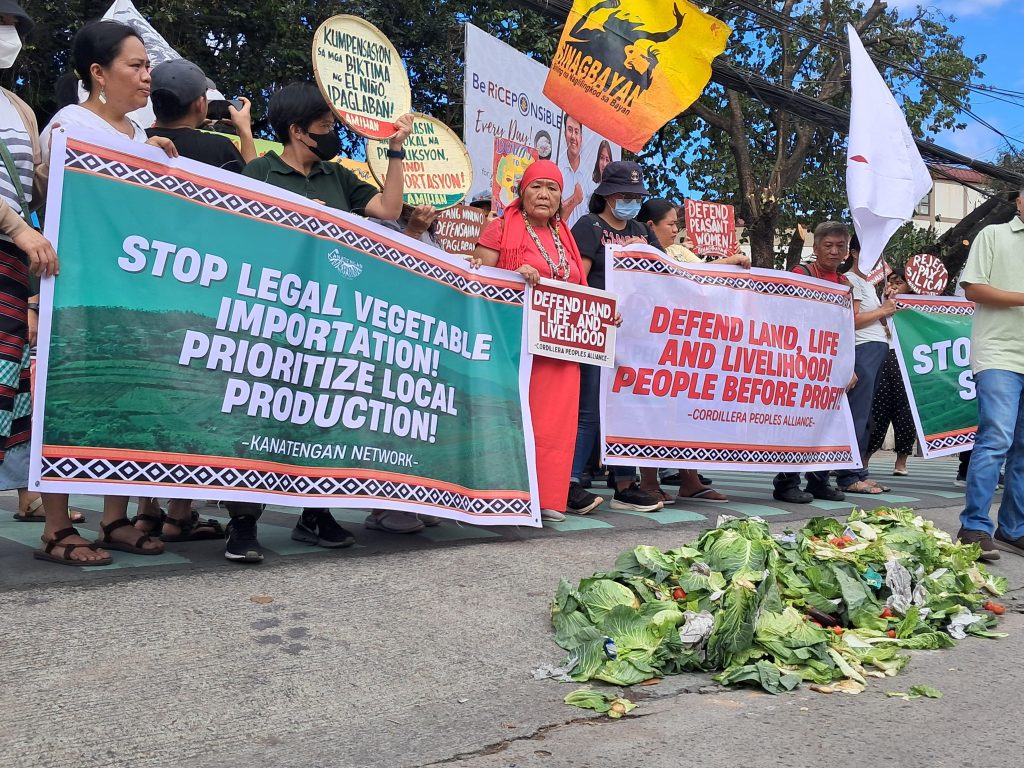
Photo credit: KATRIBU Kalipunan ng Katutubong Mamamayan ng Pilipinas
During a picket and dialogue at the agriculture department, farmers from Mountain Province demanded an end to vegetable smuggling and importation and called for government-set minimum farmgate prices based on actual production costs.
They also sought price ceilings on seeds, fertilizers and pesticides, direct agricultural subsidies, and assistance with transportation and fuel expenses.
Their petition called for the construction and repair of farm-to-market roads, cargo tramlines and storage facilities, as well as measures against high-interest lending and exploitative practices by middlemen.
KMP cited 2025 trade data showing that the Philippines imported approximately 33,233 metric tons of fresh potatoes, 12,179 metric tons of fresh carrots and 6,090 metric tons of fresh cauliflower and broccoli.
The three categories accounted for more than 51,500 metric tons of imported vegetables, according to the organization.
China was the main source of imported carrots, cauliflower and broccoli, while potatoes came from suppliers including the United States, Australia and Germany, KMP said.
The organization also raised concerns over agricultural smuggling, citing a June 2026 seizure by the Bureau of Customs of 12,909 boxes of fresh carrots valued at more than 7 million Philippine pesos at the Port of Manila.
The shipments were allegedly misdeclared as processed food products.
KMP also cited an investigation ordered by the Department of Agriculture in October into reports of imported broccoli, including produce labeled “Product of China,” being sold in Baguio City and La Trinidad, Benguet.
The reported supply involved about 50 boxes of broccoli costing 1,250 pesos each, reportedly delivered every other day through a supplier in Divisoria, a commercial district in Manila.
The alleged smuggling remained under investigation, according to KMP.
“Smuggling must be stopped, and those responsible must be held accountable. The government must also confront its own policy of relying on imported vegetables even when Filipino farmers are capable of supplying the domestic market. Legal imports can also undermine local producers when importation is prioritized over domestic production,” KMP said.
The farmers’ groups criticized the administration of President Ferdinand Marcos Jr. for what they described as inadequate support for domestic agriculture and policies that leave local producers competing with cheaper imported vegetables.
They called for government intervention to stabilize farmgate prices, lower production costs and provide farmers with sufficient support to sustain their livelihoods.
“The government cannot keep talking about food security while allowing local food producers to sink deeper into debt and losses. The government must put Filipino farmers ahead of importers and traders,” KMP said.
The participating organizations announced further protests on Nov. 11 involving Indigenous Peoples from Mountain Province affected by mining and geothermal projects.