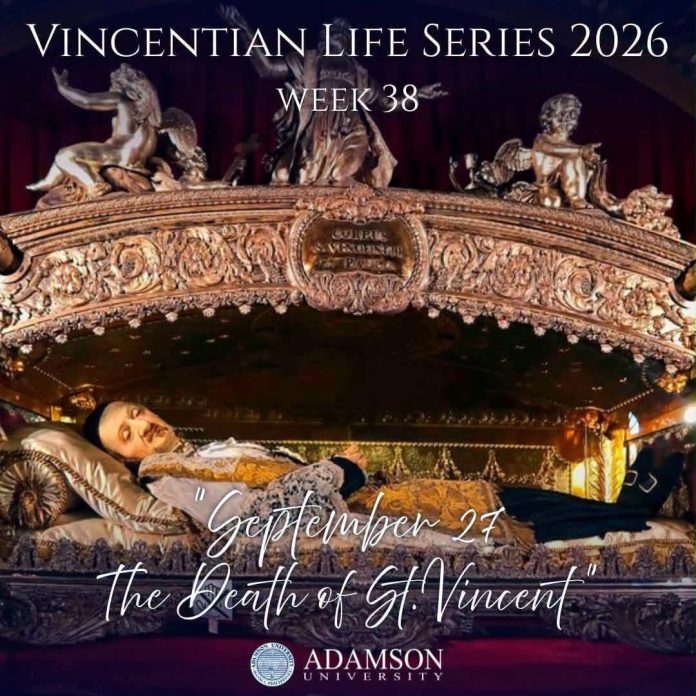
September 27 marks the end of St. Vincent’s life. For the saints, we celebrate their feasts on the day of their death. But there is little narrative on how he died. What led to his death?
With the works that St. Vincent did in his lifetime, I always had the impression that he was a very strong and sturdy man. Though he truly was, he also had his share of physical illnesses.
When he visited the sick in the infirmary of St. Lazare, the CM’s mother house, he would console the sick persons there with the following words:
“Don’t be afraid, brother, I had that illness when I was young and was cured of it. I used to suffer from breathlessness and so so no longer. I had also suffered from hernia, and God has cured me of it. I have had violent attacks of headache which have quite vanished, and also lung and stomach troubles from which I have recovered. So, just have a little patience. There is every reason to hope your illness will pass away, and that God still wishes to make use of you.”
He had what he called “my little fever” (tertian fever), which would last for two to three days or more. This malaria-type disease might have come from the years of his slavery in Tunisia.
He also had a history of a leg problem, which he had suffered from since the time he was serving the De Gondi household. For some time, he was unable to stand upright or take long journeys on foot. It recurred at different times during his life and continued until the end of his life.
A serious accident happened in 1658 when his carriage broke down on his way to the city. His head struck the pavement due to the impact. This accident brought on an intense fever for several days. The winter was quite harsh that year, and his leg troubles recurred.
Because of this, he was unable to leave the house but still managed to go down to the church for prayers and Mass in the morning. Later, he could no longer go down and instead celebrated Mass in the infirmary chapel. Much later, around August 1660, a month before his death, they turned the adjacent room into his special chapel, where he could say Mass.
The pain in his leg wore him out, and even a little movement caused intolerable pain. He could not eat, and his appetite was gone. He promised his doctor that he would take some soup and a little chicken, but later his stomach refused to accept them.
During these difficulties, he wrote to Louise de Marillac, his collaborator, who was also sick in the convent of the sisters on the other side of the street: “You are going before me. I shall rejoin you soon.”
St. Louise died on March 15, 1660, and Fr. Portail, the first CM who was his assistant, died on February 14 of the same year.
Despite his weak body, St. Vincent’s mind was very clear and lucid. He met with his consultors regularly, had his letters read to him, and asked his secretaries to reply to them.
He still continued with his conferences with the same vigor and energy. Since he could no longer go down to the hall for his conferences, he gave permission for the Daughters of Charity to go up. It was there that he held their reflection on the virtue of St. Louise after her death.
But on September 2, Sr. Mathurine Guerin DC said: “As far as his heart and mind are concerned, he is well. Bust as for his body, to tell you the truth, he can no longer rise from his chair without assistance, and has to be carried out in a chair even in his room… We must be prepared for the will of our good God, for it is very unlikely that he can face this winter.”
His weakness brought him long moments of sleepiness. When his doctor came, he recognized him, smiled back, and went back to sleep.
The sacrament of anointing was given to him on Sunday, September 26. He was striking his breast when the brothers prayed the “I confess” (Confiteor). Then some fathers came for his blessing, and he obliged — for the different groups and works he had organized — the Priests of the Mission, Daughters of Charity, Tuesday Conferences, Ladies of Charity, the Foundlings, etc.
His last remaining breaths were punctuated with ejaculatory prayers — “Jesus”… God, come to my aide… I believe… In you, I hope. Into your hands, I commend my spirit” — with the crucifix sometimes pressed to his lips.
“At about 11 o’clock [PM], it seemed as if death was imminent,” Coste writes. “Large drops of sweat began to pour down his emaciated limbs. The pulse had almost ceased to beat, and his body was covered with cold perspiration.”
“About half past four [in the morning of September 27], the death rattle in the throat, the soul of the saint appeared before his God. He died in his chair, close to the fire, fully dressed, and without a struggle. Death, far from disfiguring his features, seemed to have endowed him with a beauty and majesty that amazed all who were privileged to look upon his face.”
This is quite a loving description by one of his foremost biographers in modern times, Pierre Coste, CM.
“He had lived a life so full and there was nothing left for him to do. All his works could face the future with confidence.”
This was how Jose Maria Roman, another Vincentian biographer, ended his chapter on Vincent’s death.
An autopsy was performed on his body the next day. This explains why his heart was separated and placed in a silver urn. It is now enshrined in the chapel of the Daughters of Charity at Rue de Bac.
His body was placed in a lead coffin and buried in the middle of the choir of the Church of St. Lazare after the wake the next day.
On his tombstone was written in Latin: “Here lies the venerable Vincent de Paul, priest, founder and first superior of the Congregation of the Mission and of the Daughters of Charity. He died on September 27, 1660. At the age of eighty-five.”
The great Irish biographer and archivist Mary Purcell wrote about St. Vincent’s last days:
“The good Gascon had neared the end of his road. No longer could he speak to proclaim what an unprofitable servant he had been, to apologize for allowing himself to be driven in a fine carriage, to bemoan the fact that he was being waited on hand and foot while the poor, his poor, Christ’s poor… he had to get up and go to them. His last agony began at half-past four on Monday morning, September 27th, 1660. Well before dawn, Vincent de Paul left Paris forever.”
Father Daniel Franklin Pilario, C.M., is the President of Adamson University in Manila. He is a theologian, professor, and pastor of an urban poor community on the outskirts of the Philippine capital. He is also the Vincentian Chair for Social Justice at St. John’s University in New York.