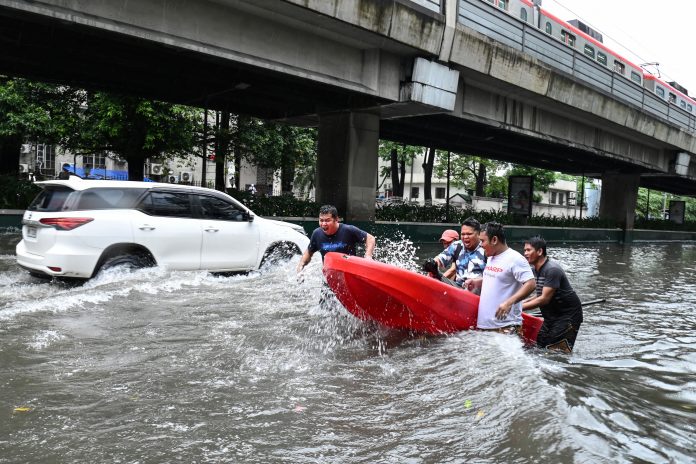
The Catholic Educational Association of the Philippines (CEAP) questioned government flood-control spending after deadly monsoon rains inundated Metro Manila and other parts of the country.
The group said extreme weather continued to expose failures in planning, construction and accountability, adding that the scale of the rainfall did not fully explain why severe flooding repeatedly disrupted communities.
“Of course, we can, and should say that 200 mm in five hours is an extraordinary volume of water. But perhaps the more uncomfortable question is: why does every extraordinary rain still expose so many ordinary failures?” CEAP said in a social media post on Aug. 18.
Metro Manila received 201.7 millimeters of rain in five hours on Aug. 17, while Quezon City recorded more than 200 millimeters in six hours, according to figures cited by CEAP.
The heavy rains flooded parts of the capital and prompted the Office of the President to order alternative work arrangements for government offices in Metro Manila and 12 provinces.
Public and private schools in the affected areas were also directed to shift to alternative learning arrangements.
CEAP said recurring flooding exposed weaknesses in drainage, land use, and waste management.
“We have drainage systems that clog, waterways that narrow, wetlands that disappear, garbage that travels faster than our waste-management programs, communities that continue to build in vulnerable areas, and citizens who sometimes treat the street as an extension of the household trash bin,” the group said.
It also raised questions over public funds spent on flood-control infrastructure. “The country has poured enormous public resources into keeping Filipinos above water, yet some projects have become so questionable that the projects themselves now need rescuing,” CEAP said.
The association cited Commission on Audit findings involving flood-control structures that could not be found at their approved locations, including more than 275 million pesos worth of anomalous projects in Bulacan province.
It also referred to earlier reports of hundreds of alleged ghost projects and renewed scrutiny of a 107-billion-peso flood-control budget as Metro Manila again experienced severe flooding.
“This is where satire becomes almost unnecessary: perhaps the Philippines does not have a flood-control problem alone; perhaps we have a control problem,” CEAP said.
The group said accountability should extend to public spending, planning, construction quality, land use, waste disposal, permits and maintenance.
It also said citizens shared responsibility for practices that worsen flooding, particularly improper waste disposal.
The southwest monsoon continued to affect Luzon and parts of the Visayas on Aug. 18. The Philippine Atmospheric, Geophysical and Astronomical Services Administration forecast 100 to 200 millimeters of rain in several provinces and 50 to 100 millimeters in Metro Manila and other areas.
The Philippine National Police reported 27 deaths linked to weeks of monsoon rains and recent weather disturbances.
The National Disaster Risk Reduction and Management Council, which was still verifying reports from affected areas, had confirmed 23 deaths, 17 injuries, and one missing person. Nearly 5 million people, or 1.43 million families, had been affected across 10 regions.
Authorities continued to monitor rivers and dams as rains persisted. The Marikina River reached 16.9 meters on Aug. 17, equivalent to the second alarm level, before falling to 14.8 meters early the following day.
The La Mesa Dam in Quezon City remained above its critical level at 79.69 meters, though still below its spilling level of 80.15 meters.
Damage to infrastructure from the recent severe weather was estimated at 3.4 billion pesos, while agricultural losses exceeded 689 million pesos, according to disaster agency data.
“The rain may be beyond our control. The integrity of what we build, the discipline with which we live, and the honesty with which we spend public money are not,” CEAP said.
The association ended its post by asking: “When the next great rain comes, will we discover that the water rose – or that our standards fell?”