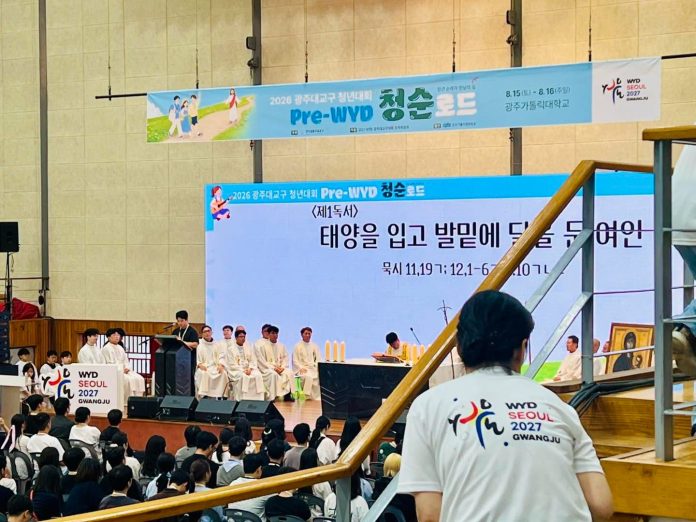
South Korean Catholic youth preparing for World Youth Day 2027 were urged to learn from the Church’s response to the 1980 Gwangju uprising and discern where they should stand when human dignity is violated.
Young people from the Archdiocese of Gwangju gathered Aug. 15-16 at Gwangju Catholic University for a two-day formation program ahead of World Youth Day in Seoul, according to a report by Fides News Agency.
Father Vincenzo Segil Son recalled the role of the local Church during the May 1980 uprising against the regime of Chun Doo-hwan, when the Archdiocese of Gwangju chose “not to remain silent” and to “defend human dignity” amid arrests, torture and repression.
The young people were invited to reflect “on the way and role of the Church in living together in the world” and to “discern where to stand in today’s suffering world.”
They were also asked to “recognize the places where human dignity is being violated today and ask themselves how they should respond.”
Gwangju was at the center of resistance to South Korea’s military dictatorship in May 1980, when citizens, students and workers demanded an end to authoritarian rule. The military violently suppressed protests on May 18 in what became known as the Gwangju Massacre.
The uprising, now commemorated as the May 18 Democratization Movement, became a national symbol of the struggle for democracy and human rights.
Son linked Gwangju’s history with Catholic social teaching, stressing that the Church’s responsibility goes beyond providing assistance to people in need.
“The Social Doctrine of the Church is not a philanthropic teaching along the lines of ‘help the unfortunate’; rather, it means asking ourselves what kind of society we need to build so that human beings can live with dignity,” he said.
Referring to the historical context that led to Pope Leo XIII’s encyclical Rerum Novarum, Son told the participants that human dignity lies at the heart of the Church’s social teaching.
“Created in the image of God, every human being possesses an intrinsic value,” he said.
“That document defended the rights, dignity and just living conditions of workers, marking the beginning of modern Catholic social doctrine.”
Catholic social teaching was one of four themes presented during the gathering, along with mission, vocation and affective education.
The diocesan organizing committee said the program was prepared so young people could “first and foremost become pilgrims, have a foretaste of WYD and embrace it as a joyful experience of faith.”
The gathering included catechetical sessions, Taizé-inspired prayers, sharing activities, a solemn celebration and a praise festival.
Participants were also encouraged to become “MAJI – Welcoming Bearers,” who will welcome young people from around the world during activities connected with World Youth Day 2027.
Preparations for the Seoul gathering are also underway elsewhere in South Korea and abroad. A World Youth Day promotion team walked the Camino de Santiago in Spain in August, organizing performances and distributing promotional materials. From Aug. 5 to 10, the team involved about 4,000 pilgrims in its activities.
Organizers are also preparing separate guidelines for the protection of minors and vulnerable adults, a first in World Youth Day history.
The guidelines, drawn up with contributions from the Pontifical Commission for the Protection of Minors and local Church authorities, will explain the consequences of inappropriate behavior while taking Korean legal procedures into account.