
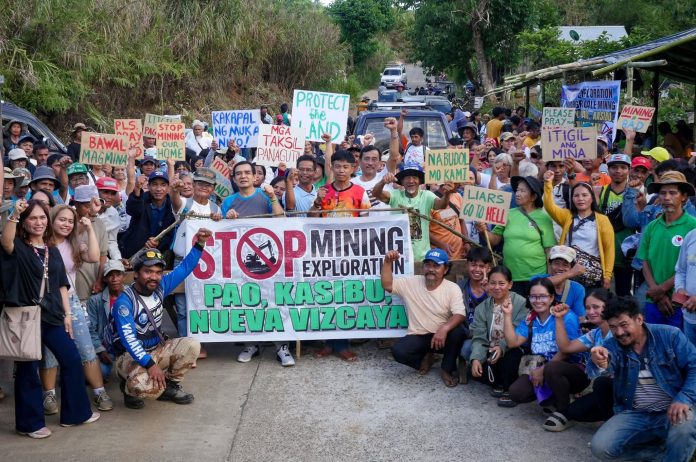
A New York-based rights organization urged Philippine prosecutors to dismiss cyberlibel complaints filed by a mining company against two lawyers and community leaders in Nueva Vizcaya province, north of Manila.
Human Rights Watch (HRW) warned on July 23 that the cases could undermine Indigenous and farming communities’ access to legal representation.
North Luzon Mineral Resources Corporation filed a cyberlibel complaint on July 2 against lawyers Fidel Santos and Edgardo Balgos, accusing them of defaming the company through statements on Facebook and during a radio broadcast.
The lawyers represent residents of Kasibu town, including farmers and members of the Indigenous Bugkalot/Ilangot community, who allege that people affected by the company’s mining exploration activities were not adequately consulted.
“Philippine prosecutors should dismiss criminal complaints filed by companies to silence communities raising concerns about their business operations,” said Lian Buan, Southeast Asia researcher at HRW.
Buan also urged Philippine lawmakers to revive measures that would make it easier for authorities to prevent such criminal cases from proceeding.
Santos and Balgos represent residents who filed a petition with the Department of Environment and Natural Resources seeking the cancellation of the company’s mining exploration permit.
The residents alleged that the company had failed to adequately consult affected communities. They said they hold a Certificate of Land Ownership Award confirming their rights as agrarian reform beneficiaries and that their area is a protected watershed under local laws.
HRW said the case against the lawyers could undermine their right to freedom of expression and the residents’ right to legal representation during the dispute.
Balgos said he had a responsibility as their lawyer “to advocate for their cause,” but warned that the criminal complaint “creates a chilling effect, because if their defender is being harassed, then the more afraid they are.”
The company said it consulted two communities twice in March 2024 before it was granted an exploration permit on June 25, 2025. The permit covers 4,455 hectares across several villages.
North Luzon Mineral Resources Corporation also said it had obtained certification from the National Commission on Indigenous Peoples, stating that the permit area does not overlap with ancestral domain.
HRW said the pattern of complaints against the community leaders and their lawyers had the effect of strategic lawsuits against public participation, or SLAPPs.
“They are filing cases one after the other. They targeted the leaders first, and now their lawyers,” said Santos.
Community leader Florentino Daynos is also facing a cyberlibel complaint filed by the company on June 19 over his support for a community barricade against mining exploration in Kasibu.
Daynos and another community leader, Anthony Glenn Guingayan Sr., were notified on June 3 that other Nueva Vizcaya residents had filed additional cyberlibel complaints against them.
The complaints filed by the company will undergo preliminary investigation in Isabela province, where the firm is based, about a four-hour drive from the two lawyers.
HRW said filing complaints far from the respondents is a common tactic in Philippine libel cases.
Cyberlibel, defined under the Cybercrime Prevention Act of 2012 as libel committed through a computer system or similar means, is punishable by six to 12 years in prison.
HRW said prosecutors may dismiss criminal complaints, including those for libel, for lack of evidence.
It also said companies and Philippine authorities have used cyberlibel charges to intimidate critics, adding that criminal defamation laws undermine the right to freedom of expression and have a chilling effect on public criticism.
The Philippines has had special rules against SLAPPs in environmental cases since 2010, but HRW said the rules have not deterred cases against environmental defenders.
House Bill No. 5592, filed in October 2022, seeks to extend SLAPP protections to all public-interest cases. It would require prosecutors and courts to determine whether a complaint is a SLAPP and dismiss it summarily. The measure has not progressed in Congress.
“Efforts to target Indigenous communities and their lawyers in the courts should prompt firm action by the Philippine government,” Buan said.
“If environmental and human rights advocacy is criminalized, affected communities will be unable to sound the alarm when corporations and officials threaten their rights,” she added.