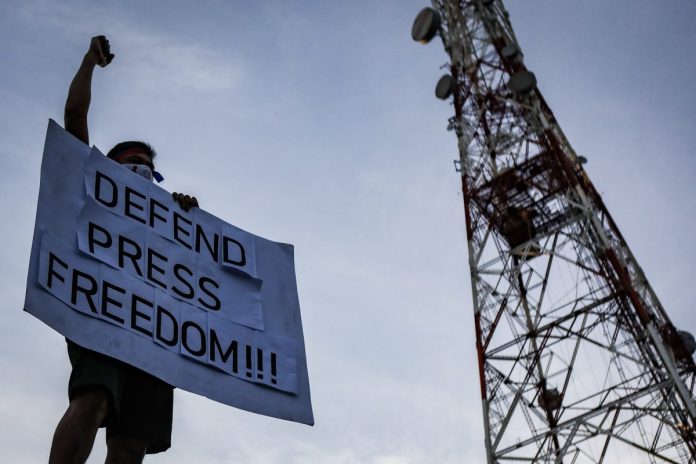
Philippine media organizations and journalists have warned that proposed anti-disinformation laws could render the state the “arbiter of truth” and pave the way for action against journalists, critics, and ordinary citizens over protected speech.
In a position paper issued July 23, the groups urged Congress to reject House Bill 9465 and its Senate counterpart, saying the measures would expand government authority over expression without addressing the systems that produce and amplify organized disinformation.
As of 2 p.m. on July 23, 2026, the position paper had been signed by 55 organizations and 55 journalists, editors, academics, and media advocates.
The groups said the bills “confuse the symptoms with the disease” by placing the burden on individual expression rather than confronting the political, economic, and technological systems that manufacture and profit from coordinated information manipulation.
The signatories acknowledged the damage disinformation inflicts on democratic discourse and public trust and said they support decisive action against it. They described the pending legislation, however, as “the wrong response to a real problem.”
The proposed measures primarily criminalize expression while leaving largely untouched the algorithms, commercial incentives, coordinated influence operations, and platform structures that enable disinformation to flourish, the groups said.
The coalition warned that the bills could give government authorities broad power to decide whether speech concerning their own actions is true or false.
“Government is frequently the subject of investigative reporting and public scrutiny,” the groups said, adding that “it cannot simultaneously serve as the ultimate authority on the truthfulness of speech concerning its own actions.”
The groups said “the antidote to falsehood is not government control over expression,” but greater transparency, timely access to public information, independent journalism, and more democratic debate.
They also raised concern over broad and ambiguous definitions of prohibited speech, which could allow inconsistent interpretation and selective enforcement.
Journalists routinely cover developing stories, disputed claims, whistleblower disclosures, leaked documents, election controversies, corruption allegations, and public health emergencies, where facts may continue to evolve, the statement read.
The groups said laws affecting expression must be “narrowly tailored and clearly defined,” and warned that legal uncertainty could discourage legitimate journalism and public participation.
The coalition also noted that existing Philippine laws already provide remedies for libel, fraud, identity theft, election offenses, cybercrime-related offenses, and other unlawful conduct associated with deception.
Before creating new criminal restrictions on protected expression, Congress should examine whether existing laws are being effectively implemented and how transparency and accountability mechanisms can be strengthened, it said.
The statement warned that criminalizing content would likely target individual users, or the “small fry,” while failing to reach the platforms, algorithmic systems, and coordinated networks that manufacture and amplify disinformation at scale.
Criminal law is also ill-suited to address the systemic nature of disinformation or hold extraterritorial entities accountable, the groups said.
The coalition called for enforceable measures requiring transparency in recommendation algorithms, political advertising, and the infrastructure behind coordinated inauthentic behavior.
It also proposed independent audits, standardized disclosure requirements, and stronger public oversight of digital platforms.
The signatories urged Congress to pass a Freedom of Information law and regulate the financing of coordinated disinformation campaigns and influence-for-hire operations.
They also called for support for independent journalism, investigative reporting, and fact-checking; stronger media and digital literacy programs in schools and communities; and independent research into the country’s information ecosystem.
The position paper urged cooperation among government, media organizations, civil society, academic institutions, and technology companies while fully respecting constitutional rights.
Such measures, the groups said, would strengthen society’s resilience against disinformation while preserving “the democratic freedoms that enable truth to emerge.”
Disclosure: LiCAS News is among the organizations that signed the position paper. LiCAS News Managing Editor and Manila bureau chief Mark Z. Saludes is also an individual signatory.