
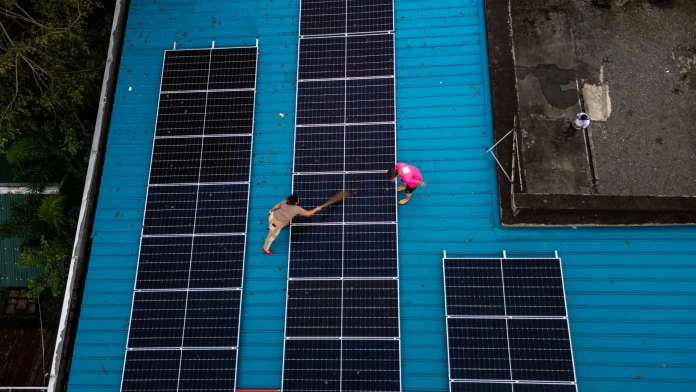
Rooftop solar systems in the Philippines can now pay for themselves in just over three years, according to a new report that says the technology could help ease the country’s energy emergency, lower electricity costs, and reduce dependence on imported fuel.
The report, How the Philippines’ rooftop solar surge can flip the energy emergency script, was released May 28 by global energy think tank Ember.
It found that rising electricity prices and falling solar equipment costs have sharply improved the economics of rooftop solar, cutting payback periods for households and businesses to levels that could accelerate adoption.
“Rooftop solar in the Philippines is taking off,” the report said.
Ember estimates that rooftop solar capacity in the country has grown from 721 megawatts (MW) in early 2025 to around 1,300 MW by early 2026, nearly doubling in just one year.
The report said the expansion remains only a fraction of the country’s potential, representing about 1% of an estimated 106,000 MW of theoretical rooftop solar capacity nationwide.
According to Ember, electricity market data show grid generation falling more sharply at midday, when solar output peaks, suggesting significant growth in behind-the-meter solar installations.
The report also points to a surge in solar panel imports as evidence of growing demand.
The Philippines imported solar panels equivalent to 5,068 MW in 2025, more than five times the 800 MW of utility-scale solar capacity installed that year. Ember said 98% of those imports came from China.
Imports accelerated further this year. In March and April 2026 alone, China exported more than 3,000 MW of solar panels to the Philippines.
According to the report, the Philippines has become China’s second-largest solar panel export market in 2026, ahead of Pakistan and behind only the Netherlands.
“The supply of panels is already on the ground. The economics are already there. Consumers are keen. Even back in 2024, 82% of surveyed households expressed some interest in adopting solar panels,” said Dave Jones, Ember’s chief analyst and lead author of the report.
The report links the growing appeal of rooftop solar to rising electricity prices across the country.
Meralco’s retail electricity prices in May 2026 were 17% higher for residential customers, 18% higher for commercial customers, and 14% higher for industrial customers compared with the same month last year, according to Ember.
“The Philippines now has the costliest residential electricity price in Southeast Asia, the second-highest commercial price and the third-highest industrial price,” the report said.
As electricity prices climbed and solar installation costs fell by about 10% over the same period, the payback period for residential rooftop solar systems dropped from four years in May 2025 to 3.1 years in May 2026. Commercial systems now recover costs in 2.3 years, while industrial systems average 3.1 years.
“The payback times for rooftop solar have hit levels that should encourage mass uptake,” the report said.
Beyond lowering electricity bills, the study frames rooftop solar as a response to the country’s continued dependence on imported fossil fuels.
“Meralco’s supply is approximately 60% natural gas, almost all USD-denominated LNG,” the report said.
“Rooftop solar, with a payback of as little as 2-3 years, will help consumers and businesses directly cut their electricity bills,” it added.
The report argues that rooftop solar, particularly when paired with battery storage, can be deployed more quickly than conventional power infrastructure while helping strengthen the electricity grid.
“Rooftop solar has two key advantages over wind and utility solar: it is built in days, not years, and with batteries, it reinforces the grid rather than stretching it,” Jones said.
Ember said the country could install 3,500 MW of rooftop solar paired with 4,500 megawatt-hours (MWh) of battery storage within the next 24 months, matching the scale of the 3,500-MW Meralco Terra Solar project, one of the largest solar developments planned in the Philippines.
The report estimates such a battery program would cost about $560 million and could provide a cheaper and faster alternative to building new coal-fired power plants.
To accelerate adoption, Ember recommended expanding affordable financing programs, legalizing small plug-and-play solar systems, and investing in battery storage at scale.
The report cited the Government Service Insurance System’s Ginhawa Solar Energy Loan program as evidence of strong demand. According to Ember, 46% of the program’s PHP12.5 billion fund had already been utilized within 27 days.
“The opportunity is real, but the upfront cost is often too high for a household or business, no matter how quick the payback time is,” the report said.
The study also called for regulations allowing small plug-in solar systems of up to 800 watts, similar to Germany’s “balcony solar” model, where roughly one million systems are already in operation.
“There is currently no legal framework for plug-in solar in the Philippines,” the report noted.
Jones said the rapid growth of rooftop solar presents an opportunity for the Philippines to reduce its dependence on imported fuels while improving energy affordability and resilience.
“The economics of rooftop solar are more attractive than ever, and its rapid rise is inevitable,” he said. “The government has an opportunity to carve its own path on rooftop solar, to pull the Philippines out of fossil dependency, and onto a path of cheap, abundant electricity.”