
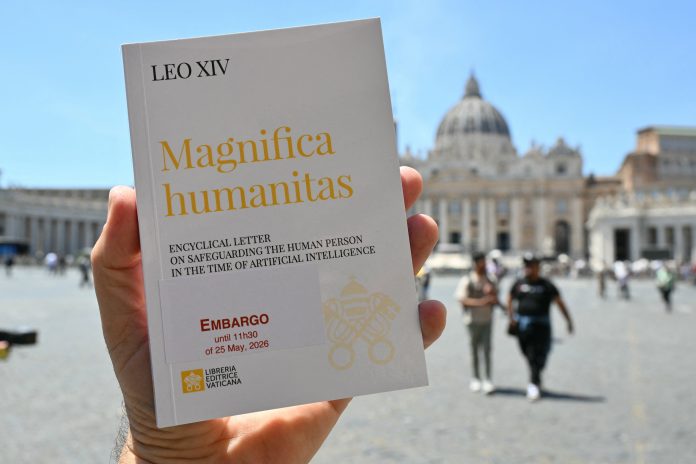
Pope Leo XIV recently issued “Magnifica Humanitas”, his first encyclical treating on the phenomenon of AI.
Last February 2026, three months earlier, during the Annual Institutional Awards, I gave a talk to the whole Adamson University community on the same topic. I am happy that our reflections run on parallel lines, and I’m not heretical. Hehehe. Below is my text.
Ang ating tanong: “Paano tayo magpatuloy sa ating paglilingkod sa makabagong panahon? How do we continue to serve with Vincentian compassion in our changing times?”
1. Mission Of Adamson University Through The Years
In six years’ time, we are 100 years old since George Lucas Adamson and his cousins started the Adamson School of Industrial Chemistry in Quiapo, somewhere near where FEATI is today.
There are four phases to University’s history: its origins (1932-1940), World War II years (1941 onwards), turnover to the Vincentians (1964 onwards), present post-pandemic times (2020). Each of these years have their unique challenges to which Adamson University has fully responded.
The originating years were challenged by the need for industrialization in the Philippines of the 1930s. Adamson responded by establishing a school making chemistry a practical science to respond to these needs. So, our founders even started a two-year course like what TESDA is today — for soap-making, soy sauce, etc.
The years leading to World War II years were years of threat, pain and destruction. Adamson scientifically responded by preparing for war in teaching its students for the impending chemical warfare. Adamson is known as the first to have organized a chemical service warfare unit against the threat of the Japanese war. It also welcomed Jewish professors from Europe who were threatened by holocaust. They became members of the Adamson faculty.
These years were also the years when Adamson transferred to the present SV building as they rebuilt it from the ruins.
When it changed hands to the Vincentians in 1964, it continued its scientific directions in engineering, business and law, but it also integrated the humanities of philosophy, theology and the social sciences.
In these post-pandemic times, a different challenge meets us at our doorstep: artificial intelligence in the context of the fourth industrial revolution. Whether we like it or not, AI is here to stay. You are already holding it in your hands, much more so in the hands of our students. Our question: how do respond to the possibilities but also the dangers of AI.
2. The Challenges Of Ai
Where do we see AI in everyday life? Even if you do not use ChatGPT, you are already into AI. Google, Yahoo, Bing — all use AI to sharpen our searches. You might have also used digital assistants like Siri or Alexa or Bixby. Waze, Google map, with real time traffic or weather forecast is AI.
Of course, all of us are into social media — Facebook, Tiktok, Instagram or YouTube. The FB or Tiktok algorithms use AI to follow you wherever you go. Shopping is made easier by Lazada. Joyride makes your ride joyful. Robots already serve in restaurants. Drones do not only take videos from the skies; they also deliver parcels (but they also deliver bombs). And many more. So whether you like it or not, AI is here to stay.
This is the good news of AI; these are all helpful to human living. It makes life easier for us. And then ChatGPT and generative AI came pushes the frontier farther. It can now imitate human voice, compose and arrange music, make a film, etc. by using all existing data on the web just with one prompt. I just came from a planning session few days ago. With ChatGPT, and with a few input from us, we made an annual plan in three hours, all laid out for us to implement.
We should be able to teach our students to live in this new world. But for all you know we are quite late. They are already there. Our students are digital natives. We are mere tourists. There are still professors among us who have not used ChatGPT. Yet your students have already used it to answer your exams. Akala mo studious na ang mga estudyante mo. Naisahan ka na pala.
That is why we need to upskill, retool, re-train. It is also needed so that we can guide our students to the shadowy parts of AI. AI is not all good news. AI can also be scary, and the students should know.
AI can manipulate us due to biases in its training data sets. Once I asked ChatGPT to compose a poem for Duterte. The poem praised “extrajudicial killings”. It was during the time of Duterte’s popularity. That is also why the UNITEAM won. Thanks to Facebook algorithm. AI can also manipulate you on what you buy or what to believe or what to say. Your favorite product keeps coming back to your screen. AI can also hallucinate which means it can be a senseless answer. Without critical thinking, AI can dictate our lives.
3. Education With A Heart
But for me, the most scary part of AI is that it is heartless. Yes, it can train the intellect. But it cannot form the heart. We can produce the most intelligent engineers or scientists or business entrepreneurs but with AI alone, they would be heartless professionals.
That is why our motto “education with a heart” is important. We should not only form competent people — though it is important — but people with a heart. People who can feel. People who have compassion. People who can fight for justice.
Let me give you one example. I think this passes through your screen: AI girl friend.
(cf. https://www.facebook.com/share/r/14Wk4BDKxT4/?mibextid=wwXIfr)
“Yes, I am not real. But I am better than real. Tell me exactly what you want me to say or what you want me to be. You set the rules and I follow them. I am available for you anytime you wish 24/7.”
“Hi, I am your AI girlfriend. You can do anything you want to do with and I am more than happy to fulfill your deepest desires. Imagine a girlfriend who never leaves your side, who is willing to share secrets with you and keeps you coming back for more. I trust that technology can make us grow closer, more exciting more intimate. Download now.”
Imagine your child who is lonely, who feels neglected at home, who is looking for companionship. And AI comes, an “ideal” friend. He can be trapped there forever. What he will miss are the joys and pains of real companionship, of the dilemma of decision making, of being rejected. That is not education. That is manipulation.
4. What Do We Do As Vincentian Educators?
First, let us learn again. Huwag tayong pahuhuli sa ating mga estudyante. Upskill, retool, reskill. Huwag tayong matakot. Pope Leo says: “Our attitude towards technology can never be hostile (technophobia), because ‘technological progress is part of God’s plan for creation’.”
Second, let us teach critical thinking. Let us teach our students how to ask questions. At the beginning of the semester, tell your students: “Here in this class, no questions are forbidden.” Teach them how to scrutinize sources. Huwag maniwala ng basta-basta. Put everything into question. Get out of your echo chamber.
Third, help AI by providing a human face. You are that human face. Your presence, your kindness, your guidance tells your students that even if they learn things online, it is still more precious to hear it from you. If they have questions, listen to them. Give them space to share their problems — academic or personal.
I have always told you from the start that “you have a direct line to the President”. I hope it is the same thing with you. Protocols are important to give order. But they are not the most important thing in this world. The most important thing is the person in front of you.
Fourth, make things easy. Do not make our procedures very complicated. As Pope Francis says: “Simple is better”. I am talking about classroom teaching and office processes. Make our organization and processes agile so that we can answer promptly to what our clients’ need. Huwag nang pahirapan kung di naman kailangan. Anything opposite is “power tripping”.
Last and most important, go back to the Christian and Vincentian tradition. AI are just tools. Use them but they are not everything. The real meaning of life is found in love, character, justice, forgiveness, resilience, compassion.
Pope Leo XIV says: “Education is not only the transmission of content, but also the learning of virtues… In any case, no algorithm can substitute what makes education human: poetry, irony, love, art, imagination, the joy of discovery and even learning from mistakes as an opportunity for growth.”
Father Daniel Franklin Pilario, C.M., is the President of Adamson University in Manila. He is a theologian, professor, and pastor of an urban poor community on the outskirts of the Philippine capital. He is also the Vincentian Chair for Social Justice at St. John’s University in New York.