When we say “Vincentian charism,” what do we mean? “What is the Vincentian charism?” is quite a difficult question to answer. But it is necessary to capture its essence so that we can easily share it with others when we are asked.
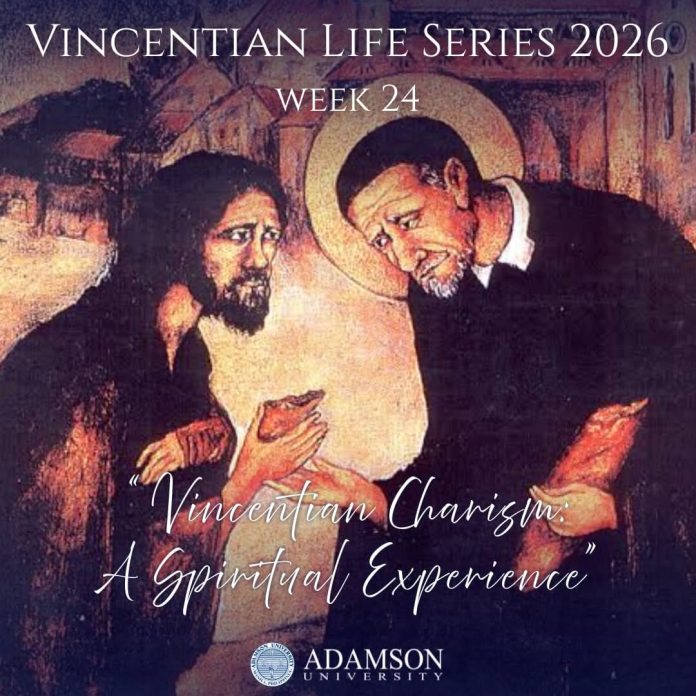
If I am asked to say it in one sentence, it is this: Vincentian charism is an experience of the poor Jesus in the poor person, and, like him, to announce to the poor the hope for their own well‑being and liberation.
St. Vincent de Paul did precisely that. After experiencing Jesus in the person of the poor, he dedicated his whole life to showing them the compassionate heart of God.
Vincentian charism is not about work or ministry. It is not just about soup kitchens, giving alms to the poor, or merely taking care of the homeless. No, it is not only about work. First of all, it is about an experience.
It is founded on the spiritual experience of a simple country priest in France by the name of Vincent de Paul.
In the early part of his priestly life, he was actually selfish. He wanted to use the priesthood for his own self‑advancement. He tried many things, established some social networks, and initiated some projects, but he did not succeed. It seemed that God was frustrating his ambitions.
One day, this young ambitious priest, Vincent de Paul, could hardly sleep or eat. His biographers call this experience a “temptation against the faith” because he could not even say the Apostles’ Creed or the Our Father without being tortured deep inside. But by the looks of it, we can say that he suffered a deep depression, almost at the brink of a nervous breakdown.
He prayed to God for guidance. He went to visit a nearby hospital whose condition was very bad— not far from the situation of some government hospitals in our time. For instance, there were not enough beds for the patients; some patients scrambled for the bed of someone who had just died. There were not enough doctors or medicine, not even food and basic necessities. Vincent was shocked by this great misery.
Face to face with the victims, he promised God that he would dedicate his life to them. He was suffering himself, but it was nothing compared to the suffering these people experienced.
Little by little, his own suffering was healed and transformed into this lifelong calling of service to the poor. Weeks and months passed, and he had more encounters with other faces of poverty in the places he visited—rural farmers who had not seen a priest for the whole of their lives, sick families with no access to medicine and food, city beggars driven by military violence in the countryside, and more. All these encounters strengthened his resolve to dedicate his whole life to their empowerment and liberation.
There are two central axes to St. Vincent’s spiritual experience: the poor Jesus and the poor person. The first axis is Jesus of Nazareth, a poor man and an evangelizer of the poor.
Jesus is God who became a poor man. Because he understands our misery, this God‑become‑poor has a special love for the poor. Vincent had a special love for Jesus in the synagogue at Nazareth (Luke 4:16–21). Jesus read the scroll and proclaimed the passage from the prophet Isaiah:
“The Spirit of the Lord is upon me,
because he has anointed me
to bring good news to the poor.
He has sent me to proclaim release to the captives
and recovery of sight to the blind,
to let the oppressed go free,
to proclaim the year of the Lord’s favor.”
This Gospel text touched him so deeply that he made it the motto of the group of priests he organized, the Congregation of the Mission. In Latin, their rallying cry is evangelizare pauperibus misit me (“to preach the Good News to the poor”).
This Jesus has “a special preference for the afflicted, the marginalized, the little ones, the sinners—the poor… He first chose poor fishermen to be his followers. He lived the life of an itinerant preacher who had no home of his own. As he lived, so he died—buried in a grave that was not even his own” (PCP II, 48). The life of Vincent de Paul revolved around this relationship with Jesus as the evangelizer of the poor; it stands or falls on the strength of this relationship.
The second axis is the poor person.
“If Jesus stands at the center of Vincentian spirituality,” one Vincentian author writes, “the poor person stands there beside him.” The poor person is not just poor in the eyes of Vincent de Paul. They are sacraments of Christ. Vincent used to speak of the “other side of the medal.” On the exterior, the poor may appear rude, brutal, demanding, or harsh. But turn the medal, and you will see the suffering image of Jesus.
The Christ of Matthew 25 is another significant image: “whatever you do to the least of these brothers and sisters of mine, you do it to me” (Mt. 25:40). He told the Daughters of Charity, “A sister will go ten times a day to visit the sick, and ten times a day she will find God there.”
Or, when they are praying in the chapel and a poor man knocks at the door, they can “leave God for God,” because the God in the chapel is the same God at the door.
St. Vincent lived 400 years ago. But in our century, Pope Francis has expressed the same intuition:
“When we want to see Jesus in person and touch him with our hands, we know where to turn. The poor are a sacrament of Christ; they represent his person and point to him.”
Father Daniel Franklin Pilario, C.M., is the President of Adamson University in Manila. He is a theologian, professor, and pastor of an urban poor community on the outskirts of the Philippine capital. He is also the Vincentian Chair for Social Justice at St. John’s University in New York.