
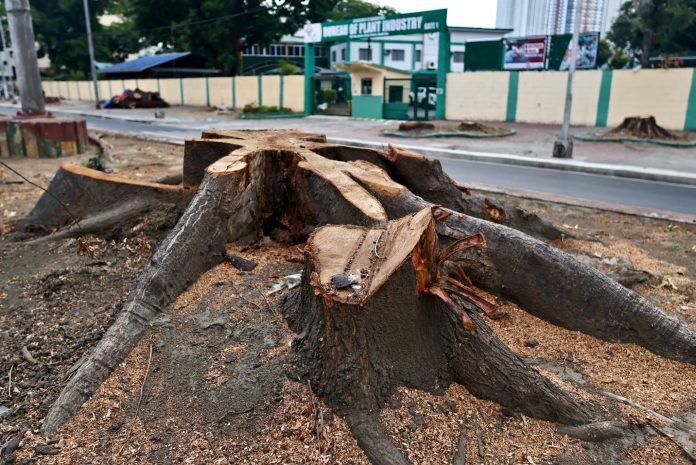
Public protests and pressure from Church and environmental groups forced authorities to halt Manila tree-cutting operations linked to a controversial expressway project on Wednesday.
The Department of Environment and Natural Resources (DENR) said further tree-cutting along Quirino Avenue for the Southern Access Link Expressway (SALEX) project had been “voluntarily stopped” following mounting public outrage over the removal of decades-old trees.
Environment Secretary Juan Miguel Cuna said the suspension would allow authorities and project proponents to reassess whether more trees could still be preserved through earth-balling or transplantation.
“Right now, the cutting they voluntarily stopped, and we are agreeable to this. Let us stop first and study it more thoroughly. Perhaps more trees can still be added to the earth-balling process,” Cuna said during a media forum.
Cuna said 38 trees had so far been uprooted and transferred to other locations. Environmental groups, however, said more than 200 trees had already been cut, while Greenpeace Philippines and anti-poverty advocates estimated that 617 trees would be affected by the project.
In a statement issued May 25, Bishop Gerardo Alminaza of San Carlos, president of Caritas Philippines, condemned the cutting of decades-old trees as “an act of ecological violence against the people of Manila.”
“The mass cutting of decades-old trees along Quirino Avenue is an act of ecological violence against the people of Manila, a direct assault on the poor who have been enduring the daily penance of extreme heat, poisoned air, and sudden floods,” Alminaza said.
He said the trees had provided shade, cleaner air, and flood protection for generations of commuters and residents, but were now being “reduced to bleeding stumps to make way for another expressway under the disguise of ‘progress.’”
Environmental network Kalikasan PNE welcomed the suspension but questioned why authorities intervened only after hundreds of trees had already been cut.
“Why only now? Why was it suspended and reviewed only after more than 200 trees had already been cut?” said Kalikasan spokesperson Cathleen de Guzman.
The group also challenged the DENR to permanently stop the project.
“A suspension is not enough. Projects that destroy the environment and people’s livelihoods must be permanently stopped,” the group said.
Kalikasan said it plans to file cases against those responsible for what it described as the “illegal and destructive cutting of trees.”
Greenpeace Philippines also criticized the project, saying the destruction of mature urban trees during a worsening climate crisis would intensify heat, flooding, and environmental vulnerability, especially among low-income communities in Metro Manila.