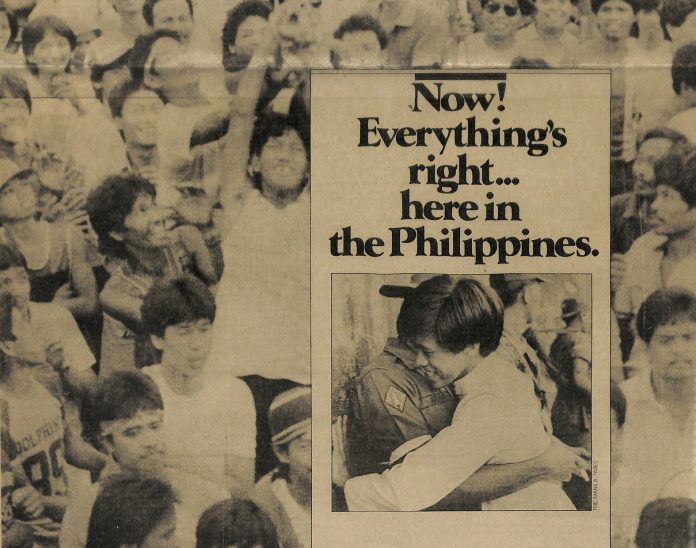
I was in EDSA forty years ago. I was then in my last years of theological studies, preparing for the priesthood.
From the death of Ninoy to his funeral in 1983, from the Friday rallies to the snap elections in 1986, we were often on the streets. We called it our alternative classroom. But after the euphoric four days in February 1986, we went back to our classrooms and reflected on what happened.
Ecstatic terms came to describe the event we experienced: miracle, epiphany, transfiguration.
A book came out, The Miracle of EDSA, a bloodless revolution. “Epifanio de los Santos Avenue” (EDSA) refers to the manifestation of the saints on the streets. The people who placed their bodies on the line were “saints,” or the saints came to protect them from the harm of bullets. It was called People Power and God Power all in one. Others call EDSA the Philippine “transfiguration” experience. The Filipino people transfigured themselves from complacency to courage. God was also transfigured in front of His people.
But we seem to have forgotten that the transfiguration was just one short instant in the life of Jesus and the apostles. The next day, they had to come down to the plain. The ending of the transfiguration narrative is not a voice coming from heaven saying, “Here is my beloved Son; I am pleased with him. Listen to him.” The real transfiguration was not on the mountain but on the plain.
All the Gospel narratives of the Transfiguration (Mt 17, Mk 9, Lk 9) continue with a scream of a demon-possessed boy shrieking with such force that it throws him into convulsions. This is dramatized in the work of the Italian Renaissance painter Raphael, now in the Vatican Art Gallery.
The voice of assurance from the clouds immediately faded, only to be drowned by the shouts of pain and anguish. The shining light emanating from their clothes was immediately dimmed by the darkness of disease and cries for deliverance.
The temptation was to stay euphoric on the mountain. The challenge was to transform life on the rough grounds. From Tabor, the journey should move to the plain, then to another hill called Calvary, the place of the skull.
This was the temptation of EDSA 1, to which many succumbed. Like the apostles, we refused to understand. We did not get it. Even as Jesus was saying he needed to go to Jerusalem, the apostles were scrambling for power, quarreling over who would sit at his right or left. Like the Levite and the priest, we went on our separate ways, forgetting the stranded man on the road.
Now, we have reached forty years in this wandering, in walking our separate ways.
The number forty in the Bible is also very symbolic; it appears around 160 times. Those forty years were years of wandering and transition, of trials and probation, of pain and promise.
The rains fell for forty days and forty nights in the time of Noah, which flooded all the dry lands for months before the dove came with twigs and the rainbow of God’s promise appeared on the horizon (Gen 7:4). Israel wandered forty years in the desert before entering the Promised Land (Ex 16:35). Moses fasted in God’s presence for forty days and forty nights before receiving the Ten Commandments (Ex 24:18).
Jesus fasted and was tempted for forty days and forty nights before resolving to proclaim the Kingdom (Lk 4:2). And after the Resurrection, Jesus remained for forty days before ascending to heaven (Acts 1:3).
Forty years were years of drowning and being saved, of infidelity and forgiveness, of death and resurrection. Let me remember some crucial events in the last forty years.
Cory Aquino suffered several coup attempts by RAM (1986–1989), inherited from Martial Law an entrenched poverty, deep social divide, and systemic corruption, which heavily tested the stability of the newly restored democracy, not to mention poverty and natural calamities such as Pinatubo in 1991.
The rule of Fidel Ramos had to endure an intense power crisis, daily blackouts, the fall of the Asian economy in 1997, the consequences of his economic liberalization, and charges of corruption.
The presidency of Joseph Estrada, who followed him, was fraught with cronyism and corruption scandals that led to his conviction for plunder in 2007. He declared all-out war in Mindanao and became known for the rule of his cronies and the Malacañang “midnight cabinet.” He was impeached in 2001.
Gloria Macapagal-Arroyo, who took the reins in EDSA 2, is remembered for the “Hello Garci” scandal, annual impeachment attempts, the NBN-ZTE broadband deal, the Fertilizer Fund scam, and the overpriced Macapagal Boulevard. She was later arrested for graft and electoral sabotage. Noynoy followed with his own set of issues: the Mamasapano massacre, the Pork Barrel scam, DAP, indecisive “Noynoying,” the laglag bala scam, and many others.
Then came Rodrigo Duterte with his promise to dismantle the “oligarchs,” only to end up with another set aligned with his drug lord friends. There were too many problems to mention: extrajudicial killings, impunity, red-tagging, the erosion of the rule of law, misogynistic rhetoric, the COVID-19 response, endless corruption, and China “invasion.”
Then Marcos and Sara came with their UniTeam, which went kaput, and the unimaginable “flood control” corruption surprised us without end.
The first EDSA celebrations were not only euphoric but complacent. The burning spirit we had when we watched each ballot box or confronted the tanks was extinguished. We were vigilant no more. We let our guards down. We sat on our laurels, as it were, and left “people power” in the hands of the powerful as they emasculated us with their greed and selfishness.
As Christian Monsod once said: “From hindsight we may have made two mistakes: we overestimated the spirit of EDSA and we underestimated the greed for power of politicians and the greed for wealth of the rich.”
As we celebrate our forty years, we take the power again into our hands in order to transfigure this ravaged land. With the spirit of assurance on that mountain, who said that God was pleased with us, we all together say: “Tayo ang people power!”
Tulad ng ginawa ni Hesus, paalisin natin ang mga demonyo sa mga inaalihan nito.
I-impeach ang mga dapat i-impeach. Managot ang lahat ng dapat managot. Ikulong ang lahat ng mga kurakot. Huwag manahimik. Isumbong ang mga alam mong katiwalian. Huwag nang ihalal ang mga political dynasty. Sila ang nagdala ng salot sa lipunang ito. Iboto ang tapat, matuwid at marangal. Sabi nga natin sa EDSA noon: “Tama na. Sobra na. Palitan na.”
Matagal pa ang laban. Pero laban lang!
Transfiguration does not happen when we are lulled into glory on the mountaintop. Transfiguration happens on the rough grounds when we are one with those who suffer and help ease their hunger, when we call out corruption and fight poverty, when we change unjust structures and work for justice, when we bind people’s wounds and help ease their pain.
Father Daniel Franklin Pilario, C.M., is the President of Adamson University in Manila. He is a theologian, professor, and pastor of an urban poor community on the outskirts of the Philippine capital. He is also the Vincentian Chair for Social Justice at St. John’s University in New York.