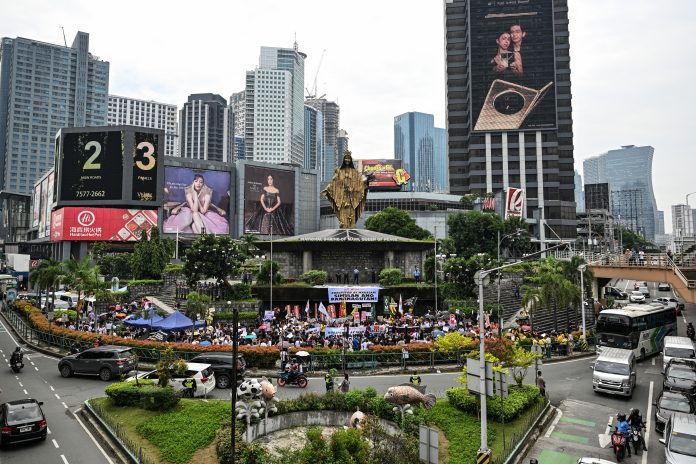
A senior Catholic official called for widening democratic space rather than restricting it as the country marks the 40th anniversary of the EDSA People Power Uprising.
Bishop Gerardo Alminaza of San Carlos, president of Caritas Philippines, warned that declaring the Epifanio de los Santos Avenue (EDSA) Shrine a “no rally zone” diminishes the spirit of the 1986 uprising.
“To declare the EDSA Shrine a ‘no rally zone’ on the very anniversary of the People Power diminishes the spirit of that historic moment,” the prelate said.
He added that EDSA is “not merely a traffic artery” but a “sacred civic ground,” adding, “it is where ordinary Filipinos, united in courage and prayer, peacefully ended dictatorship.”
Recalling the events of four decades ago, he said Filipinos gathered along EDSA “not because they were granted a permit, but because conscience compelled them.”
“They came without weapons, without violence, and without fear. They came to reclaim democracy,” he said.
Alminaza emphasized that the right to assemble and to petition the government for redress of grievances is guaranteed under Article III, Section 4 of the 1987 Constitution.
“These freedoms hold an exalted place in the hierarchy of rights. They may only be limited in the presence of grave and imminent danger to public order or safety. No such danger has been shown.”
He warned that imposing a no permit, no rally policy during the commemoration “disenfranchises many citizens and groups who seek to remember, reflect, and demand accountability,” and “sends the troubling message that remembrance must be controlled and dissent must be contained.”
“The EDSA uprising itself required no permit. It was a moral awakening. It was a collective stand against corruption, abuse of power, and systemic injustice. If anything, the anniversary should widen democratic space, not narrow it.”
The prelate cited Batas Pambansa Blg. 880 and Supreme Court rulings affirming that public parks are deemed freedom parks in the absence of a local ordinance.
He noted that the Quezon City government has not enacted an ordinance designating freedom parks and added, “By law and by jurisprudence, public spaces remain open for peaceful assembly.”
Alminaza called on authorities “to uphold the Constitution faithfully and to apply the strict test of necessity and proportionality before restricting fundamental freedoms,” stressing that “Security and order are important, but they must never become pretexts for silencing legitimate democratic expression.”
At the same time, the prelate cautioned against confrontation.
“We are also mindful of the practical consequences of confrontation,” he said, noting that tensions may escalate if restrictive measures are enforced.
“Such scenarios serve no one. It is wiser and more responsible to seek early dialogue and mutual understanding, allowing citizens to express their convictions peacefully and in an orderly manner,” he said.
“As Church leaders,” Alminaza said that they do not endorse disorder. “We do not call for violence. We call for conscience. We call for accountability. We call for a democracy that listens rather than suppresses.”
He added that EDSA belongs to the people and that the memory of People Power belongs to every Filipino, urging that the 40th anniversary serve as a space for citizens to gather peacefully, pray sincerely, speak truthfully, and demand accountability responsibly.
“Democracy was born in freedom. Let it not be commemorated in restriction,” he said.