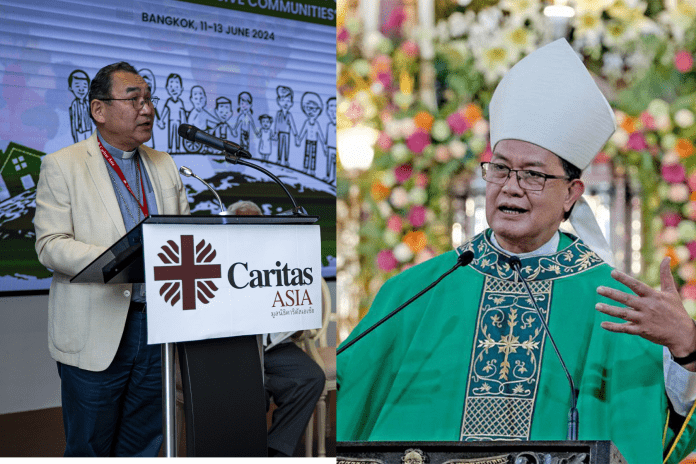
Catholic leaders in Asia opened the Season of Creation with sharp warnings that environmental destruction and systemic corruption form a single crisis threatening the poor and the planet.
In Japan, Cardinal Isao Kikuchi of Tokyo, president of Caritas Internationalis, urged the faithful not only to engage in ecological programs but also to pursue “religious conversion” rooted in care for creation.
The Church in Japan is observing the Month for the Protection of All Life from September 1 to October 4, alongside the global Season of Creation.
“It is expected that awareness-raising activities will be further strengthened from a missionary and pastoral perspective,” Kikuchi said, noting that the bishops had upgraded their “Laudato Si’ desk” into a full department to guide ecological efforts.
He asked Catholics to use this period “to clarify the direction of the Month for the Protection of All Life,” especially as the Church marks the 10th anniversary of Laudato Si’.
Kikuchi echoed Pope Leo XIV’s message for the World Day of Prayer for the Care of Creation, which carried the theme “Seeds of Peace and Hope.”
The Pope, he said, invited Catholics to follow Jesus’ parables of the seed: patient, small, yet transformative in bearing fruit.
But the Pope also sounded a warning, saying that the “violation of justice and peace falls most heavily on the poorest, the most marginalized and the excluded. In this respect, the suffering of indigenous communities is symbolic.”
Reflecting on the Gospel, Kikuchi reminded Catholics that true discipleship demands a radical witness to God’s love, even beyond “the common sense of this world.”
He challenged the faithful: “What are the boundaries of common sense that we must now discard in order to bear witness to God’s love? And what is the way of the cross that we should walk now?”
In the Philippines, Cardinal Pablo Virgilio David of Kalookan, vice president of the Federation of Asian Bishops’ Conferences (FABC), tied the Season of Creation to urgent calls for justice.
Preaching on the Feast of Creation, he launched the Catholic Bishops’ Conference of the Philippines’ pastoral letter Rising from the Floods of Corruption and a new Access to Justice Ministry.
“The story of Gelo reminds us: corruption and the exploitation of creation kill. Greed destroys both the poor and the planet,” David said, recalling a 20-year-old sacristan who died of leptospirosis after daily exposure to polluted floodwaters while searching for his missing father.
Quoting Laudato Si’ §49, he underscored that “we are faced not with two separate crises, one environmental and the other social, but rather with one complex crisis.”
He echoed Pope Francis’ plea: “Let us hear both the cry of the earth and the cry of the poor.”
David also denounced the “god of greed” in Philippine society, criticizing the expansion of legalized online gambling under the Philippine Amusement and Gaming Corporation (PAGCOR).
“No one can serve two masters… You cannot serve God and mammon,” he said, warning that both public policy and private lives must resist the lure of money and profit.
He called for conversion “from being slaves of greed to living simply, humbly, and gratefully,” urging Catholics to see Christ present in both creation and the poor. “We will not serve mammon; we will serve God,” he declared.
Both bishops framed the Season of Creation as a time not just for environmental programs but for deep renewal of faith and action.
Kikuchi pressed Catholics in Japan to strengthen missionary witness through ecological conversion, while David urged Filipinos to resist corruption, defend the poor, and live in solidarity with creation.