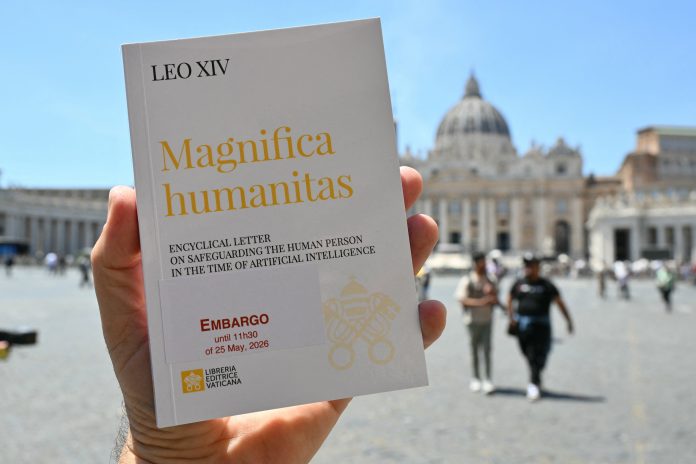
Even as Artificial Intelligence continues to expand, human suffering remains an unavoidable and central issue that is difficult to resolve, even with automated solutions powered by AI. In exploring this dilemma, I considered Magnifica Humanitas, Pope Leo XIV’s first encyclical, and how it illustrates dehumanization in a borderless meta-universe. This brief article aims to move beyond textual shadows and focus on the theme of human suffering, steering clear of detailed theological footnotes and academic analyses to avoid the complexities of the vía académica. Ultimately, the Pope’s goal is to keep his message simple, ensuring that people everywhere can easily understand it.
This breadth ensures that the face of human suffering is not reduced to artificiality by self-serving technology. With a balance of caution and hope, Pope Leo XIV urges us to guide AI’s breakthroughs by grounding our judgment in a living social doctrine rather than in disastrous explorations. He frames this technological frontier through the Social Doctrine of the Church, viewing truth not as a monopoly that protects enterprises driven by scientific advancement, but as a shared gift cultivated through diverse human interactions.
Inhumane Solutions as a Corollary of AI
Implementing AI without ethical safeguards risks strengthening oppressive systems and heightening human suffering. In vulnerable communities, AI can worsen poverty by prioritizing market efficiency over basic human needs. The use of autonomous AI and guided missiles in warfare is particularly alarming. By removing human empathy from lethal decisions, it subjects victims to relentless, calculated destruction, as seen in the military dominance of the United States and Israel in ongoing conflicts.
Beyond political warfare, uncontrolled AI growth risks reducing human complexity to mere digital assets through data optimization. Pope Leo XIV underscores our environmental and social responsibility, stating: “care for our common home and our responsibility toward the poor and future generations require that the use of the goods of creation and the new possibilities offered by technology be regulated in such a way as to respect the environment, avoid waste and prevent new forms of exploitation” (MH, 67).
The massive infrastructure required for AI data centers substantially impacts the environment, consuming critical resources and disrupting ecosystems. Building data centers at sea further endangers marine life, fueling unchecked technological expansion that threatens both ecosystems and livelihoods.
Not Leaving the Poor Behind: The Protagonists of Human Advancement
Jesus’ language of suffering does not simply accept a bleak destiny. Instead, it brings deep and radical hope to the marginalized. In today’s world, technology can also serve as a powerful ally in this liberating hope. When designed and used correctly, Artificial Intelligence can empower the poor by expanding access to vital social services and supporting community-driven solutions that can transform lives.
A critical tension exists: while AI can analyze poverty, its development has been dominated by influential institutions at the expense of human intelligence. This technical dominance sustains current power structures without adequately considering social impacts.
Can AI break free from these oppressive institutional limits and serve the common good? Failing to act carries serious risks. Left unaddressed, AI will reinforce existing inequities and intentionally exclude the oppressed from digital spaces, pushing them into hidden zones of suffering. As Pope Leo points out: “when such power is concentrated in the hands of a few, it tends to become opaque and evade public oversight, increasing the risk of distorted forms of development that give rise to new dependencies, exclusions, manipulations and inequalities” (MH, 95).
To avoid this erasure, we must fundamentally rethink technology’s purpose. AI should be used to build grassroots cooperative movements that empower vulnerable communities and dismantle the root causes of dehumanization. By refocusing on the vulnerable, AI can become a true tool for human liberation.
Revolutionizing Solutions
The current AI landscape frequently produces hyper-realities and superficial simulacra. This reliance on “AI sharks,” corporate monopolies projecting curated realities, undercuts the innate dignity and agency of the human will. As Pope Leo notes: “For AI to respect human dignity and truly serve the common good, responsibility must be clearly defined at every stage: from those who design and develop these systems to those who use them and rely on them for concrete decisions” (MH, 105).
While AI can instantly generate a commodified or coded image of God, or calculate poverty indices with clinical accuracy, it remains blind to the existential pain of human suffering. To truly serve humanity, AI must be re-evaluated across three dimensions.
First, at the social level, AI can amplify marginalized voices, unite disparate struggles, and encourage genuine human communication. Technology must act as an impetus for grassroots change rather than passive consumption. As the Pope states: “A more moral AI is not enough if that morality is determined by a few. What is needed is a more active political involvement that is capable of slowing things down when everything is accelerating, and of protecting the opportunities for communities still to be able to participate and ask questions” (MH, 107).
Second, at the spiritual level, while AI can systematize theological definitions, it can never inspire a human heart to pursue an integral faith praxis, a lived spiritual commitment that connects belief with justice.
Finally, at the transformational level, the experience of the Arab Spring demonstrates that technology can function as a logistical tool for mobilization. Yet digital networks cannot automatically instill moral commitment in leaders. The hope is that AI’s vast computational capacities can move beyond mere messaging and provide platforms that cultivate both structural and personal transformation.
Reflecting on Magnifica Humanitas, theologian Leonardo Boff writes:
“he, referring to Pope Leo XIV, clearly takes the side of care, of selfless love, of the perspective of the victims, the poor, and the oppressed… It presents us with a contemporary, very current text, with the language of our time and therefore accessible to all… assumed and directed in such a way that they generate hope in the possibility of a different world, affectionate, friendly to nature and open to the Infinite…”
(https://leonardoboff.org/2026/05/29/la-magnifica-humanitas-del-papa-leon-xiv-nueva-vision-y-nuevo-estilo-pontificio/)
Thus, the merit of solidarity, rooted in concrete action, remains the authentic methodology for confronting ongoing dehumanization rather than relying solely on advancing technologies such as AI.
Brother Jaazeal Jakosalem, OAR, is a Filipino Laudato Si’ reader. A member of Pusyon Kinaiyahan, an environmental group in the Visayas. He is currently based in Germany as a member of PCPR-Europe, working for the Philippine campaigns related to the protection of human rights.