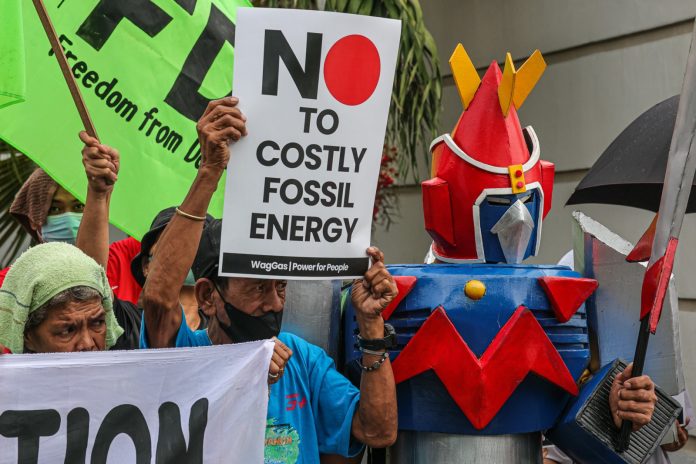
Climate advocates have urged Philippine President Ferdinand Marcos Jr. to stop government auctions for fossil gas-fired electricity, warning that expanding gas power could increase electricity costs and prolong the country’s dependence on fossil fuels.
The Power for People Coalition (P4P) appealed to the Office of the President on Nov. 12, citing what it described as inaction by the Department of Energy (DOE) on its earlier request to revoke a circular governing auctions for mid-merit gas-fired power.
The coalition said the policy sets no explicit limits on the amount of gas-fired electricity to be procured or a timetable for reducing reliance on the fuel.
“As the climate and energy crises deepen, it’s simply unwise to keep tying the Philippines’ future to gas,” said P4P convenor Gerry Arances.
The appeal coincides with the United Nations climate conference, COP31, in Türkiye, where the Philippines is among countries participating in negotiations on global climate action.
P4P warned that further investments in fossil gas infrastructure could divert funding from renewable energy projects and prolong the country’s dependence on fossil fuels.
“The more we develop fossil gas infrastructure, the more we push renewable energy development away. There is no room for fossil fuels, especially with methane emissions from fossil gas exacerbating climate crisis,” said Arances.
Citing a Climate Analytics study, the coalition said the Philippines must drastically reduce the share of fossil gas in electricity generation from 6.5% to below 1% between 2030 and 2040, with a complete phaseout by 2040, to align with efforts to limit global warming to 1.5 degrees Celsius.
The coalition also questioned the economic consequences of expanding gas power as consumers face rising electricity costs.
According to P4P, the weighted average generation rate for fossil gas supplied to Manila Electric Co. (Meralco) reached 12.80 pesos per kilowatt-hour in October 2026, about 3 pesos higher than in January.
Arances said reliance on imported liquefied natural gas exposes consumers to international price fluctuations driven by geopolitical conflicts. He added that domestically produced gas offers little protection because its prices are also tied to international markets.
“Consumers are forced to bear costly generation rates of fossil gas, while companies rake in billions in profits from power generation,” said Arances.
Workers’ groups also raised concerns about the impact of electricity costs on households already struggling with low wages.
Leody De Guzman, president of Partido Lakas ng Masa, said continued reliance on fossil gas would place an additional burden on workers and low-income families rather than improve energy security.
“If the government forces to prolong fossil gas use, consumers, workers, and the urban poor will receive costly electricity, instead of energy security,” De Guzman said in Filipino, according to a translation provided by P4P.
He criticized the government’s refusal to raise the minimum wage to a level sufficient to meet workers’ needs while electricity costs continue to increase.
Flora Santos, president of Oriang, said communities paying high electricity rates are also among those most vulnerable to climate-related disasters.
“Ordinary citizens pay for costly electricity driven by fossil gas, yet we are also the ones most affected and vulnerable to the climate crisis,” Santos said in Filipino, according to the coalition’s translation.
Santos criticized the continued use of fossil fuels, citing their contribution to climate change and the worsening effects of typhoons, flooding, extreme heat and El Niño.
P4P said expanding gas-fired power would expose the Philippines to further economic and climate risks while delaying the transition to renewable energy.
“With the Philippines among the countries most vulnerable to climate impacts, it is imperative that the national government cease its fossil gas push,” said Arances.
“Every fraction of a degree upward in global temperature rise means life-threatening climate disasters and worse slow-onset impacts. We cannot afford allowing our own government to gamble with our people’s lives,” he added.