
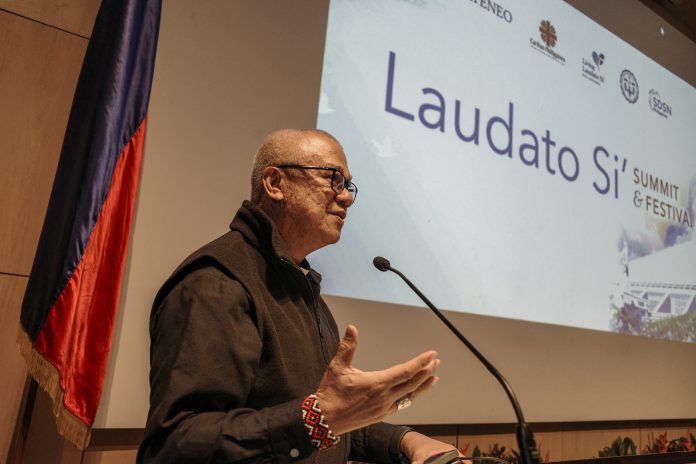
The president of Caritas Philippines challenged the Catholic Church to look beyond the value of donations and examine how wealth is created, and stressed that charity cannot be separated from justice and care for creation.
“Our concern is not only what is given, but also how wealth is generated, how development is pursued, and how our economic decisions affect people, communities, and the environment,” said Bishop Gerardo Alminaza of San Carlos.
“At the same time, the Church also teaches that charity can never be separated from justice, nor love for the poor from care for creation,” he added.
The prelate made the remarks in “A Pastoral Reflection on Charity, Justice, and Hidden Holiness of God’s People,” which examined how the Church should balance gratitude toward benefactors with its commitment to justice and environmental protection.
He shared the reflection around the same time the Archdiocese of Manila conferred the Pro Ecclesia et Pontifice award on SM Prime Holdings executive committee chairman Hans Sy.
Pro Ecclesia et Pontifice, Latin for “For Church and Pope,” is the highest papal honor that may be conferred on laypeople for service to the Catholic Church.
SM Prime Holdings is pursuing a 360-hectare reclamation project in Pasay City that has drawn opposition from environmental groups, scientists, and coastal communities.
Critics warn that the project could damage marine habitats, reduce municipal fishing grounds, displace fisherfolk, and expose reclaimed coastal areas to liquefaction, storm surges, land subsidence, and earthquake risks.
Alminaza’s reflection did not mention Sy, the award, or any particular person, company, or institution.
The bishop said the Church remains grateful to individuals, families, businesses, and institutions that support its mission, saying, “Every authentic act of generosity deserves our gratitude.”
But he said gratitude should not prevent the Church from examining the social and environmental effects of business, investment, and development decisions.
“Authentic development must always respect human dignity, protect biodiversity, uphold the rights of local communities, and safeguard the integrity of creation for future generations,” Alminaza said.
He cited commitments by the Catholic Bishops’ Conference of the Philippines to ethical stewardship, responsible investment, and ecological conversion, including a policy against accepting donations originating from activities that gravely harm people or the environment.
“These commitments are not directed against any particular person, company, or institution,” he said. “Rather, they express the Church’s desire for her own life to become ever more consistent with the Gospel she proclaims,” he added.
Alminaza said social responsibility should not be measured only by philanthropy after wealth has been accumulated.
The ways wealth is created, invested, and used for development should already promote human dignity, justice, peace, and ecological sustainability.
“Charity reaches its fullness when it walks hand in hand with justice,” he said.
The bishop also called on the Church to recognize ordinary Catholics whose service often receives little public attention, including parents, catechists, volunteers, young people, farmers, and fisherfolk.
“Their names may never appear in newspapers. They may never receive public honors. Yet they are among the living treasures of the Church,” Alminaza said.
He urged government, business, civil society, and the Church to help build an economy that serves life, protects creation, and leaves no one behind.
“Above all, may we continue to seek not merely generous hearts, but transformed hearts; not merely successful lives, but holy lives,” he said.