
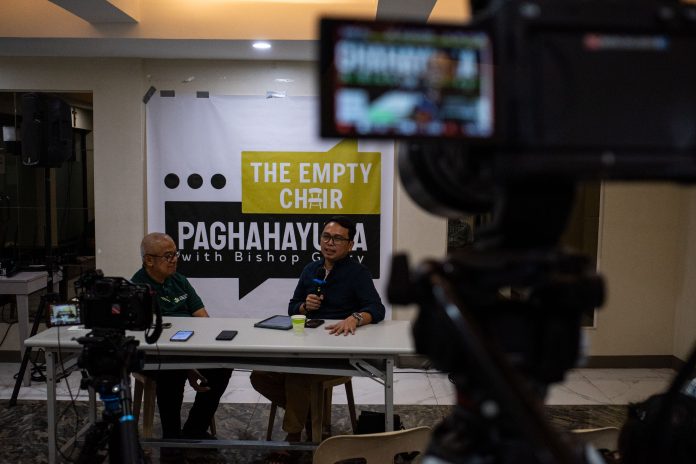
A Philippine energy advocate called for the resignation of Energy Secretary Sharon Garin, accusing the government of mishandling a six-month energy crisis by expanding coal and gas while consumers face rising costs and recurring power outages.
Gerry Arances, Executive Director of the Center for Energy, Ecology and Development, said accountability should begin with Garin over the government’s response to fuel prices, power plant shutdowns and electricity costs.
“She needs to step down. She needs to resign. The Filipino people deserve better,” Arances said during a Sept. 22 press conference.
He accused the Department of Energy of continuing to promote 5 gigawatts of new coal plants while failing to resolve petroleum price problems or impose meaningful accountability on corporations that have profited during the crisis.
Arances said Garin’s policies are “prolonging the suffering of Filipinos in the power and energy sectors,” while noting that responsibility extends beyond the energy secretary because “the policies the DOE implements originate from higher authorities.”
Six months into the crisis, Arances said, ordinary consumers are bearing much of the burden through higher electricity and fuel costs.
The effects extend to drivers and commuters, farmers whose irrigation systems depend on diesel, and fisherfolk whose boats run on diesel engines. “Ordinary Filipinos are carrying the burden of the crisis,” Arances said.
He criticized government assistance programs as selective and inadequate, saying proposals from organizations including the Catholic Church to cushion the impact on consumers were ignored.
Arances also questioned the government’s continued reliance on fossil fuels as a response to power supply problems.
At the height of rotating brownouts and plant shutdowns in the Visayas, he said, the government responded with plans for additional coal plants, increased gas supply and gas auctions for Luzon and the Visayas.
“The very solutions being proposed by the government are the same things that caused the energy crisis in the first place,” Arances said.
He cited repeated shutdowns at several power plants in the Visayas, including 110 shutdowns at TVI Unit 1 and 98 at TVI Unit 2. He also cited 74 shutdowns at Panay Energy Development Corp., 19 at KSPC Unit 1 and 13 at CEDC Unit 1. Most of the facilities are less than 10 years old.
He said plant shutdowns leave electric cooperatives and distribution utilities without contracted supply, forcing them to buy electricity from the Wholesale Electricity Spot Market, where prices rise when supply is tight.
Arances said that amid the outages, WESM marginal prices in certain areas in Visayas reached as high Php 48/kWh, with coal plant WESM participants also reaching settlement prices as high as Php 32/kWh. The costs are eventually passed on to consumers.
He said repeated outages and the lack of meaningful penalties amounted to “a breakdown of the Department of Energy’s mandate to ensure energy security.”
Arances also criticized the government’s response to rising electricity bills, particularly the handling of proposals to remove system loss charges paid by consumers in areas served by Manila Electric Co. (MERALCO).
He said discussions eventually focused only on removing the value-added tax on system loss charges, which he argued would offer little relief compared with increases in household electricity bills.
“When we examine the government’s response to rising fuel prices and rising electricity costs, the conclusion is clear: People have been left on their own,” Arances said. “They have been left to fend for themselves.”
The energy advocate said the same concerns extend to Pax Silica, a government-backed initiative involving artificial intelligence, semiconductors and critical minerals.
He cited the project’s projected requirement of 3 gigawatts of electricity. “Three gigawatts of power is not a simple requirement,” Arances said.
He argued that the broader strategy surrounding the project remains tied to gas, nuclear power, and coal, warning that it could perpetuate the problems behind the current energy crisis rather than change the country’s energy direction.
Arances pointed to renewable energy initiatives as an alternative, citing the 10 Million Solar Rooftop Challenge supported by Caritas Philippines, the Catholic Bishops’ Conference of the Philippines, the Powerful People Coalition and other groups.
He credited the Catholic Church with promoting solarization in parishes, dioceses and Church-affiliated institutions, but stressed that community action cannot replace government responsibility.
“The Philippine government must still be held accountable for failures in the power sector and for the policy mistakes that continue to deepen the crisis,” Arances said.