
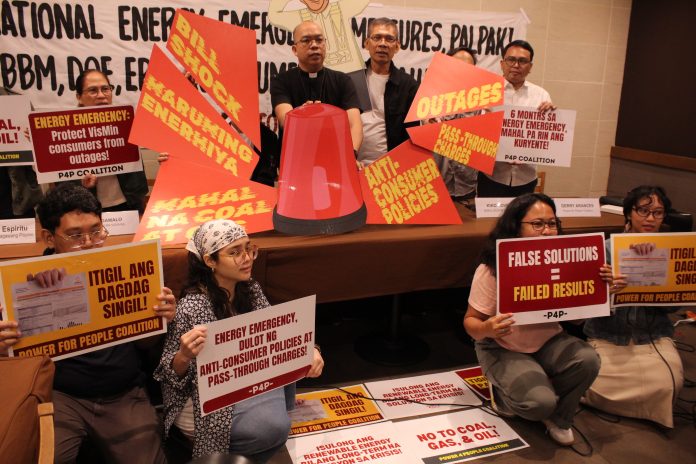
Consumer groups in the Philippines called for the resignation of Energy Secretary Sharon Garin on Sept. 15, saying electricity rates and outages have worsened six months into a national energy emergency.
The Power for People Coalition (P4P) said consumers continued to face higher electricity bills and unreliable supply despite government measures intended to address disruptions in global energy markets.
President Ferdinand Marcos Jr. placed the country under an energy emergency through Executive Order 110 in March. The coalition said the declaration followed the United States and Israel’s attack on Iran in February.
The order was intended to allow the Department of Energy and other government agencies to implement coordinated measures under existing laws to address risks from disruptions in global energy supply and their impact on the domestic economy.
“The administration gave itself police powers to steer the country’s response to the energy emergency. Six months on, and consumers are reeling from all-time high electricity costs, unexplained bill shocks, and rampant outages,” said Gerry Arances, convenor of P4P.
“No amount of temporary aid can cover up for how the government failed Filipino consumers in this time of crisis,” said Arances.
The coalition said residential electricity rates in the Manila Electric Co. franchise area have risen by at least P1.57 per kilowatt-hour over the past six months.
Consumers in off-grid areas and those served by other distribution utilities faced steeper increases, the group said, with bills reflecting increases of nearly P4 in Mindoro and nearly P3 in areas served by VECO and MORE in the Visayas.
The coalition also criticized the Marcos administration, the Department of Energy and the Energy Regulatory Commission for promoting additional coal and gas capacity during the emergency.
Arances said plans for 5 gigawatts of new coal capacity and an auction dedicated to gas power could further expose consumers to volatile fossil fuel prices and lock the country into costly power sources.
“In the face of a national energy crisis underscored by fossil fuel dependence, Marcos Jr, the DOE, and the ERC, in their infinite wisdom, pivoted even further towards promoting fossil fuel expansion,” said Arances.
He said Garin had been tasked with leading the government’s response but had failed to protect consumers from price volatility.
“Six months on, and the DOE has not shaped up. There is no reason why consumers should not call for a change in leadership, and for Secretary Garin to step down,” said Arances.
The groups also cited recurring power supply alerts, particularly in the Visayas.
“Since May, the Visayas grid has recorded nearly 34 red alerts and 96 yellow alerts. Electricity supply is not enough for millions of people,” said Fara Gamalo of the Freedom from Debt Coalition Eastern Visayas.
Gamalo said the government continued to promote additional coal and gas projects in the Visayas and Mindanao in the name of energy security despite recurring outages.
“Failed fossil fuels are not the solution to energy security. What they should focus on is stopping the outages and holding those responsible accountable,” said Gamalo.
Father Warren Puno, convenor of Quezon for Environment, said communities in Quezon province had resisted the proposed 1,200-megawatt coal plant in Atimonan for more than a decade because of concerns over its impact on livelihoods, health and the environment.
“For over a decade, Quezon has resisted the development of the 1,200MW coal plant in Atimonan, calling for protections against the ecological dangers of the fossil fuel,” said Puno.
He questioned why the government continued approving fossil fuel projects when renewable energy alternatives were available.
“We ask the government: why approve more fossil projects when renewable energy is present and desired?” said Puno.
He said the recent growth of solar power reflected public demand for alternatives to coal and gas.
“In their goal to achieve energy security, the government is compromising community welfare, the affordability of electricity, and our transition to renewables,” he said.
The coalition also pointed to conditions in off-grid communities, where dependence on diesel leaves consumers exposed to high costs and unreliable supply.
“In off-grid areas like Oriental Mindoro, we depend on expensive, dirty and unreliable diesel. Our brownouts have reached almost 20 hours a day,” said Arlene Sampson of Partido Lakas ng Masa-Oriental Mindoro.
Sampson said El Niño also threatened farmers, fishers and local food security, while fossil fuel use aggravated the climate crisis.
The coalition said renewable generation costs fell by an average of P0.86 over the past six months, while gas and coal costs in the global market rose by 127% and 26.73%, respectively.