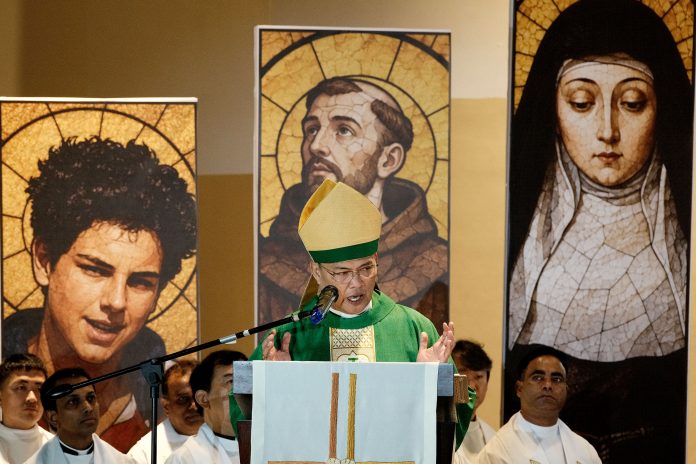
Here is the full text of the homily delivered by CBCP President Archbishop Gilbert Garcera at the opening Mass of the Asian Catholic Digital Missionary Assembly at Radio Veritas Asia in Fairview, Quezon City, on Sept. 11, 2026:
My dear brothers and sisters in Christ, dear journalists, media practitioners, and friends of Radio Veritas Asia,
I accepted this invitation not because I am the President of the Catholic Bishops’ Conference of the Philippines. I accepted it because this place – Radio Veritas Asia is very memorable to me. This is the same stage, in this same building where, after EDSA II, the Late Archbishop of Manila, Jaime Cardinal Sin appointed me as Administrative Director of Radio Veritas Asia. Here, we gathered our employees and celebrated international events with our Telugu, Urdu, Tamil, Kachin, Karen, Mandarin, Bengali, Hindi, Sinhala, Filipino, and other language services. From this very place – here in Buick Street, Fairview, Quezon City, through analogue transmission, the Catholic faith was heard in the forests and communities of Asia.
Radio Veritas was born from the vision of the Federation of Asian Bishops’ Conferences – FABC, to communicate the Gospel across the diverse realities of Asia. Today, the technology has changed—from short wave radio transmission to digital platforms, social media, podcasts, livestreams and artificial intelligence.
But the mission remains: to bring truth, hope and the Gospel to the peoples of Asia.
For us Asian Bishops – for us members of the FABC Central Committee, we say: “we do not just proclaim Jesus in Asia, we whisper Jesus in all of Asia.” The phrase “whispering Jesus in Asia” is a beautiful and profound way of describing the mission of the Church in the Asian context. It suggests that proclaiming Christ in Asia is not primarily about making a loud declaration, but about gently, respectfully, and patiently making Jesus present in the lives and cultures of peoples. We bring Jesus not by shouting over Asia, but by drawing close to Asia, listening to its peoples, walking with them, serving them, and gently making the love of Christ heard and experienced.
There is also a beautiful paradox in the phrase: a whisper is quiet, but it can travel far when spoken with love and conviction. The mission may not always appear spectacular, yet a quiet witness can enter hearts, families, communities, and cultures in ways that loud proclamation cannot.
In this sense, “whispering Jesus in all of Asia” is a spirituality of mission—a call to proclaim Christ through humility, dialogue, presence, compassion, accompaniment, and faithful witness, trusting that God himself will make the Gospel take root.
The Areopagus of the Modern Age
In the Apostolic Exhortation, Ecclesia in Asia, 1999 – Pope St. John Paul reminds us that social communication has become a powerful force in shaping culture, especially among the young. He calls the media the “Areopagus of the modern age.” Today, that Areopagus is everywhere—in our radios, televisions, smartphones and social-media platforms.
The Church therefore cannot simply use media to spread a message. We must enter the new culture created by modern communication, learning its language while remaining faithful to the Gospel.
This means that Catholic media must not only speak to Asia; it must also listen to Asia—especially to the poor, migrants, indigenous peoples, young people, victims of injustices and the marginalized. Before speaking about people, learn to listen to people.
A vocation, not merely a profession
Dear journalists and digital media practitioners, you are not merely content creators. You are witnesses. Every headline, photograph, video, post and story makes a choice: What will we highlight? Whose voice will we hear? Whose voice will remain unheard? That is why communication is not merely technical. It is a moral responsibility.
In today’s Gospel, Jesus asks: “Can a blind person guide a blind person?” This question challenges all of us who communicate. Are we helping people see reality more clearly—or are we adding to the confusion? Are we reporting what is true—or simply what is trending, what is popular, or what wins the most thumbs-up and heart emojis? Are we informing people—or merely provoking them?
In a world where truth can easily be measured by clicks, likes, reactions, and shares, we must never allow popularity to become the measure of truth.
And Jesus tells us: “Remove the wooden beam from your own eye first.” Before we expose the blindness of others, we must examine our own blindness—our prejudices, assumptions and biases. Authentic witnessing begins with self-examination and listening.
Disarm our words
This is why, in his new encyclical, Magnifica Humanitas, paragraph 214, Pope Leo’s call to “disarm words” is so relevant and timely today. Words can heal, but words can also inflict wounds. Words can build bridges, but words can also create walls and construct the tower of babel in our modern times.
To disarm words does not mean to weaken journalism. It means to speak the truth without hatred, to denounce injustice without dehumanizing, and to criticize without destroying the dignity of the person.
In the digital age, where misinformation travels quickly and AI can produce convincing falsehoods, the responsibility of journalists becomes even greater. The world needs media practitioners who can help people discern what is true.
Therefore: Verify before you publish. Listen before you judge. Understand before you interpret. Give context before you condemn. Do not allow clicks, ratings, followers or virality to become more important than truth.
“I have become all things to all”
St. Paul in the first reading tells us: “I have become all things to all.” This is also the mission of Catholic media in Asia. Asia is not one reality. It is a continent of different cultures, religions, languages, poverty, development, conflict and hope. As Bishops of Asia, FABC promotes the triple dialogue – dialogue with the different cultures of Asia, the dialogue with the different religions in Asia and the dialogue with the Poor. “Whispering Jesus in Asia” is almost a spirituality of the triple dialogue. We whisper Jesus in the cultures by allowing the Gospel to take flesh in Asian ways of life. We whisper Jesus among the religions by listening, building friendship, and working together for peace. We whisper Jesus among the poor by becoming present to them through compassion, solidarity, and service.
Therefore, we must listen to Asia — especially to those whose voices are often unheard: the poor, migrants, indigenous peoples, young people, victims of injustices and the marginalized.
Before speaking about people, learn to listen to people.
Once, with nothing more than an analogue transmitter, Radio Veritas sent the voice of the Gospel across the vast landscapes of Asia—through the forests and mountains of the remotest parts of China, across villages and communities, and into the Muslim heartlands of the Middle East. Its signal travelled where missionaries could not easily go, crossing distances, cultures, languages, and borders. It was, in a very real sense, a whisper of Jesus carried on the airwaves—quietly reaching hearts in the farthest corners of Asia. Today, every digital platform is a transmitter. That is a great privilege—and a great responsibility. May each one of the participants in this conference continue to be a voice that speaks to Asia, a voice that listens to Asia, and a voice that gives hope to Asia.
And may our journalism and digital missionary presence always serve truth, human dignity, justice, peace and the common good. Because ultimately, we are not called simply to communicate information. We are called to be witnesses to the Truth—and the Truth is Jesus Christ.