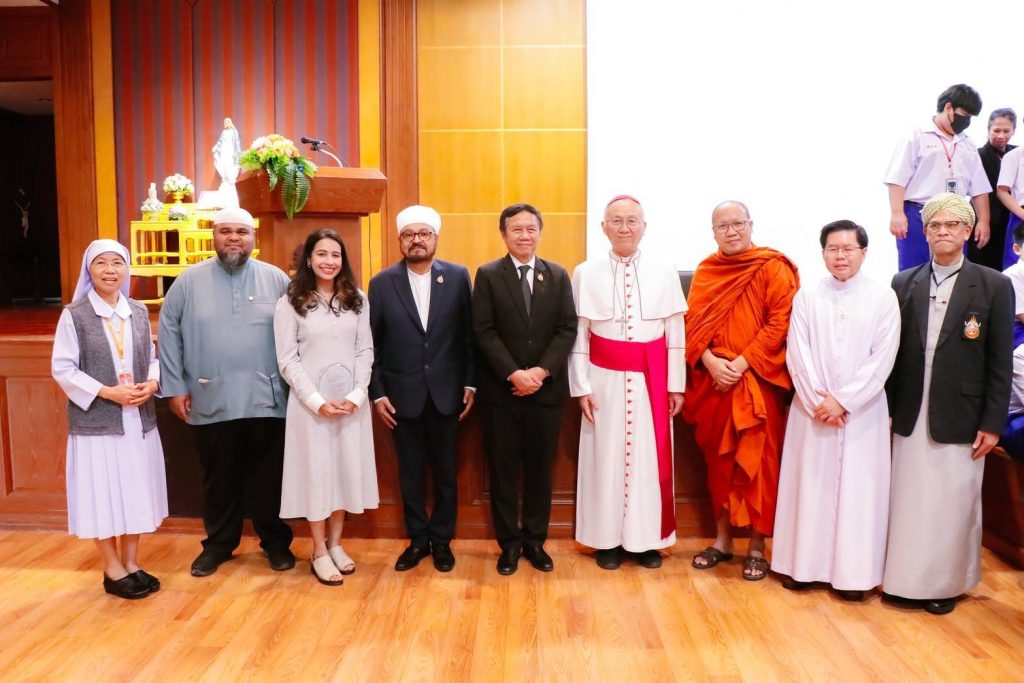
When senior Buddhist monks sit side by side with the president of the Catholic Bishops’ Conference of Thailand to celebrate student character awards, the witness speaks louder than words: genuine moral formation transcends religious boundaries to illuminate an entire nation.
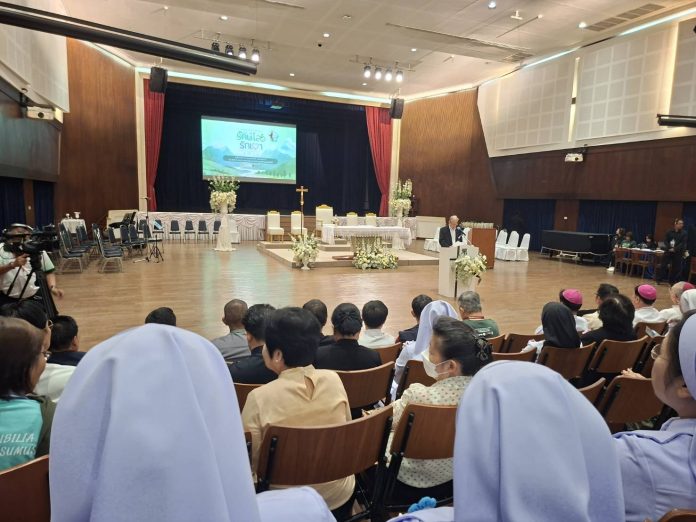
On Sept. 9, 2026, the Baan Phu Wan Pastoral Training Center in Sam Phran District outside Bangkok was the venue of the “Catholic Virtue School” celebration — a gathering honoring institutions, educators and students dedicated to character building and ethical leadership.
Among the distinguished guests were Phra Khru Sangkhaborirak Ekkarat Apirakkh, chairman of the “Friends of Virtue” Network and member of the Moral Promotion and Driving Committee under the renowned Moral Center, alongside Phra Sarawut Chakkadhammo, a Dhamma lecturer representing multi-faith moral initiatives.
The event was also honored by the secretary-general of the Office of the Private Education Commission (OPEC), Ministry of Education.
The event served as both a platform for students to present their moral projects with pride and a ceremony to present awards honoring schools and personnel for their efforts in promoting virtue.
It was presided over by Archbishop Francis Xavier Vira Arpondratana, president of the Catholic Bishops’ Conference of Thailand (CBCT) and archbishop of Bangkok, and honored by the presence of the secretary-general of the Office of the Private Education Commission (OPEC), Ministry of Education.
Goodness as Salt and Light
Addressing hundreds of educators and students, Archbishop Vira said, “A truly good person undergoes an internal transformation driven by their relationship with God and religious principles. Catholic schools must carry this mission forward through concrete action—acting like salt preserving the earth and light illuminating the world.”
That transformation, he said, becomes visible only when a person actively does good and becomes a positive example to others.
The archbishop urged Catholic schools to carry this mission forward through concrete action and stronger networking, notably among Catholic schools in the Central Region, and to dedicate themselves to fostering goodness in students through daily practice.
“We must integrate these values into classrooms and daily life as much as possible,” he said. “In doing so, goodness acts like salt preserving the earth and light illuminating the world, embodying the Catholic educational identity of love and service.”
A Tiny Minority, A National Model
While Catholics represent less than 1 percent of Thailand’s population, Catholic schools educate more than 460,000 students nationwide — the vast majority of whom are Buddhist or Muslim.
That reality has shaped the Church’s moral education approach around universal values: gratitude, service, justice, empathy and integrity.
Through the Catholic Education Council of Thailand (CECT) and regional dioceses, the Church drives the “Moral Schools” or Virtuous Schools initiative — a benchmark-driven framework officially certified by the renowned Moral Center and recognized by the Ministry of Education.
Last month, more than 500 Catholic educators, diocesan leaders and civic officials gathered in northeastern Thailand to celebrate a decade of standardized moral integration in Catholic education, culminating in the Catholic Moral Awards 2026.
The awards honored schools that seamlessly embed virtues such as honesty, financial stewardship, and social responsibility into daily routines.
At dedicated regional showcases like the Baan Phu Wan event, exemplary institutions are officially recognized for breakthrough practices and present specific holistic frameworks to peers.
What It Takes to Become a Virtuous School
To earn the official “Virtuous School” certification — a joint framework overseen by the Ministry of Education and audited by the Moral Center — schools must satisfy two frameworks.
First, the Core Five National Values under Thailand’s National Moral Promotion Action Plan:
- Sufficiency: moderation, financial discipline such as student savings programs, and sustainable use of resources.
- Integrity: structural anti-corruption initiatives, transparent grading and honest conduct.
- Discipline: personal accountability, punctuality and adherence to community standards.
- Volunteerism / Public Mind: regular community service and proactive helping.
- Gratitude: respect toward parents, teachers, community and nation.
Second, a progressive Five-Star Quality Evaluation System.
Certification is not a one-time stamp but an incremental ladder. To be audited for any star level, schools must submit physical portfolios including student-led moral projects tackling local issues such as anti-bullying or waste reduction, biannual behavioral assessment trackers for students, and curriculum maps showing how ethics are integrated into math, science and language lessons.
By grounding rigorous academic standards in timeless Gospel values, Catholic schools in Thailand continue to show that true education shapes not only the mind but the heart — building a compassionate generation that serves the common good of all.