The Catholic Church in northern Philippines called for justice and dialogue following the arrest of 11 residents opposing mining exploration in Nueva Vizcaya province.
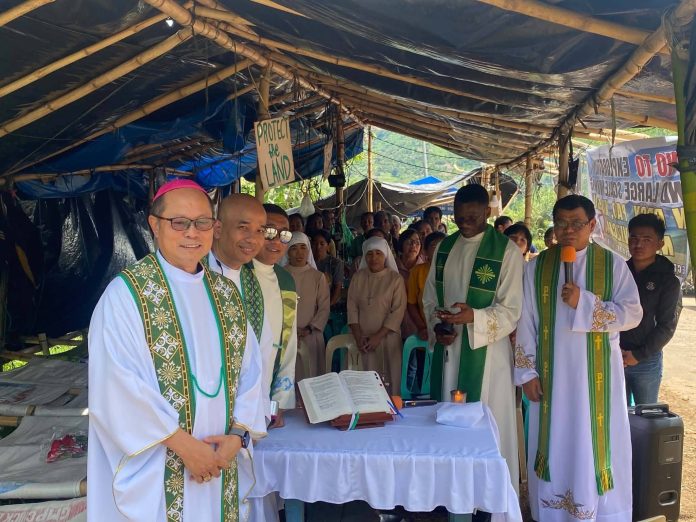
In an Aug. 30 pastoral letter, Bishop Jose Elmer Mangalinao of Bayombong expressed concern over the arrest and detention of residents involved in the anti-mining barricade in Paquet village, Kasibu town.
“Ang pagtatanggol sa lupa at kalikasan ay hindi agad krimen” (Defending the land and the environment is not automatically a crime), Mangalinao said.
Police arrested 11 people on Aug. 28 as residents sought to block the entry of crude oil that North Luzon Mineral Resources Corp. (NLMRC) intended to use for drilling activities, according to the Alyansa ng Novo Vizcayano para sa Kalikasan (ANVIK).
ANVIK claimed that the police arrived at the barricade to assist the company’s operation.
Residents began putting up community barricades in May to oppose NLMRC’s exploration for gold and copper across 4,456 hectares in the area. They cited the absence of community consultation before drilling operations and raised concerns over possible displacement and the impact on livelihoods and the environment. Three people were also arrested at the same protest on Aug. 19.
Mangalinao said he was not prejudging cases that could be filed against those arrested and acknowledged the authority of police and the courts.
He said, however, that enforcement of the law should not be separated from justice, compassion and respect for human dignity.
The prelate said communities worried that mining exploration could affect their farms, water sources, forests, and their children’s future have the right to ask questions and seek dialogue.
“Ang tunay na pag-unlad ay dapat maglingkod sa tao at sa kabutihang panlahat” (True development must serve people and the common good), he said.
Mangalinao appealed to police to exercise their authority with restraint and respect for human dignity. He also urged government agencies and mining interests to listen to people directly affected by proposed projects.
He asked the detained residents and their supporters to continue asserting their rights peacefully and urged all sides to choose dialogue over confrontation.
“Ang Simbahan ay handang tumulong sa prosesong ito—hindi upang palitan ang pamahalaan o ang hukuman, kundi upang maging tulay kung saan may pagkakahati at hidwaan” (The Church is ready to help in this process—not to replace the government or the courts, but to serve as a bridge where there is division and conflict), he said.
Caritas Philippines, through its Integral Ecology Ministry, expressed solidarity with Mangalinao, the Diocese of Bayombong, Indigenous Peoples, farmers, and communities in Kasibu.
The Philippine Church social action arm condemned the Aug. 28 arrests and called for an impartial investigation into the arrests and the reported use of force during the police operation.
It urged authorities to protect the rights and dignity of those arrested and ensure access to their families, legal counsel, medical care where needed, and due process.
Caritas also called on the Department of Environment and Natural Resources, the Mines and Geosciences Bureau and the National Commission on Indigenous Peoples to suspend exploration and related clearing or transport activities while the project’s permits, consultations, environmental safeguards and compliance with free, prior and informed consent are independently reviewed.
“The struggle in Kasibu confronts our country with a fundamental question: What kind of development are we pursuing, who decides, who benefits, and who is made to bear the cost?” said Bishop Gerardo Alminaza of San Carlos, president of Caritas Philippines.
Alminaza, who also serves as the interim chairperson of the Integral Ecology Ministry, said development cannot come at the expense of human dignity, Indigenous rights, watersheds, biodiversity, and the common good.
“We stand with the Diocese of Bayombong, Bishop Mangalinao, and the priests, religious, and lay faithful who accompany communities defending their land, water, and future,” he said.
“Their ministry is not partisan obstruction; it is faithful witness to the Gospel and to the inseparable dignity of people and creation,” he added.
Caritas noted that Mangalinao himself had faced legal action over his pastoral presence among communities opposing mining exploration in Kasibu.
In June, the bishop, a priest, and several community advocates were named in a civil forcible-entry complaint arising from the barricades. The Kasibu Municipal Trial Court dismissed the complaint on June 24 for lack of jurisdiction.
Cardinal Pablo Virgilio David of Kalookan also expressed solidarity with Mangalinao and communities seeking a greater voice in decisions over mining in Nueva Vizcaya.
“I wish to express my solidarity with Bishop Elmer Mangalinao and the Diocese of Bayombong, and especially with the communities of Nueva Vizcaya who are asking that their voices be heard before further mining activities are allowed to proceed in their land,” David said.
David acknowledged that minerals, particularly copper, are increasingly needed for the transition to renewable energy, but warned that extraction should not come at the expense of communities and ecosystems.
“But a ‘green transition’ cannot be called green if extracting its minerals destroys forests and watersheds, contaminates rivers, threatens farms and livelihoods, or turns rural and Indigenous communities into sacrifice zones,” he said.
The cardinal urged government agencies to review environmental clearances affecting contested areas and, where legally warranted, suspend them until independent environmental studies are completed and affected communities and local governments are genuinely consulted.
He also called for an end to harassment, intimidation, and the unnecessary criminalization of environmental defenders.
“Development cannot mean extracting what lies beneath the earth while destroying the life that flourishes above it,” David said.
Bishop Dave Dean Capucao of Infanta likewise expressed solidarity with the people of Nueva Vizcaya, saying the neighboring prelature shared concerns over environmental protection and the welfare of poor communities.
Capucao urged government authorities, law enforcement agencies, and all parties involved to exercise restraint, protect human rights, and allow dialogue to prevail over confrontation.
He also stressed the rights of Indigenous Peoples, saying their free, prior, and informed participation in decisions affecting their ancestral domains must be upheld.
“Authentic peace is born where truth is spoken, justice is pursued, human dignity is protected, and creation is cared for as God’s gift entrusted to all,” Capucao said.