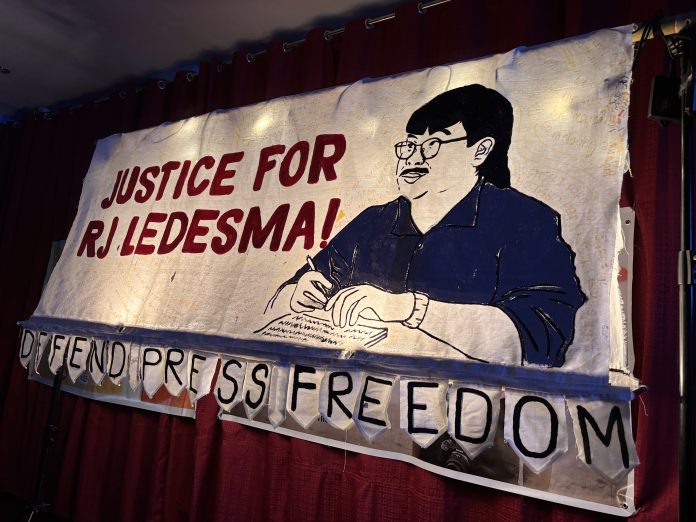
Philippine alternative media network Altermidya marked National Press Freedom Day by launching the Justice for RJ Ledesma Campaign and renewing calls for an independent investigation into the killing of the community journalist.
The network on Aug. 29 warned that journalists should not be treated as combatants because they report from conflict-affected communities or speak with people living there.
Ledesma, a writer and editor of Paghimutad-Negros and Altermidya’s regional coordinator for Negros Island, was among 19 people killed during military operations in Barangay Salamanca, Toboso, Negros Occidental, on April 19.
He was in Toboso doing community work and immersion reporting on hacienda farmworkers and the possible effects of renewable energy projects on vulnerable farming communities.
“RJ was there because he was a journalist. He went to communities because that was where the stories he was covering were unfolding. A journalist should never be treated as a combatant simply because he enters a conflict-affected community, speaks with people there or reports on their conditions,” said Raymund Villanueva, chairperson of Altermidya Network.
The Philippine Army initially identified all 19 fatalities as members of the New People’s Army. A National Fact-Finding and Solidarity Mission that later investigated the incident found that nine of those killed were civilians who did not participate in the armed encounter.
“We are demanding answers. We want an independent investigation that will establish how RJ was killed, who was responsible, and whether violations were committed. His family, his colleagues and the public deserve to know what happened in Toboso,” Villanueva said.
Altermidya urged the Commission on Human Rights, the Presidential Task Force on Media Security and other government agencies to support an impartial investigation independent of the military units involved in the April 19 operation.
The network said investigators should examine witness accounts, forensic evidence, records related to the military operation and other available material to establish the circumstances of Ledesma’s death and determine responsibility.
“Justice means finding out what happened and holding those responsible to account. It cannot end with statements or promises of investigation. There has to be a credible process that follows the evidence and establishes responsibility,” Villanueva said.
Ledesma reported on human rights, land struggles, sugar workers, reclamation, palm oil expansion and the impact of renewable energy projects on communities in Negros.
Paghimutad-Negros had faced red-tagging and vilification before his death. In October 2022, the Facebook page of the Philippine Army’s 303rd Brigade described one of the publication’s human rights reports as “propaganda” and linked it to the National Democratic Front of the Philippines.
Altermidya said the previous attacks did not by themselves establish responsibility for Ledesma’s killing but reflected the hostile environment in which community journalists in Negros have had to work.
“A reporter does not become a combatant because of the people he interviews or the community he enters. If journalists can be targeted simply for reporting from conflict-affected areas, then every journalist whose work takes them beyond official spaces is at risk,” he said.
Detained community journalist Frenchie Mae Cumpio sent a message to the campaign launch, linking Ledesma’s case to the risks faced by journalists reporting stories from communities.
“Members of the press face a constant threat should they unveil the stories from the ground,” Cumpio said.
Cumpio, who has been detained for more than six years and referred to herself and the other detainees as the Tacloban 5, accused the National Task Force to End Local Communist Armed Conflict of contributing to red-tagging and efforts to restrict the flow of information.
She cited her own detention and the red-tagging of journalist Atom Araullo as examples of what she described as threats against members of the press. “It is disturbing that the Philippines remains unsafe for journalists,” Cumpio said.
She also cited unresolved killings and intimidation of journalists, as well as pressure on student publications, in arguing that members of the media continue to face risks in carrying out their work.
Cumpio urged journalists to continue reporting from communities despite those threats. “I urge young journalists to never stop writing — our pens have once toppled down a dictatorship,” she said.
Writing from the Correctional Institution for Women, Cumpio also relayed the support of political prisoners there for the defense of press freedom.
“Locked behind bars, the political prisoners in CIW raise our fist in support of our struggle for press freedom. The women prisoners in the Philippines gained a lot of triumphs in terms of the treatment and services among detention facilities through the persistent and fearless broadcasts of the members of the press,” she said.
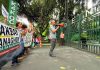
The Justice for RJ Ledesma Campaign was launched at Sikat Studios in Quezon City with the installation of a large lantern made of wood and cloth bearing the words “Justice for RJ Ledesma” and verses from his poems and other writings.
Participants lit the lantern during a program honoring Ledesma’s life and journalism before proceeding to the Boy Scout Circle for an indignation rally.
The gathering also echoed calls for Cumpio’s release and the release of all political prisoners.
Altermidya said the campaign would continue beyond National Press Freedom Day through case monitoring, public advocacy, and reporting on the communities and issues Ledesma covered.
“We will continue to demand justice for RJ and accountability for his killing. We will also continue the work he believed in. A journalist was killed, but the stories should not disappear with him,” Villanueva said.
The network called on journalists, media organizations and press freedom groups to support the demand for an independent investigation and defend the right of journalists to report from marginalized and conflict-affected communities without red-tagging, intimidation or violence.