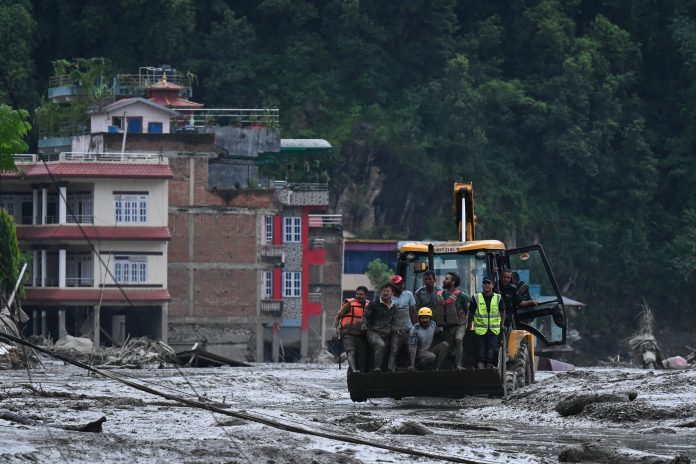
The Catholic Church in Nepal is assessing relief needs after a glacial collapse triggered devastating floods along the Nepal-Tibet border, killing at least 165 people and leaving more than 1,000 missing.
The floods swept through villages, market areas and transport routes Wednesday along the Bhote Koshi and Trishuli rivers.
Hundreds of tourists were among those unaccounted for, while the affected area includes a major pilgrimage route to Tibet.
In a report by Crux, Father Silas Krishna Bogati, apostolic administrator of the Nepal vicariate, said that the flood originated in Tibet and moved downstream into Nepal, washing away homes and villages in four districts.
“We have 25 Catholic families, who are safe,” Bogati told Crux, adding that “there were huge casualties” in the affected area.
Bogati said Father James Britto, a priest of the vicariate, was stranded after crossing the river to celebrate Mass.
“[He] had gone to celebrate Mass to the other side of the river,” said Bogati, adding, “but cannot return to his mission station as roads and bridges have been washed away.”
At least 19 bridges and nearly 25 miles of road were destroyed. Bogati said the Church was assessing how it could support rescue and relief efforts.
“The Catholic Church together with caritas will make an assessment of this disaster and make an appeal to Caritas partners,” he told Crux.
He said the government had declared the affected districts a disaster area for three months as authorities treated the injured, carried out rescue operations and moved stranded people to safer areas.
“This is second time we have faced such disaster in that area but this one is massive,” he said.
Nepali police said 162 bodies had been recovered. Chinese state media said three people were killed at Gyirong Port in Tibet.
In Nepal, 468 tourists, including 393 foreigners, remained unaccounted for a day after the disaster, according to the tourism ministry. On the Chinese side, rescuers were searching for 558 missing people, including 260 foreign nationals, Agence France-Presse (AFP) reported.
The affected area includes a route used by pilgrims traveling toward Mount Kailash in Tibet, a sacred site for Hindus and Buddhists, as well as by trekkers and other tourists.
Environmental historian Ruth Gamble of La Trobe University told AFP that the rush of mud and debris was “like an inland tsunami, travelling nearly 170 kilometres down the Bhote Koshi valley into Central Nepal.”
“Entire villages and market areas have been wiped out,” said David Fisher, Nepal head of the International Federation of Red Cross and Red Crescent Societies.
The U.S. Geological Survey said the disaster was caused by a glacial collapse and debris flow. The seismic activity had initially been reported as an earthquake.
“This event was initially reported as a magnitude 4.4 earthquake,” the USGS said.
“Additional analysis of nearby seismic stations, long-period seismic waves, and satellite imagery led to the determination that the seismic event was instead a glacial collapse and debris flow, and that no earthquake had occurred,” it added.
Authorities warned that another flood remained possible because of a blockage upstream.
“With a blockage still lodged upstream on the Nepal-China border river, authorities warn a second flood may occur,” said Qianggong Zhang, head of climate and environmental risks at the Kathmandu-based International Centre for Integrated Mountain Development.
The Nepali Army carried out rescue flights and moved people from danger zones near the river. Authorities in Tibet deployed nearly 800 emergency workers, 150 vehicles, sniffer dogs and speedboats, according to Chinese state media.