
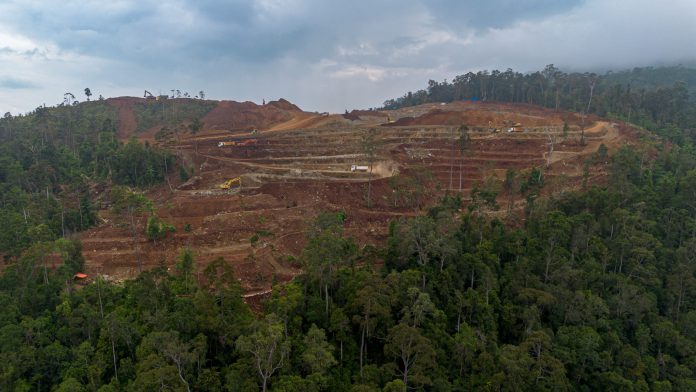
An environmental coalition and an opposition lawmaker warned that President Ferdinand Marcos Jr.’s new critical minerals policy could fast-track large-scale mining and put Indigenous peoples, farmers and local communities at greater risk.
Executive Order No. 122 establishes a national framework for developing the critical minerals industry as the government seeks to strengthen the Philippines’ position in the global green technology supply chain.
The order says the country has identified at least 9 million hectares of prospective areas with potential mineral resources. It provides for faster mining permits, accelerated privatization of government-owned mining assets and increased investment in mineral processing and downstream industries.
House Deputy Minority Leader and ACT Teachers party-list Rep. Antonio Tinio described the order as a “wholesale surrender” of the country’s mineral wealth to foreign and large mining companies.
“This Executive Order is a wholesale surrender of our national patrimony to foreign and big corporate interests. Despite its lofty language of industrialization and value-adding, the reality is that EO 122 reduces the Philippines to a source of cheap raw minerals for the global green technology value chain, while our people bear the brunt of environmental destruction and displacement,” Tinio said in a statement.
EO 122 identifies critical minerals as important to national security and development and as raw materials for industrial activities, including the clean energy transition, digital transformation and infrastructure development.
It directs the government to promote refining, advanced material processing and the manufacture of products such as batteries, electronic components and renewable energy technologies.
Tinio said provisions on national exploration, mineral reservations, the “Use It or Lose It” policy and the privatization of government-owned mining assets could accelerate the entry of large-scale mining into prospective areas, including agricultural lands and ancestral domains.
“The ones who will truly benefit from this policy are foreign corporations and big mining companies. They will extract our critical minerals, export them as raw materials, and leave our environment devastated and our people displaced. This is not industrialization—it is plunder,” he said.
Alyansa Tigil Mina, or ATM, also rejected EO 122, saying its emphasis on privatization and the expansion of mineral lands could threaten food and water security and pose health risks to affected communities.
The environmental coalition said Marcos’ push for critical minerals lacked a clear industrial policy and could create “sacrifice zones.”
ATM opposed a provision allowing areas covered by canceled, expired, relinquished, surrendered or otherwise freed-up critical mining tenements to be considered for declaration as critical mineral reservations.
The group also raised concerns over local autonomy, transparency and accountability. It said the reorganized Mining Industry Coordinating Council, or MICC, lacked civil society participation while providing for private sector representation.
ATM also criticized the absence of a mine audit, which it said should be required before the government proceeds with measures such as privatizing mining assets and declaring mineral reservations.
The coalition said the requirement that the MICC’s work be aligned with free, prior and informed consent guidelines failed to recognize what it described as strong opposition among Indigenous peoples to the revised FPIC guidelines.
EO 122 directs the Department of Environment and Natural Resources-Mines and Geosciences Bureau to streamline requirements and procedures for mining-related applications within six months, including the conduct of public consultation.
The order calls for simultaneous processing to replace the current sequential system, with clear timelines and an interagency monitoring committee for mining applications. A fully integrated digital platform covering national and local permits, licenses and regulatory clearances is to be operational within one year.
Tinio warned that faster processing could weaken meaningful participation by communities affected by mining.
“The so-called streamlining of the permitting process is a smokescreen for railroading mining projects without genuine community consent. It undermines the rights of farmers, indigenous peoples, and local communities who will be displaced from their lands and livelihoods,” he said.
Tinio also linked EO 122 to Pax Silica, arguing that the policy could facilitate projects supplying minerals to global technology and clean energy industries.
“Look no further than the Pax Silica project to see exactly who this EO is designed to serve. Pax Silica threatens to displace farming communities and destroy critical ecosystems, all to produce silica for foreign green energy supply chains. EO 122’s provisions on streamlining mining permits and declaring critical mineral projects as ‘national priority projects’ will be weaponized to ram through projects like Pax Silica, silencing community opposition and circumventing local government authority,” Tinio said.
“The Marcos Jr. administration is using the climate agenda and the rhetoric of clean energy transition to justify the plunder of our natural resources. Pax Silica is a glaring example of how ‘critical minerals’ development translates on the ground: foreign and corporate interests extracting our resources at the expense of our environment and the Filipino people,” he added.
ATM called on Marcos and the Department of Environment and Natural Resources to immediately open discussions with affected communities over ongoing barricades and legal challenges involving mining projects.