
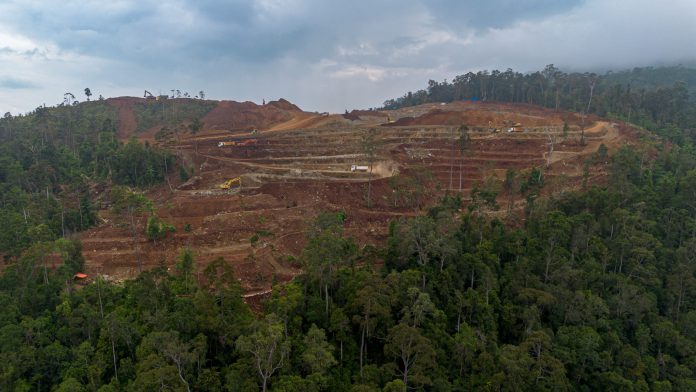
The Philippine government’s push to expand mining is increasing climate risks and exposing communities that oppose extractive projects to repression, despite the sector contributing less than 1% to the national economy, a climate advocate said.
Normel Bermundo, a climate justice and human rights advocate, said policies supporting large-scale mineral extraction have accelerated forest loss, weakened community rights, and placed environmental defenders and development workers at risk.
In an analysis published July 29, Bermundo cited Philippine Statistics Authority data showing that mining and quarrying contributed 0.95% to gross domestic product in 2023 and employed less than 0.5% of the country’s workforce.
The sector is projected to account for only 2% of GDP by 2028.
The Center for Environmental Concerns-Philippines said the country lost 1.6 million hectares of tree cover from 2001 to 2025, leaving forests on 24% of its land area.
CEC identified mining as a major cause of deforestation, citing 58,967.3 approved permits and 1.9 million hectares under unpermitted operations.
The figures were presented at a July 10 forum, “Plundered, Not Poor: State of the Philippine Environment 2026,” organized by CEC and the IBON Foundation.
The mining expansion comes as the Philippines faces more intense typhoons, faster sea-level rise, and extreme rainfall, according to the Organization for Economic Co-operation and Development’s 2026 economic survey.
The OECD said climate change posed growing risks to infrastructure, businesses, livelihoods, property, and ecosystems, with poor and vulnerable communities facing the heaviest losses.
Bermundo said the Mining Act of 1995 and Executive Order No. 130 have encouraged large-scale extraction at the expense of ecological protection, community rights, and land rehabilitation.
He cited exploration projects by UK-based Woggle Corp., a subsidiary of FCF Minerals, in Dupax del Norte, and North Luzon Mineral Resources Corp. in Kasibu, Nueva Vizcaya. Both projects face local opposition.
The Department of Environment and Natural Resources signed an agreement with the United States on Feb. 4 to support the processing of critical minerals and rare earths in the Philippines.
The agreement is part of the U.S. “Pax Silica” initiative launched in December 2025.
Bermundo said the agreement was presented as an economic partnership but “functions fundamentally as a U.S. strategy to secure control over the critical minerals supply chains.”
The Philippines is the world’s second-largest nickel producer, accounting for more than 10% of global production and holding the third-largest reserves, according to the analysis.
Bermundo also linked the extractive development model to the vulnerability of farmers and rural communities already struggling with landlessness and climate-related losses.
Government data cited in the analysis showed that 72% of farmers did not own land between 2012 and 2022. Agricultural damage reached ₱60 billion in 2024 after consecutive typhoons and El Niño.
Bermundo said the government responded with loan programs, including a $1 billion World Bank loan in 2025, instead of providing direct relief or carrying out structural land reform.
He said the continuing conversion of farmland and forests for commercial developments, industrial estates, dams, and coastal reclamation had further weakened the ability of communities to withstand climate disasters.
The government has promoted renewable energy, reclamation, large dams, and mining as part of its development agenda since President Ferdinand Marcos Jr. took office in 2022.
Bermundo said communities and civil society groups that challenged such projects had faced red-tagging, harassment, surveillance, arrests, and criminal charges.
Development workers providing humanitarian assistance, skills training, and support to local communities have also been targeted, he said.
“When civil society and frontline communities speak out against so-called development projects that undermine people’s rights and welfare, they face state repression through red-tagging, harassment, and criminalization,” Bermundo wrote.
“These projects are framed as ‘development,’ but the question is: for whom, and for what?” he added.
Bermundo urged the government to uphold the Supreme Court’s May 2024 ruling in Deduro v. Vinoya, which declared that red-tagging, vilification, and guilt by association violated a person’s rights to life, liberty, and security.
He also called for the passage of the Human Rights Defenders Protection Act and the People’s Mining Bill.
“The Philippine government should recognize CSOs not as threats, but as vital partners in environmental protection and genuine development,” Bermundo said.