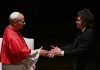
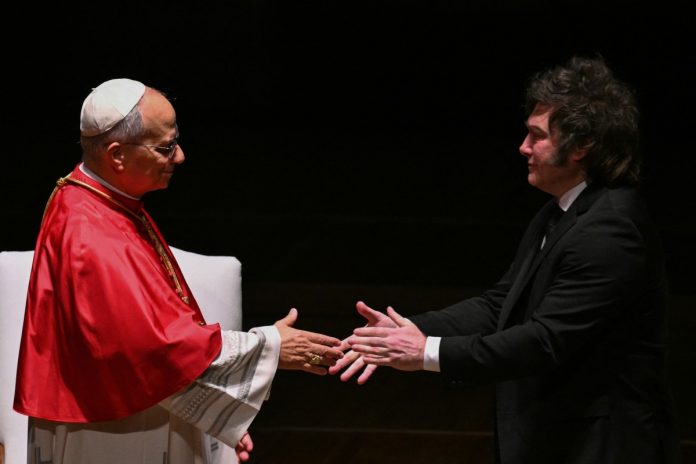
Addressing the authorities, civil society and diplomatic corps on Sunday at the Palacio Libertad in Buenos Aires, in his first address on Argentine soil, Pope Leo XIV outlined the responsibilities of those entrusted with public office. He urged them to place the common good above immediate interests and called on Argentina’s political leaders to exercise authority as a service to the entire community, highlighting the need to strengthen democratic institutions, promote economic opportunities and ensure that growth benefits all sectors of society.
Arriving in Argentina on the second leg of his Apostolic Journey, following his visit to Uruguay and ahead of his onward journey to Peru, Pope Leo said he had come as the Successor of Peter and as a pastor, wishing to address the entire nation and those who have the task of serving it.
READ THE FULL TEXT OF POPE LEO XIV’S ADDRESS HERE
Authority as service
Reflecting on Argentina’s history and democratic heritage, the Pope stressed that democracy must be safeguarded through dialogue, participation and respect for institutions.
It is strengthened, he said, by “willingness to listen, through careful use of words, through the patient search for agreement” and by recognising those with different views as fellow citizens sharing a common future.
And focusing on political leadership, he said: “Authority is most authentic when it is exercised as service, when it looks beyond the immediate, and when it uses its power to promote the welfare of all.”
Those exercising public office, he added, have a duty to act prudently, acknowledge the limits of their power and direct their decisions towards the good of the entire community.
Economic growth must benefit all
The Pope identified work as a fundamental element of the common good, recognising the efforts of those working in agriculture, industry, businesses, schools and hospitals, as well as those supporting their families.
He called for policies that “promote whatever creates opportunities, stimulates private initiative and ensures that economic growth also benefits those who are disadvantaged.”
He specifically mentioned families facing an uncertain future, the unemployed, the elderly, and those who, despite working hard, struggle to meet their household needs.
Pope Leo also challenged the country to reflect on the future of its younger generations, asking why so many feel compelled to leave their homeland to pursue their aspirations.
“A nation must seriously ask itself where it has failed when its young people have to leave their homeland to make their dreams come true,” he said.
Creating opportunities for young people to build their future in Argentina requires strengthening education, vocational training, universities, and research. It also means trusting their abilities and giving them a voice in public life.
“The nation needs to rely on their intelligence, creativity, and participation, starting now,” he said.
Integrity and stronger institutions
The Pope also called for greater cooperation among South American countries in confronting organised crime, human trafficking, arms and drug trafficking, and corruption.
These threats, he warned, “undermine social cohesion, fuel violence and divert resources necessary for the common good.” Coordinated action among States and stronger institutions are indispensable, he continued, and he pointed out that institutional credibility depends on the integrity of those who govern.
“Corruption undermines the confidence of citizens in their institutions,” he warned.
He also urged Argentina to preserve its tradition of dialogue and negotiation, insisting that the legitimate interests of nations must be defended through respect for the law and a constant effort to reach agreement.
A responsibility towards future generations
Pope Leo further called on political leaders to recognise the dignity of unborn children and safeguard human life from its earliest moments until its natural end. He urged particular concern for people affected by illness, dependency and disability.
He also highlighted environmental questions, noting that Argentina’s considerable natural resources offer significant possibilities for development, and insisted that their use must serve the wellbeing of communities and protect the conditions that make life and work possible.
In his long and wide-ranging speech, during which he was interrupted by applause on more than one occasion, Pope Leo also mentioned the ethical responsibilities arising from technological advances, particularly artificial intelligence, and he called for careful consideration of their consequences.
Concluding his address, the Pope returned to the responsibility of each generation to preserve and pass on the nation’s heritage.
“Much of that responsibility rests in your hands today,” he said, urging those present to bring to fruition what they had inherited and keep alive the commitment to “establish national unity” expressed in the preamble to Argentina’s Constitution.
“May those who come after you,” Pope Leo reiterated, “inherit a united homeland, worthy of its history and the possibilities it holds.”
This article was originally published on Vatican News. All copyrights reserved to the Dicastery for Communication – Vatican News. Unauthorized republication by third parties is not permitted.