A Philippine women’s rights group warned that expanding US military presence could expose Filipino women and children to greater risks of violence, displacement and human rights abuses as Washington strengthens defense ties with Manila.
The Center for Women’s Resources (CWR) said increased military cooperation, including joint exercises and the expansion of the Enhanced Defense Cooperation Agreement (EDCA), threatens communities already vulnerable to armed conflict and displacement.
The warning came during US President Donald Trump’s visit to the Philippines for the 49th Association of Southeast Asian Nations (ASEAN) Summit, which drew protests against Washington’s military and economic policies in the region.
CWR said women and children in militarized communities face heightened risks of harassment, sexual violence, trafficking and other abuses. It warned that military activities could displace families, damage the environment and restrict livelihoods.
The group cited figures from human rights organization Karapatan, which reported 11.3 million victims of threats, harassment and intimidation under President Ferdinand Marcos Jr.’s administration.
Karapatan also documented 49,459 victims of forced evacuation, many of whom were women, according to CWR.
The women’s group condemned the arrests of more than 200 protesters opposing Trump’s visit and the US-led Pax Silica initiative in Metro Manila on Nov. 15.
Farmers, Indigenous peoples, students, workers and human rights advocates were among those arrested as authorities tightened security ahead of Trump’s arrival, CWR said.
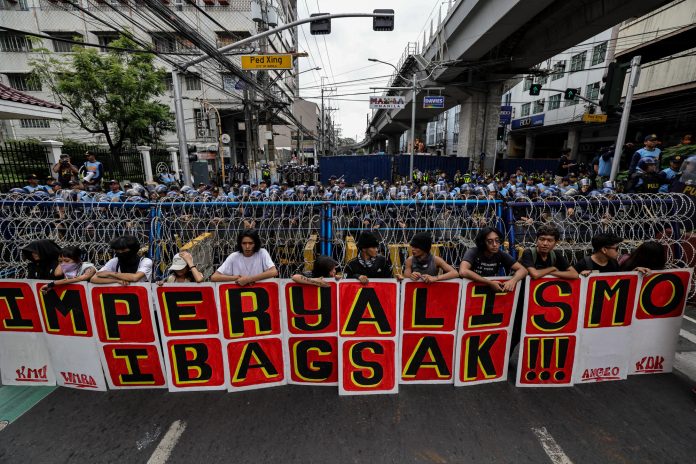
In a separate protest, more than 2,000 demonstrators gathered along Recto Avenue near Mendiola in Manila to oppose Trump’s visit, according to BAYAN Secretary General Mong Palatino.
Palatino condemned the police deployment of barbed wire, container vans and barricades that prevented protesters from reaching Mendiola.
He also challenged Marcos’ announcement that no Pax Silica agreement would be signed during Trump’s visit, saying the Philippines had already joined the coalition in April and signed a critical minerals agreement in February.
BAYAN demanded that the government withdraw from Pax Silica, halt construction activities at the planned industrial hub in New Clark City and release documents related to negotiations.
Palatino described the failure to sign the scheduled agreement as a temporary victory for protesters. He also criticized Trump’s position on tensions in the West Philippine Sea, arguing that increased US military deployments serve Washington’s geopolitical interests rather than Philippine territorial defense.
CWR raised concerns over the country’s growing dependence on US military power, accusing the Marcos administration of suppressing opposition to policies that threaten livelihoods, ancestral lands and national sovereignty.
The group questioned government spending priorities, citing a proposed ₱324.63 billion military budget for 2027 and a USD 2.5 billion US Foreign Military Financing package for the Philippines covering fiscal years 2026 to 2030.
It said the military allocations contrast with inadequate public funding for healthcare, education, housing and social protection.
“Genuine security must be measured by people’s ability to live free from poverty, hunger, violence, displacement, and exploitation – not by the number of military agreements signed, weapons acquired, or foreign troops deployed,” said CWR Executive Director Cham Perez.
US Ambassador Lee Lipton had reaffirmed Washington’s “enduring commitment to the Philippines and our shared vision for a peaceful, secure, and prosperous Indo-Pacific.”
CWR warned that expanding US military alliances must be examined against growing geopolitical rivalry and competition for influence in Southeast Asia.
It urged the Philippine government to end policies that intensify militarization and pursue an independent foreign policy centered on peace, national sovereignty and the protection of communities, particularly women affected by armed conflict.
All photos by Jire Carreon