On the evening of October 23, as the sun dipped below the horizon at Song Khon, the Sacred Forest settled into a deep stillness. Beneath the canopy, the setting felt less like a stand of trees than a living cathedral, holding memory and the weight of history.
Here, on the banks of the Mekong River roughly 600 kilometers northeast of Bangkok, a story of faith, courage and sacrifice was brought to life.
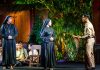
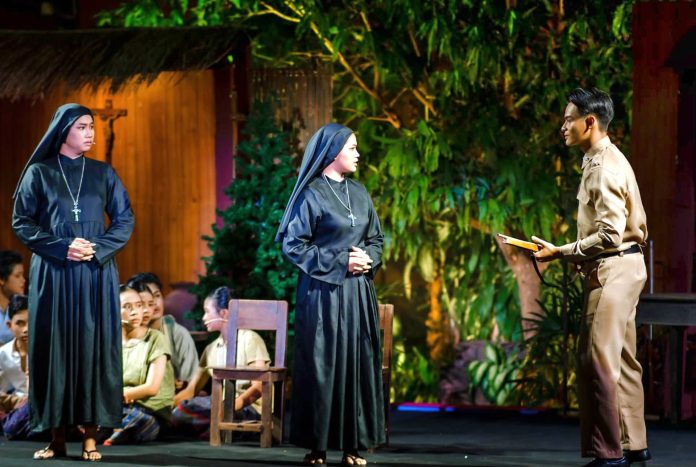
Commemorations of the 37th anniversary of the beatification of the Blessed Seven Martyrs of Song Khon coincided with the national Thai Laypeople’s Day, centered on an immersive, site-specific 75-minute dramatic production, “Echoes of Faith: The Blessed Martyrs of Song Khon.”
Drawing from events that took place 86 years ago in the small rice-farming village, the production combined theater, live choral harmonies and an original score to honor the first native Thais raised to the altars of the Catholic Church.
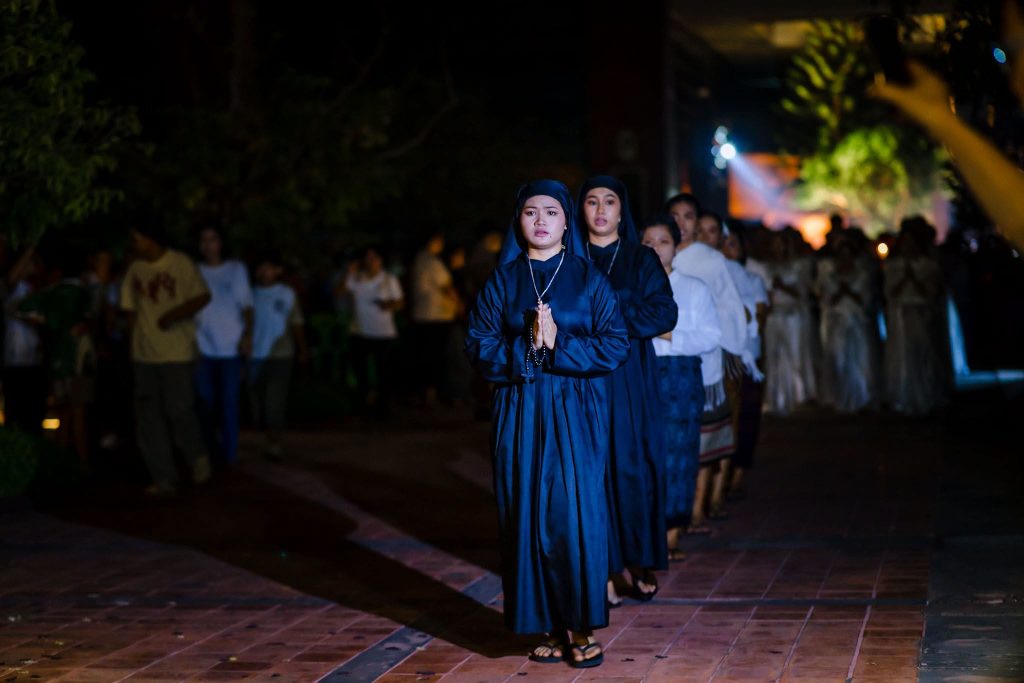
Unlike traditional theatrical presentations confined to a stage, Echoes of Faith unfolded on the historical grounds of the Sacred Forest itself.
The setting became part of the performance, drawing hundreds of audience members into a space where history and prayer converged.
Broadcast live nationwide, the production brought together more than 70 performers, including actors, a choir and a musical ensemble, supported by a production crew of more than 50.
Actors from St. Joseph Thare School and a local state university led the dramatic enactment, supported musically by students from Darasamutr School in Sri Racha and the Archdiocese of Tharae-Nongsaeng.
“Those bullets that claimed the lives of brave souls who defied gunfire, sustained by their faith—I find this premise alone to be incredibly compelling. Yet this is not merely a well-crafted novel or a piece of short fiction; it is a true story,” said Fr. Joseph Anucha Chaiyadej, executive director of Catholic Social Communication Thailand (CSCT).
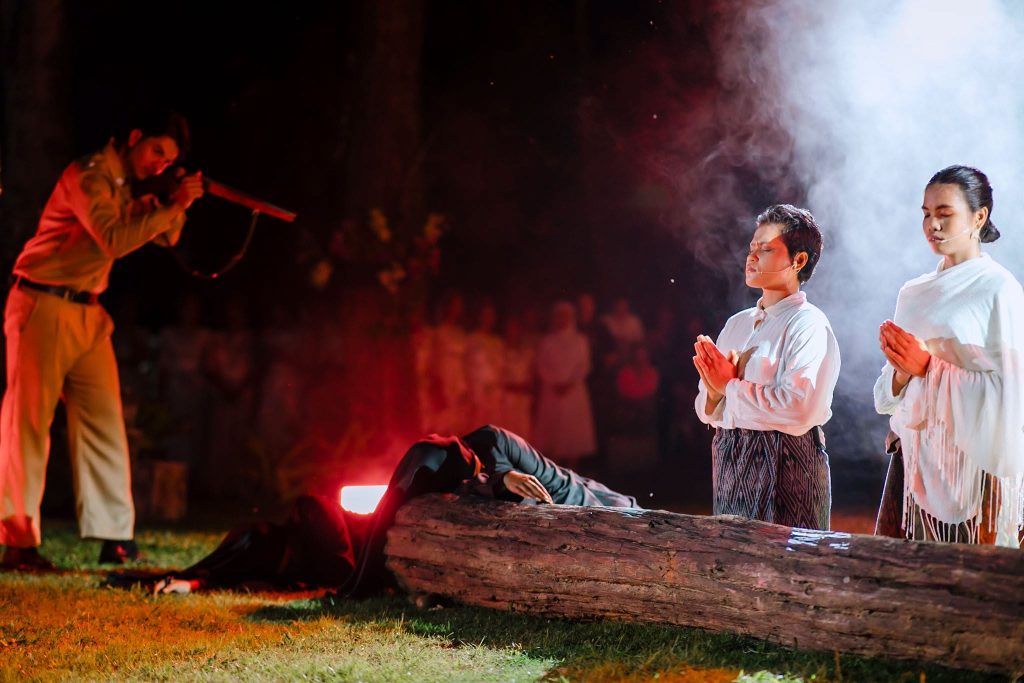
As the enactment moved toward its final moments, the boundary between theater and reality seemed to narrow. The production recreated the harrowing march of the condemned women as they walked through the village toward the cemetery.
In an unscripted moment, members of the congregation—led by Archbishop Anthony Veeradet Chaiseri of Tharae-Nongsaeng and Bishop Stephen Boonlert Phromsena of the neighboring Diocese of Ubon Ratchathani—joined the procession in silent prayer.
The crowd followed the cast to the execution site, watching in solemn stillness as the actors knelt to await the simulated volley of gunfire.
Behind the Canvas: The Creation of an Anthem
The idea originated with the Office for the Laity under the Catholic Bishops’ Conference of Thailand (CBCT), which sought to center the Thai Laypeople’s Day gathering at Song Khon, a place closely associated with lay witness.
When CSCT was asked to develop a faith-centered presentation, Archbishop Veeradet suggested a performance depicting the story of the martyrs.
Fr. Anucha, who wrote the script and composed the production’s central theme song, recalled how the creative process unfolded with a speed that felt guided from above.
The composition features live instrumentation alongside the vocal harmonies of a choir from a nearby Catholic school.
The emotional weight of the story also affected the performers.
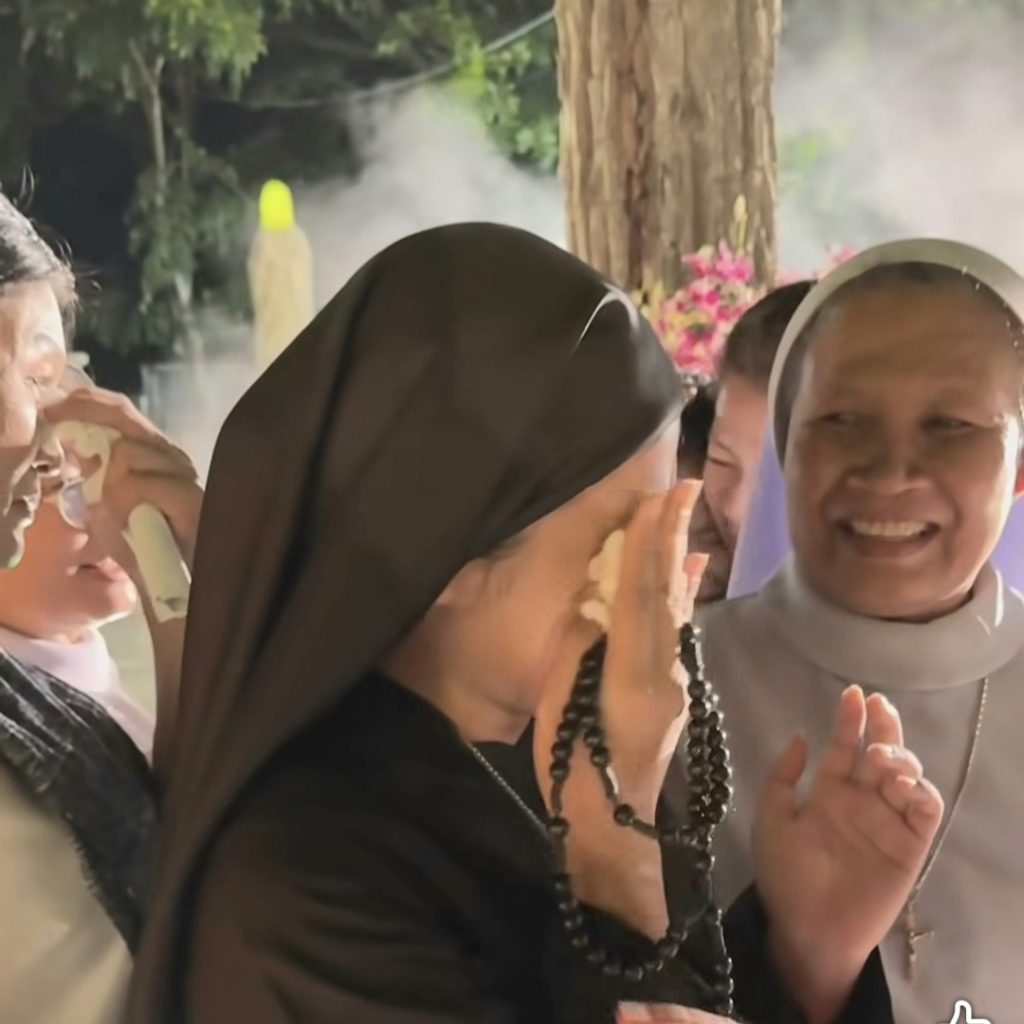
Although most of the cast members are not Catholic, the demands of portraying the historical figures drew them deeply into their roles. After the final curtain, actors remained in character, weeping and embracing one another on the forest floor as they absorbed the weight of the history they had reenacted.
The 1940 Persecution at Song Khon
The history revived on the Mekong shore dates back to 1940.
During the Franco-Thai War, rising anti-French nationalism fueled suspicion toward Catholic communities, many of which were ministered by French missionaries from the Paris Foreign Missions Society (MEP).
Foreign missionaries were expelled, Catholic schools closed, and local authorities pressured villagers to renounce their faith.
When the parish priest in Song Khon was forced out of the district, responsibility for the village’s spiritual life fell to the laity and native religious.
Philip Siphong Onphithak, 33, was a lay catechist and teacher who encouraged families under threat. Sr. Agnes Phila Thipsuk, 21, and Sr. Lucia Khambang Sikhamphong, 23, were religious sisters of the Lovers of the Holy Cross. Agatha Phuttha Wongwai, 59, Bibiana Khamphai Suwan, 15, Maria Phon Wongwai, 14, and Cecilia Butsi Wongwai, 16, were among the laywomen and girls who refused to abandon their faith.
Philip Siphong was lured out of the village and shot to death on December 16, 1940, becoming the group’s first martyr.
Ten days later, eight women and girls set out together from the village. Among them were two young girls named Cecilia.
As the procession moved through the village, the parents of young Cecilia Sorn Wongwai intervened and brought her home before the group reached the execution site.
Seven women continued to the cemetery in the Sacred Forest—the two religious sisters and five laywomen and girls.
Sister Agnes Phila had written a firm letter refusing to yield, affirming their unwavering devotion to God while maintaining their peaceful loyalty to their homeland.
The women knelt in prayer in the cemetery, where police opened fire. Six died at the scene. Cecilia Butsi Wongwai, 16, was wounded but survived the shooting and later lived as a witness to the events.
Together with Philip Siphong, the six women killed at the cemetery were recognized as the Seven Blessed Martyrs of Song Khon.
Following extensive documentation and witness testimony gathered over decades, Pope John Paul II solemnly beatified the Seven Martyrs of Song Khon on October 22, 1989, at St. Peter’s Basilica in Vatican City, marking the first time native Thai Christians were raised to the altars of the Church.
Today, the Shrine of Our Lady of the Martyrs of Thailand in Ban Song Khon stands as a national place of pilgrimage.
As the final notes of the theme song faded into the trees on October 23, the performance left the assembly not in sorrow but in quiet reflection—a reminder that while violence can silence a voice, the strength of faith can echo across generations.