
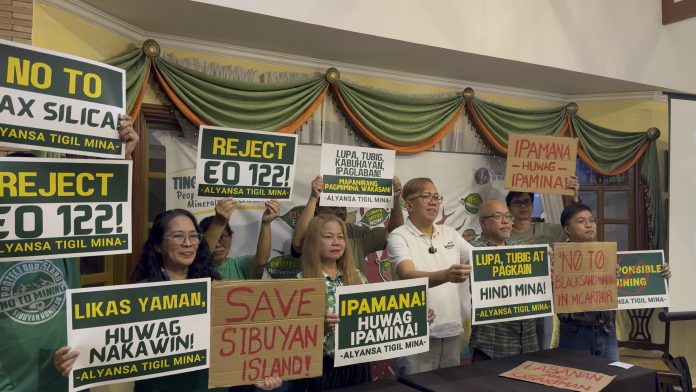
Environmental and human rights groups in the Philippines called on President Ferdinand Marcos Jr.’s administration to adopt and publicly disclose a national industrial policy before expanding critical-minerals extraction, warning that Executive Order 122 could deepen large-scale mining.
The groups raised the demand during the launch of Mining Hell Week, where they also criticized the government’s move toward an agreement on Pax Silica and called for alternative legislation governing mineral resources.
Alyansa Tigil Mina National Coordinator Jaybee Garganera said minerals extracted and processed in the country should support domestic industrialization rather than primarily serve major powers.
“It is essential for the Philippines to have its own industrial policy,” Garganera said, adding that mineral development should support national industrialization instead of “simply supplying the needs of superpowers.”
He warned that EO 122 could encourage further extraction without a broader policy on how mineral resources should be used.
“Without a national industrial policy to guide the utilization of minerals for the country, EO 122 will only serve to justify rampant extraction and enable sacrifice zones.”
Community leaders cited existing mining conflicts as evidence of the risks.
Elizabeth Ibañez of Sibuyanons Against Mining said the government had allowed mining on Sibuyan Island despite its biodiversity and community opposition. She also said the Department of Environment and Natural Resources had not acted on a petition seeking cancellation of the mining contract of Altai Philippines Mining Corporation.
In Masbate, Marylou Verano of Ang Aroroy ay Alagaan said mining had damaged water, food sources and livelihoods in Aroroy.
“Our waters have been poisoned, our food contaminated by toxic chemicals,” Verano said.
She said women often bear a disproportionate burden because they must cope with damaged livelihoods, unsafe food and water, and health problems in their families.
The groups called for the immediate passage of the Alternative Minerals Management Bill and launched “Tingog sang Katawhan,” or “Voices of the People,” to gather community demands on environmental and human rights issues.