A Vatican official urged Filipino Catholics to examine whether their participation in the Eucharist leads them to share with those in need, uphold workers’ dignity, protect creation, and pursue justice.
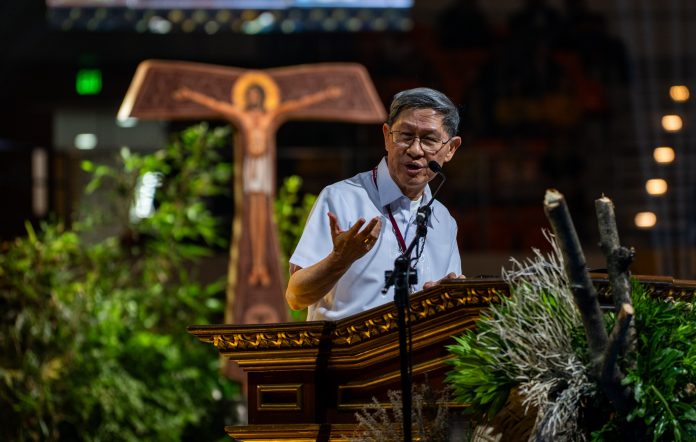
Cardinal Luis Antonio Tagle told participants of the 12th Philippine Conference on New Evangelization at the University of Santo Tomas in Manila on July 24 that the Eucharist cannot be reduced to ceremonies and religious practices detached from daily life.
“The Eucharist is a sacrament of love, of friendship,” Tagle, pro-prefect for the Section for First Evangelization and New Particular Churches of the Dicastery for Evangelization, told the gathering.
Reflecting on Christ’s words, “Remain in me,” during the Last Supper, Tagle described Christian life as an active response to God’s love.
“Remaining in Jesus means loving and love is active,” he told participants, adding that Christians remain in Christ “by loving.”
The prelate described the Eucharist as the remembrance of Christ offering his life as a friend for others, including those who considered him an enemy.
“No one has greater love than this. To lay down one’s life for one’s friends. And that is the Eucharist,” he said.
The cardinal cautioned Catholics against focusing on ceremonial details while ignoring the relationships the Eucharist demands.
“Kaya sana po, huwag lang natin titignan ng Eucharist as, a set of ceremonies,” he said. (“So I hope we do not look at the Eucharist merely as a set of ceremonies.”)
Tagle pointed to the early Christian communities in the Acts of the Apostles, whose members listened to the apostles, prayed, broke bread, and sold their possessions to support those in need.
As they broke the Eucharistic bread, he said, “they also break their riches,” ensuring that “no one was in need.”
He also recalled St. Paul’s rebuke of Christians in Corinth who gathered for the Lord’s Supper but refused to share food with one another.
“Kapag hindi nagpapansinan, kapag hindi nagmamalasakitan, sabi ni St. Paul, hindi Eucharist ang inyong pinagtiwang,” Tagle said. (“When people ignore one another and do not care for one another, St. Paul says what you celebrated was not the Eucharist.”)
Friendship, respect, and compassion, he said, are marks of a Eucharistic community.
Tagle urged Catholics who participate in the Eucharist to become “friends to one another in the Lord,” particularly through “generosity, in compassion, in works of justice.”
“At sana ang mga nasa Eucharist, gano’n din ang maging lifestyle,” he said. (“And I hope those who participate in the Eucharist will live the same way.”)
The cardinal also linked the presentation of bread and wine during Mass to the protection of creation and recognition of human labor.
The offertory prayer describes the gifts as the fruit of the earth and the work of human hands.
“Creation is fruitful, but it is intended by God to be shared by all,” Tagle said.
He said the presentation of the gifts should teach Catholics “to value creation, to work as stewards of creation” and “to recognize the dignity of human labor.”
Corruption, environmental destruction, hoarding, and the unjust treatment of workers are contrary to Eucharistic spirituality, he said.
“Part of our Eucharistic spirituality is to see in every laborer, every worker, a friend of Jesus whose work must be valued,” Tagle said.
He also urged Catholics to listen to the suffering of other people and the crises confronting the world, warning that attending Mass without listening to others is inconsistent with remaining in Christ.
“Nagsisimba nga. Pero hindi naman nakikinig sa hinaing ng mundo. Hindi naman nakikinig sa hinaing ng mga kapatid,” he said. (“They attend Mass, but they do not listen to the cries of the world. They do not listen to the cries of their brothers and sisters.”)
“E di, parang hindi rin tayo nanatili kay Jesus,” he added. (“Then it seems that we have not truly remained in Jesus.”)
Tagle described the dismissal at the end of Mass as a call to mission rather than simply the conclusion of a religious service.
“The Mass is ended. Go in peace. Go!” he said. “Be a missionary.”
Catholics are sent to proclaim the Word of God, care for creation and share the Lord they have received, he said.
“You spread the news about your best friend, Jesus,” Tagle said. “And you form communities and families of the friends of Jesus everywhere you go.”