
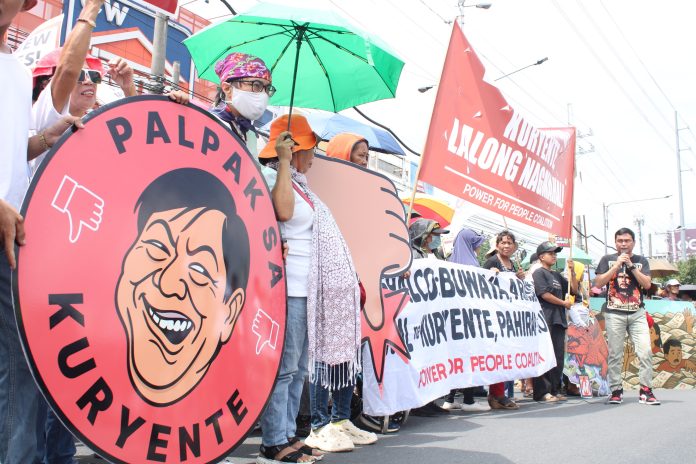
President Ferdinand Marcos Jr.’s proposal to remove system loss charges from electricity bills will not substantially reduce power costs without wider reforms to the country’s energy policies, a consumer advocacy group said.
The Power for People Coalition (P4P) welcomed Marcos’ call for Congress to amend the Electric Power Industry Reform Act, or EPIRA, but said the government must also address high generation charges and the country’s dependence on imported coal and gas.
“The elimination of system loss charges is a good step, but it’s absurd to present it as novel in his 5th SONA,” P4P convenor Gerry Arances said in a statement following Marcos’ fifth State of the Nation Address on July 27.
Arances said consumers had demanded the removal of unfair charges from electricity bills for decades.
“The administration cannot expect a pat on the back for too little too late–especially when it keeps ignoring the biggest extra charge in our power bills: high fuel costs,” he said.
During his address, Marcos called for the immediate amendment of EPIRA to prohibit utilities from passing system loss charges and the corresponding value-added tax on to consumers.
“Panahon na para tanggalin na natin ang systems loss na pinapasa sa konsyumer,” Marcos said. (“It is time to remove the system loss charges passed on to consumers.”)
System loss refers to electricity lost because of technical factors, such as heat in wires and transformers, and nontechnical causes, including pilferage.
Marcos said consumers should not be required to shoulder those costs.
“Pinapasa ito sa konsyumer at kinakarga sa bill na pinapatungan pa ng value-added tax. Hindi naman kasalanan ng konsyumer kung bakit nagkaroon ng systems loss. Kaya hindi naman tama na kailangan sila pa ang pagbabayarin dito,” he said. (“It is passed on to consumers and added to their bills, where it is also subjected to value-added tax. Consumers are not responsible for system loss, so it is not right to make them pay for it.”)
The president told Congress: “Therefore, we the people request–no, we demand for the immediate amendment of the EPIRA and to prohibit charging systems loss against consumers including the value-added tax thereon.”
P4P said an amendment limited to system loss charges would leave the larger problems in the power sector untouched.
The coalition blamed high generation rates on the country’s dependence on imported fossil fuels and policies that allow power companies to pass increases in fuel costs on to consumers.
“Because of our country’s grave dependence on imported coal and gas, consumers are paying for all-time high power generation rates, no thanks to power companies, who are enabled to pass these higher costs onto consumers,” Arances said.
P4P called for an overhaul of the wider policy and regulatory framework governing the electricity industry, not only the provisions covering system loss.
The coalition also welcomed Marcos’ recognition of renewable energy as a response to the energy crisis and his call for Congress to pass the proposed “Sariling Kuryente” Act.
The measure would seek to make household solar panels and battery storage systems easier and more affordable to install.
“Upang maging simple, madali, at abot-kaya ang pagpapakabit ng solar panels at battery storage system sa kanilang mga bahay, hinihiling ko ang tulong ng Kongreso para maipasa ang ‘Sariling Kuryente’ Act,” Marcos said. (“To make the installation of solar panels and battery storage systems in homes simple, easy, and affordable, I ask Congress to help pass the ‘Sariling Kuryente’ Act.”)
P4P, however, opposed the administration’s plans to pursue nuclear energy and expand gas development.
“Perhaps it is time for us to revisit nuclear energy production,” Marcos told lawmakers.
“We will ensure it is safe. We will ensure the good benefits of nuclear energy will be explained properly to the public,” he said.
Marcos also announced that hydrogen power projects were in the pre-development stage in Marinduque, Masbate, Zamboanga Sibugay, Basilan, and other areas.
P4P described nuclear power and further gas development as “dangerous and costly distractions” in a country with abundant renewable energy potential.
“If the government can allocate time and resources to be aiming to launch rockets into space, we can most definitely build a 100% renewable energy-based power sector,” Arances said.