There is chaos in the Philippine Senate, once a revered chamber of Congress where the rule of law was established and upheld. Its reputation has now been tarnished after shots were fired there, and Sen. Ronald “Bato” dela Rosa, former president Rodrigo Duterte’s first police chief and primary enforcer of his bloody war on drugs, escaped from the Senate premises more than a week ago to avoid arrest on charges of crimes against humanity under a warrant issued by the International Criminal Court (ICC). His escape was allegedly facilitated by some of his Senate allies.
Brave Filipinos who witnessed numerous killings have come forward to fight for justice and testify, many of them relatives of victims of the drug war. They found the courage to speak out despite threats from allies of the former president, who is set to stand trial before the ICC in The Hague, the Netherlands. His daughter, Vice President Sara Duterte, has also been impeached and is set to face trial in the Senate.
Other investigations into alleged corruption involving politicians and their cronies continue in Congress after billions of pesos allocated to flood-control projects were later discovered to be nonexistent. A former Department of Public Works and Highways district engineer in Bulacan has testified, while a former public works undersecretary has agreed to become a state witness. A former Bulacan assistant district engineer has admitted that projects were overpriced or nonexistent. Private contractors involved in flood-control operations have given explosive testimonies naming numerous lawmakers and public officials allegedly seeking payoffs. A whistleblower has also provided critical evidence involving cash-filled suitcases allegedly delivered to top political figures.
These revelations expose the depth of corruption in Philippine politics, where many legislators belong to families that form part of the ruling elite. They are members of a vastly wealthy oligarchy living in luxury while ruling a nation that has 12 to 15 dollar-billionaires and more than 12,800 dollar-millionaires. They could help reduce poverty if they chose to share more of their wealth and use it to ease suffering, promote justice, protect the environment, and defend human rights. They could also provide decent livelihoods and meaningful social development for the hundreds of thousands of workers employed in their companies.
In the Gospel of Saint Matthew, a rich young man approached Jesus of Nazareth and asked how he could gain eternal life. Jesus told him to live a virtuous life and obey the commandments, which the man claimed he already did. Seeing that the man was wealthy, Jesus did not condemn him for being rich, but advised him: “Sell your possessions and give to the poor, and you will have treasure in heaven. Then come, follow me.” (Mt 19:21)
Jesus wanted all people to have enough food, decent homes, education, and the opportunity to live in dignity and prosperity. That no one should live in poverty or hunger is one of his central teachings. To help the poor, he said, is to serve him himself. (Mt 25:31–46)
Poor, hungry Filipinos
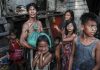
The oligarchy has helped create a nation where many families remain poor and hungry. The official poverty rate stands at 15.5 percent of the population, translating to around 17.54 million Filipinos living in dire poverty. Yet as many as 58.62 million Filipinos consider themselves poor. Many live in slums and shanty communities and struggle daily to feed their children. This level of inequality represents a grave social injustice and reflects the failure of both the ruling elites who control the government and the Church, which has often failed in its mission to challenge the structural injustice at the root of poverty in the nation.
Do these wealthy families who make up the oligarchy possess a conscience that can distinguish right from wrong, good from evil? With 58.62 million Filipinos going hungry each day, they appear to be choosing to ignore this dire reality.
Jesus said that unless the rich share their wealth with the poor, it would be extremely difficult for them to enter the Kingdom of God. Such sharing must go beyond charity or handouts. It means working with honest people and social movements to transform the structural injustice, inequality, and corruption that allow the greedy rich to become even wealthier. For many, such change seems nearly impossible, like threading a rope through the eye of a needle, as Jesus said. Yet faith in God and in Jesus calls people to work for good, oppose evil, and bring justice to others. As Saint James wrote, “faith without action is dead.”
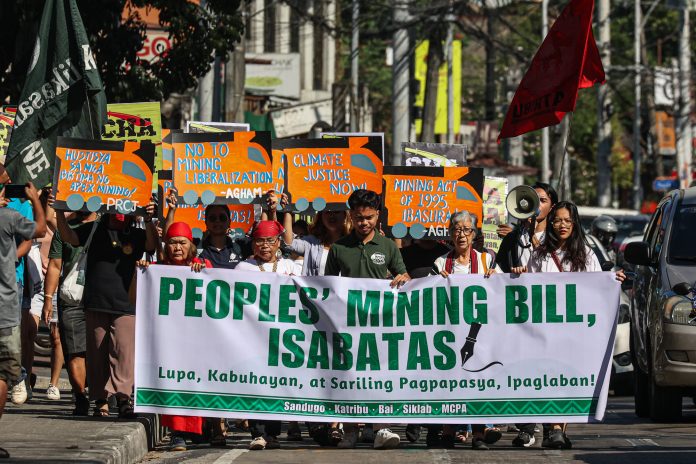
Dedicated Christians are taking action, performing courageous work to protect both the environment and vulnerable communities from exploitation. The Haribon Foundation and World Wide Fund for Nature have planted many native trees. These nongovernmental organizations work directly with Indigenous Peoples (IP) to secure land stewardship and sustainably map forests. Brave Filipinos in these organizations, including Alyansa Tigil Mina and Climate Rights International, document corporate violations, organize protests, and demand a halt to mining in key biodiversity areas and island ecosystems. They put themselves at risk in opposing large-scale nickel, gold, and copper mining operations in ecologically sensitive areas such as Palawan and the Caraga Region, where mining activities have caused severe soil erosion, river siltation, and toxic acid mine drainage. May their voices be heard and heeded.
Climate action networks, including Aksyon Klima Pilipinas and the Center for Environmental Concerns, have strongly protested government cuts to the 2026 environmental budget and opposed the construction of new fossil fuel plants. These organizations deploy decentralized off-grid solar and micro-hydro systems to remote island communities, bringing new opportunities and improved living conditions. They also conduct educational campaigns to accelerate the transition to localized renewable energy. Some groups install solar panels on buildings to help mitigate climate change. Coalitions such as the EcoWaste Coalition and Greenpeace continue campaigning against the construction of incinerators and pushing for a total ban on single-use plastics.
We are all challenged to become involved in ending poverty and injustice and in helping build a happier, more just, and more prosperous Philippines for its people.
Note: Any original information, stories, or news articles posted on this site that are authored by the Preda Foundation and Father Shay Cullen may be shared, copied, or reproduced without further permission, in support of truth, freedom of expression, and the public’s right to know.
LiCAS News was granted permission to republish and adapt this article by Father Shay Cullen in the spirit of truth-telling and the pursuit of justice.
Irish missionary Father Shay Cullen, SSC, founded the Preda Foundation in Olongapo City in 1974 to promote human rights and the rights of children, especially victims of sexual abuse.
The views expressed in this article are those of the author and do not necessarily reflect the editorial stance of LiCAS News.