As a Nobel Peace Prize laureate once said, “Technology is a useful servant but a dangerous master.”
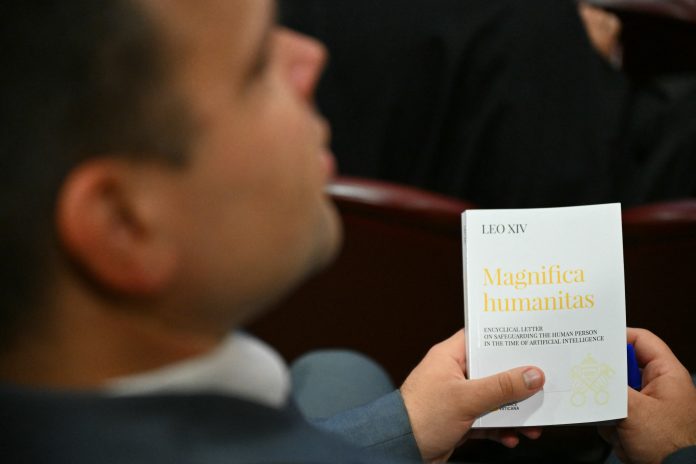
This also summarizes the central message of Pope Leo XIV’s first encyclical, Magnifica humanitas, published just after the conclusion of the 2026 Laudato Si’ Week.
It tackles the subject of artificial intelligence (AI) and whether its widespread global adoption will uphold human dignity and serve the common good.
Morally neutral?
Pope Leo XIV frames the buzz around AI as a pursuit of optimization, to the point of overcoming human limitations. It certainly appeals to corporations seeking to maximize profits at almost any cost. It is likewise attractive to people who want immediate answers to questions they cannot answer themselves.
There is nothing inherently wrong with AI as a technological tool. Much like previous innovations, from the creation of plastics to the rise of social media, it is intended to solve problems and make daily life simpler.
However, any technology is a “double-edged sword.” It can worsen lives as easily as improve them, depending on how it is used. In this context, technology is not morally neutral. The problem arises when AI is deployed without ethical frameworks and shared standards of social justice guiding the entire process.
It becomes a way for corporations to treat workers as disposable objects in the pursuit of greater gains or performance. It becomes dangerous when it is made widely accessible without fostering responsibility among users or strengthening their capacity for critical thinking. It becomes even more dangerous when it is used to distort truth and exploit the vulnerabilities of others for the benefit of the rich and powerful.
The promise of innovation is so appealing that many fail to recognize the hidden costs of these technologies. Every use of AI software consumes significant amounts of energy and water while contributing to greenhouse gas emissions. Many also fail to see what makes AI possible, from data labeling to the mining of rare earth elements, often involving unsafe working environments and low wages.
Without ethical standards and values, even the most innovative solutions can become false solutions. Development risks becoming centered on the accumulation of wealth, with people reduced to mere means to an end. AI could effectively become a substitute for human beings, but without the compassion, mercy, and other qualities that define our humanity.
Magnifica humanitas builds on what Laudato Si’ says about the technocratic paradigm, wherein the logic of technical efficiency and profit-making is allowed to dominate economic, social, and even personal decisions. It promotes the illusion of overcoming limits and even the myth of becoming limitless in a finite world, often at the expense of those considered expendable.
Finitude and beyond
Yet Pope Leo XIV argues that while humanity must strive to alleviate suffering, it is through our limitations that we recognize the dignity inherent in every person. This dignity is reflected in the choices we make, our understanding of our own worth, the way we treat others, and even in our very existence.
Upholding dignity requires applying social criteria to innovation in the workplace to ensure that, in implementing a just transition, no one is left behind. Such innovation must embody transparency, accountability, inclusion, access, and equity. These principles have long been recognized across many issues, but they are worth repeating in the context of the ongoing Fourth Industrial Revolution.
It is no coincidence that Pope Leo XIV published Magnifica humanitas 135 years after the last pope named Leo issued an encyclical that not only laid the foundation for modern Catholic social teaching, but also addressed the First Industrial Revolution. That period ultimately contributed to the current climate crisis, worsened by weak scientific awareness and, in recent decades, by the failure to impose regulations and accountability on polluters.
These multilateral shortcomings must not be repeated in dealing with AI and other digital advancements. Pope Leo XIV calls for sufficient regulatory mechanisms to uphold social justice and prevent distortions arising from technological power.
Through the principle of subsidiarity in the Church’s social doctrine, he also argues for transparency and accountability in how corporations manage expertise, data, and decision-making. While recognizing the right to private property, he reiterates that it remains secondary to the universal destination of goods, the principle that everyone has a right to the use of food, water, and other resources, both in the present and for future generations.
These principles do not apply only to the private sector. Governments must also enforce regulations addressing the many issues linked to digital advancements at both national and international levels. These include curbing disinformation, imposing stricter oversight on mining operations linked to data centers, stopping child labor in related industries, ensuring fair compensation, and improving working conditions for workers.
True development is not measured by economic gains or the speed of achieving results. Rather, it is about caring for our common home and for those who live in it, especially the most vulnerable. It is about understanding and living out our role as stewards of the world instead of acting as its masters. It is about recognizing that we are part of nature and acknowledging our deep interconnectedness.
Magnifica humanitas is ultimately a message of peace. In a world marked by conflict, tension, and distrust, there remains a possibility for peace through the fruits of justice and charity. Technology can help accelerate this, provided it is directed toward addressing the climate crisis, reducing inequalities, and advancing the common good.
Only by recognizing the magnificence of our humanity can we truly move toward the future we need.
John Leo Algo is the National Coordinator of Aksyon Klima Pilipinas and the Deputy Executive Director for Programs and Campaigns at Living Laudato Si’ Philippines. He has been representing Philippine civil society at UN climate and environmental conferences since 2016 and has worked as a climate and environment journalist since 2016.