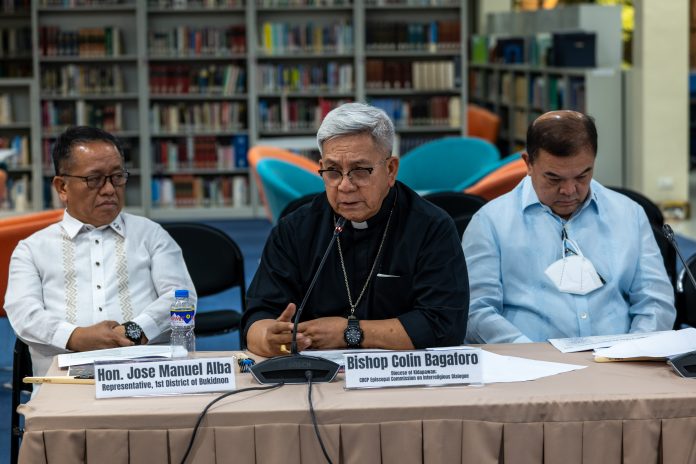
Philippine church leaders warned against what they described as “selective accountability” amid mounting corruption and accountability cases involving top government officials.
Bishop Jose Colin Bagaforo of Kidapawan, chairperson of the Episcopal Commission on Interreligious Dialogue of the Catholic Bishops’ Conference of the Philippines, said the rule of law loses meaning when powerful figures are shielded from scrutiny.
In a statement issued May 28, the prelate stressed recent controversies involving “several public officials, especially senators and the vice president of the Republic of the Philippines,” once again exposed how corruption continues to erode public trust and weaken democratic institutions.
Bagaforo, convenor of the InterReligious Leaders’ Council for National Transformation, said accountability “must apply to all — regardless of political affiliation, social status, popularity, or position in government.”
“Public office is a public trust,” he said, adding that those entrusted with greater authority carry “an even higher moral and legal responsibility before the people.”
The statement comes amid corruption controversies involving lawmakers and the impeachment proceedings against Vice President Sara Duterte.
Bagaforo called on institutions mandated to uphold justice and accountability, including the Ombudsman and the Sandiganbayan, to “relentlessly pursue all cases where there is probable cause and sufficient basis under the law.”
“The rule of law loses its meaning when exemptions are made for the powerful, the influential, or the politically connected,” he said.
Without naming specific officials, the bishop said there should be “no excuses in the exercise of the law” in cases involving corruption, abuse of authority, negligence of duty, and repeated violations of ethical standards expected from public servants.
“Accountability cannot be selective. Justice cannot depend on political convenience,” he added.
Bagaforo also linked the appeal to the recently reconvened Bishops-Legislators’ Forum on Integral Human Development, which seeks to promote ethical leadership and dialogue among government, church, and civil society leaders.
“At a time when public cynicism toward institutions continues to deepen, initiatives that encourage moral reflection, ethical leadership, and shared responsibility in governance become even more necessary,” he said.
The bishop urged Filipinos to remain vigilant and continue demanding integrity and transparency in public service.
“Citizens must continue to exert moral and democratic pressure against corruption in all its forms,” he said.
He also called on elected officials to show “delicadeza and a sense of shame when implicated in acts unbecoming of public office,” stressing that leadership is not only about legal survival but also “moral credibility and the preservation of public trust.”
Bagaforo ended the statement with a call to restore ethics and moral courage in governance.
“May this moment become not another cycle of public outrage, but a renewed call to restore ethics, responsibility, and moral courage in governance,” he said.