A humanitarian crisis refers to “an event or series of events that represents a critical threat to the health, safety, security or well-being of a community, a country or a large group of people.” In these difficult times of displacement, people need medical and funeral assistance, food and nutrition, housing and protection, or other basic necessities for survival.
At present, the United Nations has worldwide organizations that respond to such events through “disaster risk management,” including the United Nations Development Programme (UNDP), the United Nations High Commissioner for Refugees (UNHCR), the United Nations Children’s Fund (UNICEF), the World Food Programme (WFP), the World Health Organization (WHO), the International Organization for Migration (IOM), and the United Nations Population Fund (UNFPA), among others.
These international groups did not yet exist in St. Vincent’s time. Let me narrate what he did in order to cushion the impact of the humanitarian crisis that medieval France was experiencing.
1. THE ABANDONED CHILDREN [Foundlings]
One of the worst impacts of the humanitarian crisis was on children.
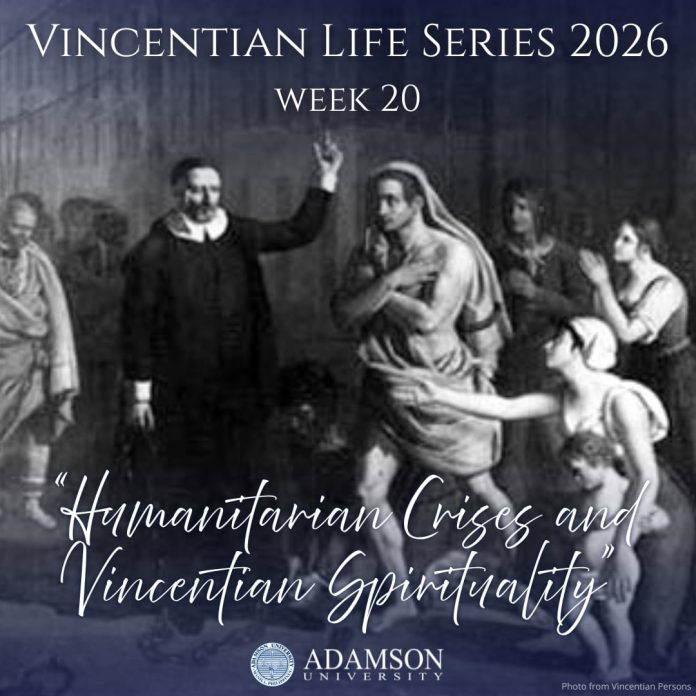
There were hundreds of abandoned children, called the “foundlings,” in Paris. Vincent took up the challenge of saving them. Initially, they stayed with the Daughters, then Vincent rented a house for them. But the number of children grew to 1,200, which became a logistical nightmare.
How did St. Vincent creatively solve the situation? This is the summarized account of Fr. Robert Maloney, CM:
“When Louis XIII died in 1643, a provision in his will permitted Queen Anne of Austria to assign a million dollars to Vincent as a stable endowment for his Congregation’s missions in Sedan. Vincent chose to use the money to build 13 small houses close to Saint-Lazare, the motherhouse of the Congregation of the Mission. He then rented them to the Ladies of Charity to use for lodging the foundlings. The regular rent money became the stable endowment to support the missions in Sedan. Notice how Vincent got two for one on the deal! The money from the king’s bequest bought the houses for the foundlings, and the rent money from the Ladies of Charity supported the missions in Sedan. But the number of foundlings continued to grow and funds to provide for them were difficult to find.”
In 1647, due to the pressure of caring for the growing number of foundlings, the Ladies of Charity considered abandoning the work. But Vincent’s appeal was deeply convincing. Before the wealthy Ladies, Vincent made them choose:
“Well then, Ladies, compassion and charity have led you to adopt these little creatures as your own children; you have been their mothers according to grace since the time their mothers according to nature abandoned them. See now whether you, too, want to abandon them. Stop being their mothers to be their judges at present; their life and death are in your hands. I am going to take the vote; it is time to pass sentence on them and to find out whether you are no longer willing to have pity on them. If you continue to take charitable care of them, they will live; if, on the contrary, you abandon them, they will most certainly perish and die; experience does not allow you to doubt that.”
2. REFUGEES AND BEGGARS: Responding to Other Ills
This work with abandoned children was one of St. Vincent’s crisis interventions on behalf of the homeless and marginalized.
Later in his life, St. Vincent responded to other pressing problems in society: prisoners known as the “galley slaves,” refugees displaced by the violence of war in the countryside, and the growing number of beggars in the cities.
For this, he mobilized a vast social network of clergy, religious, laypeople, and influential figures across France and beyond to aid the poor. Then came the establishment of the Association Internationale de la Charité (Ladies of Charity) in 1617, the Daughters of Charity in 1633, and the Congregation of the Mission in 1625, all of which continue to exist today.
Beyond these first organizations, the broader Vincentian Family network, including the Society of St. Vincent de Paul, Vincentian Marian Youth, and other groups inspired by the charism of St. Vincent, can easily account for 5 to 6 million volunteers worldwide across more than 100 organizations (cf. The Vincentian Family: famvin.org).
St. Vincent is known for being an effective “organizer.” In his Châtillon experience, his first assessment was: “This is not well organized.” He went about organizing pastoral structures in every mission, among beggars, ladies of the court, the clergy, and many others.
But there is another side, sometimes overlooked, to Vincent’s ministry: its affective component. If mercy is the “visceral love” of God, gushing forth “from the depths naturally full of tenderness and compassion,” like the love of a father or mother “moved to the very depths out of love for their child” (Misericordiae Vultus, 6), Vincent was among the first to express it concretely.
Vincent says:
“We cannot see our neighbor suffer without suffering with him” (SV XII, 270).
Elsewhere he says:
“The poor people who don’t know where to go or what to do, they are suffering and their numbers increase every day; these are my burden and sorrow” (Roman, 559).
3. CORPORAL AND SPIRITUAL WORKS OF MERCY IN OUR TIMES
In Misericordiae Vultus (2015), Pope Francis called for a rediscovery of the corporal and spiritual works of mercy. These works are not foreign to Vincent’s Little Company.
From a contemporary perspective, these traditional categories can be rethought through both their personal and social dimensions, both of which remain relevant and necessary.
For instance, the corporal works of mercy, even while retaining their traditional expressions, can be recast into structural forms of advocacy.
“Feeding the hungry” can take the form of ensuring global food sustainability. “Giving drink to the thirsty” can also mean ecological advocacy against the incursions of powerful mining and logging companies into watersheds that provide water to communities. “Clothing the naked and sheltering the homeless” means not only occasional dole-outs but also working with grassroots communities in their struggle for land rights and sustainable housing programs. “Comforting the sick and burying the dead” can mean fighting for accessible health care and affordable medicine, especially for the poor. “Visiting the prisoner” can also mean working for a more just legal and judicial system that does not send innocent people to prison.
The spiritual works of mercy, such as “instructing the uninformed,” refer to relevant work in education and the empowerment of women at a time when gender equality in primary education remains a United Nations goal. “Admonishing sinners and comforting the sorrowful” can refer to counseling work, psycho-spiritual interventions during calamities, and accompaniment of young people and those in difficult circumstances. “Forgiving injuries and bearing wrongs patiently” can take the form of listening to pain and supporting truth commissions or reconciliation processes in post-conflict situations. “Praying for the living and the dead” refers to the ever-relevant dimension of prayer, contemplation, and dialogue in crisis situations and in everyday life.
In his letter to the Vincentians during the 400th anniversary of their founding, the late Pope Francis quoted St. Vincent, who advised his followers “to seek out the poorest and most abandoned” anywhere, anytime, everywhere, every time.
“Come, let us devote ourselves with renewed love to serve persons who are poor, and even to seek out those who are the poorest and most abandoned.”
(St. Vincent de Paul, Conference 164, January 1657)
Father Daniel Franklin Pilario, C.M., is the President of Adamson University in Manila. He is a theologian, professor, and pastor of an urban poor community on the outskirts of the Philippine capital. He is also the Vincentian Chair for Social Justice at St. John’s University in New York.