A priest representing Caritas Philippines urged Senators to confront fossil fuel-driven generation charges behind rising electricity costs, warning that consumers are bearing the burden of the country’s dependence on imported coal, gas, and oil.
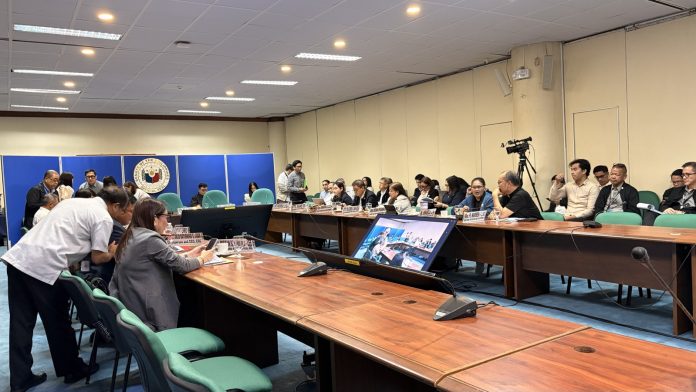
Fr. Warren Puno of the Diocese of Lucena made the appeal during a Senate hearing on electricity prices on May 18, cautioning lawmakers against limiting reforms.
“We strongly demand that the most expensive pass-through charge be addressed: the one embedded in the generation charge, which accounts for more than half of the electricity bill,” Puno said.
The priest delivered the statement on behalf of Bishop Gerardo Alminaza of San Carlos, president of Caritas Philippines.
Puno linked the country’s recent power outages and rising electricity prices to continued dependence on imported fossil fuels.
“The energy crisis exposed that ordinary people are the ones suffering most from our continued dependence on imported coal, gas, and oil for electricity,” he said. “These are not only unreliable, but also extremely expensive.”
Puno pointed to the reported death of an elderly man who was unable to use a nebulizer during last week’s rotating brownouts and extreme heat.
“Electricity is especially important for vulnerable sectors. It is necessary for a decent life for everyone,” he said.
Puno said consumers shoulder additional costs whenever global fuel prices spike because pass-through mechanisms are embedded in power supply contracts.
“Every time the prices of coal, gas, and oil surge in the global market, consumers bear the added cost because it is allowed in the contracts of distribution and generation companies themselves,” he said.
The priest also criticized the continued expansion of coal projects, including the proposed 1,200-megawatt coal plant in Atimonan backed by Meralco and the Department of Energy.
“In our town of Atimonan, Meralco, with the blessing of the DOE, continues to push for the construction of a 1,200 MW coal plant that we have long opposed,” he said.
“Beyond being destructive to the environment and climate, it will simply become another source of automatic fuel pass-through charges that Meralco will pass on to consumers,” he added.
Puno said lawmakers should not allow energy firms to profit while consumers struggle with rising power costs.
“If our lawmakers truly want to provide relief to consumers, the extremely high generation cost should not be set aside,” he said.
“Ordinary people should not be made into a source of profit during a crisis.”
The priest also defended community-led rooftop solar initiatives following recent remarks by Meralco referring to informal solar installations as “guerrilla solar.”
“The Church has been working for years to establish solar rooftops in parishes, dioceses, and communities,” Puno said.
“Solar should not be suppressed, but supported,” he added.
He urged the government to focus on public education and financing mechanisms that would allow households to install rooftop solar systems safely and affordably instead of imposing additional restrictions.
Puno also called on the government to fund large-scale rooftop solar deployment as part of the country’s emergency energy response, particularly in poor and off-grid communities still dependent on oil and bunker fuel.
“The government itself should become aggressive in the deployment of solar, especially for vulnerable sectors, the poorest communities, and off-grid areas,” he said.
Puno ended his remarks by urging lawmakers to accelerate the country’s transition to renewable energy to shield Filipinos from future energy shocks.
“We ask our lawmakers to pursue long-term protection for Filipinos from future crises by accelerating and raising the country’s ambition for renewable energy,” Puno said.
“Our people must break free from expensive and unreliable electricity from coal, gas, and oil.”