The Philippine government invoked the deaths of drug war victims and described Sen. Ronald “Bato” Dela Rosa as a “fugitive from justice” in a Supreme Court filing seeking to clear the way for the enforcement of an International Criminal Court (ICC) arrest warrant against the former police chief.
In a 77-page comment filed through the Office of the Solicitor General (OSG), government lawyers argued that Dela Rosa could not seek judicial protection while allegedly evading arrest over crimes against humanity charges linked to the Duterte administration’s anti-drug campaign.
The ICC last week unsealed an arrest warrant accusing Dela Rosa, former president Rodrigo Duterte, and other alleged “co-perpetrators” of the “crime against humanity of murder.”
“By his own conduct, he has placed himself outside the protection of the law,” Solicitor General Darlene Berberabe said in the May 16 filing.
“Until he submits himself to lawful authorities, he must be deemed a fugitive from justice and should not be allowed to seek any relief from the courts,” the document read.
The filing sharply contrasted Dela Rosa’s appeal for constitutional protections with the experience of victims killed during anti-drug operations under Duterte.
“What makes this especially painful is the stark contrast with the experience of countless victims of Tokhang,” the OSG said.
“They were never afforded the luxury of interpreting the law for themselves, never given the opportunity to question whether force should be used against them, never heard before judgment was effectively carried out,” it added.
“Their judgment was unilaterally issued, not by competent judicial authority, but by those who pulled the trigger,” the OSG continued. “They ended up dead, forever silenced, their deaths too often reduced to a single phrase: ‘nanlaban.’”
Dela Rosa, who served as Philippine National Police chief from 2016 to 2018, has challenged the ICC proceedings before the Supreme Court, arguing that the tribunal lost jurisdiction after the Philippines withdrew from the Rome Statute in 2019.
The government rejected that argument, saying the country remains obligated to cooperate in proceedings initiated before its withdrawal.
“Withdrawal from the Rome Statute does not relieve a State Party from cooperating in proceedings already initiated before the ICC,” the OSG said, citing the Supreme Court ruling in Pangilinan v. Cayetano.
Government lawyers also argued that Philippine authorities may enforce the ICC warrant under Republic Act No. 9851, the domestic law covering genocide, war crimes, and crimes against humanity.
“The ICC warrant against Senator Dela Rosa does not require validation by a domestic court to be enforceable,” the OSG said.
The OSG recounted Dela Rosa’s role in implementing “Oplan Double Barrel,” the nationwide anti-drug campaign launched shortly after Duterte assumed office in 2016.
It cited official figures placing drug war deaths at more than 6,000, while noting independent estimates reaching as high as 30,000.
The government also cited Dela Rosa’s public defense of the campaign, including a 2024 statement in which he said: “No regrets. Given the chance to do it again, I will do it again. The same approach.”
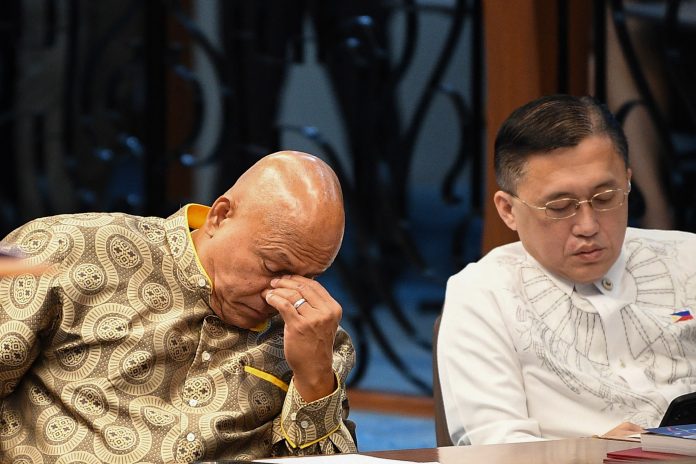
The filing came days after Dela Rosa briefly stayed inside the Senate amid reports that authorities were preparing to serve the ICC warrant.
Senate leaders placed him under “protective custody” before he later left the Senate premises. His whereabouts remain publicly unknown.
Duterte was arrested in March 2025 and transferred to The Hague, where he remains in ICC custody awaiting trial.