Church leaders have renewed calls to halt large-scale mining in Nueva Vizcaya, warning that the projects endanger the province’s watersheds, forests, and Indigenous communities, who have long safeguarded their ancestral land.
Bishop Elmer Mangalinao of Bayombong condemned the continued entry of mining companies into what he called the “Watershed of Region II,” saying the province has already suffered from years of extractive operations.
“There are already two big mining companies here — OceanaGold in Barangay Didipio, Kasibu, and FCF Mining Company in Quezon,” Bishop Mangalinao said during the program Barangay Simbayanan on Radyo Veritas 846.
“This FCF, together with Woggle whose term is about to end because they can no longer extract minerals from their area, now want to dig on the other side. They want to bore and destroy the villages,” he added.
The prelate said about 15 more companies are applying for mining permits in different parts of the province. He warned that if allowed, these projects could devastate Nueva Vizcaya’s mountain ecosystems.
He also questioned the Department of Environment and Natural Resources (DENR) for issuing permits in watershed zones.
“That’s what puzzles us. What is the DENR for? I don’t think they understand the reality of our situation,” he said. “The mere designation of ‘watershed’ should already mean that no one is allowed to destroy it, but they are giving licenses and rights.”
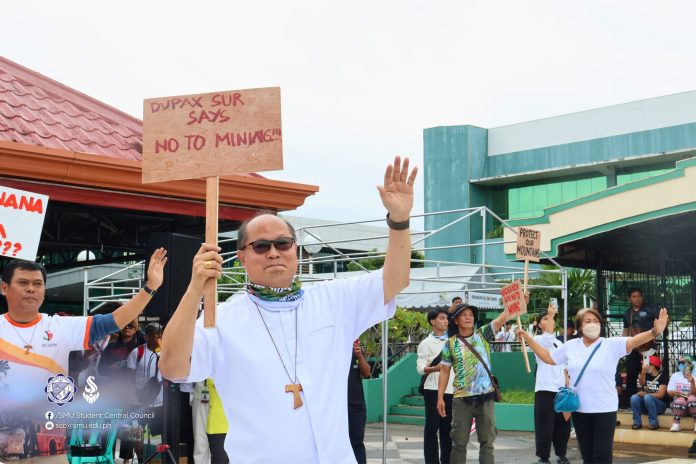
Bishop Mangalinao praised local officials who have opposed mining projects and said the Church continues to stand with residents resisting extractive operations.
The diocese has held protest rallies and plans to organize a peace march with faith-based groups while communities maintain barricades in affected areas.
He lamented a court decision that issued a temporary restraining order against residents instead of mining companies. For locals, he said, the mountains “are not merely a source of livelihood but a foundation of life, culture, and home.”
“The true development,” the bishop added, “does not come from mining but from caring for the environment that gives life to all.”
Echoing the bishop’s message, the Catholic Educational Association of the Philippines (CEAP) expressed solidarity with the people of Nueva Vizcaya.
“Nueva Vizcaya stands on sacred ground, home to fertile farmlands, rich forests, and Indigenous communities who have long protected this land,” CEAP said in a statement.
“Yet in Dupax del Norte, a British mining company has been granted exploration rights covering 3,102 hectares for gold and copper, threatening the watersheds that supply the Magat and Cagayan Rivers and the farms that feed Luzon. This is not progress, it is peril disguised as promise!” the statement read.
The group urged the faithful to heed “the cry of the earth and the poor,” calling on citizens to pass on to future generations “a living inheritance, not poisoned rivers, barren hills, and broken spirits.”
CEAP appealed to the local government of Nueva Vizcaya to suspend destructive mining and hold public consultations, and to the DENR to “fulfill your mandate to safeguard ecological balance and let integrity guide every signature.”
It also urged Catholic schools to form the next generation of ecological stewards and encouraged the youth to “use your voice, your platforms, and your creativity to mobilize your peers.”
“Refuse silence. Join local assemblies, sign petitions, and monitor violations. Choose leaders who value life over profit,” CEAP said.