As we commemorate the dead, we need to remember the thousands who died unjustly in our midst. The mothers and orphans of extrajudicial killings often say: “Hindi sila lubusang mananahimik hanggang hindi nila matamasa ang katarungan.”
“Hanggang gumagala ang mga pumatay sa kanila,” they continue, “gumagala pa rin ang mga kaluluwa nila.” To seek justice even after death is a human longing for God’s vindication in this life and the life to come.
In almost all the wakes of EJK victims which I attended, you will see chicks on top of their coffins. I asked one mother what it means: “Habang tinutuka ng sisiw ang mga palay, tinutuka din nila ang budhi ng mga pumatay sa kanila. Hindi makakalayo ’yon — susuko o di kaya ay mahuhuli ’yon.”
The “chick” is the victim’s deep prayer for poetic justice — that God will vindicate them and render them peace. In Christian theology, injustice is not the last word. God’s kingdom is a kingdom of justice and peace. That is what the widows and orphans pray for in the words of the Our Father: “Let your kingdom come — on earth as it is in heaven.”
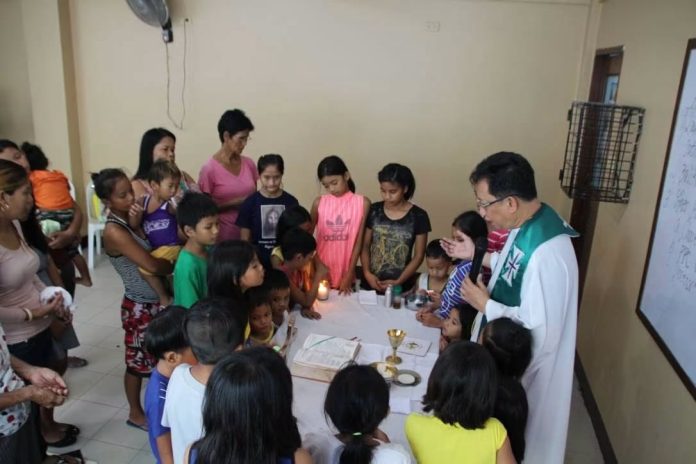
I once facilitated a trauma healing session around this time (All Souls’ Day) with orphans of extrajudicial killings. I asked them to write a letter to their fathers. These are some excerpts.
“Pa, mahal na mahal kita. Alam mo Pa, noong buhay ka pa, sobrang alalang-alala ako sa ’yo kasi mahal na mahal kita…”
“Papa, pinapangako ko po sa iyo na lahat ng gusto mo po para sa akin at sa mga kapatid ko ay matutupad dahil ikaw ang nagsilbing inspirasyon. Ikaw ang nagbigay ng dahilan para sa laban na kinakaharap namin…”
“Kunti lang pinagsamahan natin pero maraming salamat sa ’yo, Pa. Kung may pagkakataon na magkita tayo kahit saglit lang, may hiling ako sa ’yo na yakapin ka. Ilang taon na po pala mula nang ikaw ay lumisan. Ang hirap ng walang Tatay pero sige lang, wala naman po akong magagawa…”
The Duterte regime has demonized these victims as “animals,” “subhuman,” “rapists,” “hopeless cases,” and people who “could no longer change.” But in the eyes of the children, these fathers selflessly “poured their own blood” for the persons they loved.
They were not perfect, simple men, living their simple lives. Maybe some of them used drugs; many also did not. In the Truth Commission hearings, one young man was so sickly and was just doing the household chores his whole life. Another was a PWD and was asked by his mother to buy meds for her. Kian was a schoolboy who just wanted to take his exams the next day. One was the only son who supported his ailing mother. Juan just came home to celebrate the birthday of his daughter with spaghetti. And then he was shot in front of them.
In an article I wrote recently, I argued that these victims shall be considered martyrs — not because they were killed out of outright hatred of the faith, “in odium fidei” (as in the traditional category of martyrs in the church), but out of hatred for love and compassion — “in odium amoris” or “in odium misericordiae.”
Their deaths were not as dramatic; their lives were so ordinary, commonplace and unheroic. But they also equally met violent deaths as they expressed their commitment and fidelity to their families and friends. Many of them were ordinary sons, fathers or laborers — working with meager incomes for their families.
Some of them were not even pious nor were staunch defenders of the faith. They were merely doing what an ordinary human person was expected to do: to love their neighbor, to take care of their families, to show compassion to someone in need, to be of help in any way whatsoever. They were killed “on duty,” as it were.
I would like to say that there is a great Christian sense in ordinary expressions of love, of small narratives of everyday justice, of everyday lives of fidelity among the simple and the ordinary. They faced their violent deaths not as resolutely, but even very hesitantly. If they were given a chance to escape, they probably could have.
But their dedication and fidelity to their loved ones and neighbors were ultimately non-compromising. Their violent deaths were signs of their Christian love for the neighbor in living out the way of compassion carved out by Jesus himself.
José Ignacio González Faus, the Spanish theologian, describes these martyrs as “witnesses to love,” “killed by the hatred of love.” The Latin American Jesuit martyr Ignacio Ellacuría calls them “crucified peoples.” I call them “martyrs at the margins.”
May justice be rendered to them and their grieving families. And may they rest in God’s peace.
Father Daniel Franklin Pilario, C.M., is the President of Adamson University in Manila. He is a theologian, professor, and pastor of an urban poor community on the outskirts of the Philippine capital. He is also the Vincentian Chair for Social Justice at St. John’s University in New York.