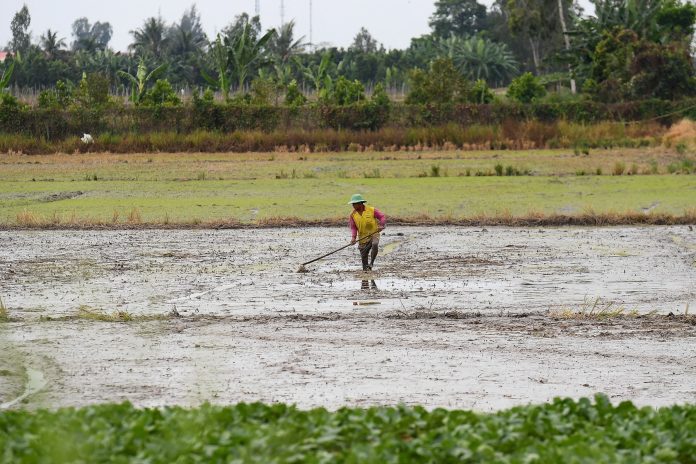
Farmers in Viet Nam’s Mekong Delta turned to rice-shrimp farming and other climate-resilient practices as rising seas, saltwater intrusion, and upstream dams disrupted the river system that had long sustained one of Asia’s major food-producing regions.
UN News reported Oct. 10 that the delta was facing growing pressure from climate change, declining freshwater flows and a sharp reduction in sediment reaching its coast.
“The timing, the strength of floods, how hot it’s going to be and when have become harder for farmers to predict. Because all this determines when they plant their crops,” said Jack O’Connor, a marine ecologist at the United Nations University’s Institute for Environment and Human Security in Bonn.
For generations, farming in the delta depended on seasonal floods that carried freshwater and sediment across its low-lying landscape and helped make Viet Nam one of the world’s leading rice exporters.
That cycle has become less reliable as sea levels rise and patterns of drought and flooding become harder to predict.
Vietnamese authorities also warned this year that El Niño could bring prolonged heat, reduced rainfall and worsening saltwater intrusion, potentially threatening hundreds of thousands of acres of rice in the delta.
The Mekong Delta is also home to large Indigenous Khmer, Hoa and Cham communities.
Viet Nam’s 2019 census recorded 1,141,241 Khmer people in the region, according to a 2025 study using census data. The study said Khmer communities were concentrated mainly in rural areas of Soc Trang, Kien Giang and Tra Vinh, as well as parts of An Giang.
Separate research has documented the climate vulnerability of Khmer farming households in the delta. A study of 426 households in Tra Vinh, Soc Trang and Kien Giang found varying levels of livelihood vulnerability, with households in Tra Vinh facing significantly higher vulnerability than those in the other two provinces.
Upstream dams have added to the pressure on the delta by trapping much of the sediment that once traveled downstream.
A scientific study published in 2021 and cited by UN News estimated that sediment reaching the delta had fallen from about 143 million metric tons two decades earlier to around 32 million tons.
O’Connor said wetlands and mangrove forests normally trap sediment along the coast, helping the land gradually rise and providing a natural defense against higher seas.
But when dams interrupt that process, “you have reduced freshwater supply and you have reduced sediment supply,” he said. The sediment, he added, is “valuable for keeping the coastline able to keep track with sea level rise.”
Saltwater has also moved farther inland during dry periods, affecting rivers, canals and groundwater used for agriculture.
Authorities sometimes close sluice gates when salinity levels become too high to safely irrigate rice fields. Farmers, however, can then face another problem — having too little water for their crops.
“They’re worried about the salt on their crops, but they’re even more worried about the fact that if they don’t have any water, there’s no crop,” O’Connor said.
Some farmers have responded by adapting their production to brackish conditions rather than trying only to keep saltwater out.
In parts of the delta, farmers alternate between growing rice and raising shrimp on the same land. Rice is cultivated when conditions are fresher, while shrimp, which can tolerate brackish water, are raised as salinity increases.
Farmers are also increasingly adopting organic methods that use fewer chemical fertilizers and pesticides.
Research by O’Connor and his colleagues found that organically grown plants showed signs of greater strength, while fields cultivated without chemical pesticides supported greater biodiversity.
Researchers found that dragonflies were more abundant in organic fields. Spiders and other natural predators were also more plentiful, while fish and crabs in rice paddies could provide farmers with food or another source of income.
The benefits of individual changes, however, were limited by the interconnected waterways of the delta.
An organic farmer can stop using chemical fertilizers and pesticides, but water entering the field may already have passed through conventional farms.
“In the lab, it looks very good. In the field, it has these challenges,” O’Connor said.
He said addressing the changes facing the delta required action beyond individual farms.
“It starts with individuals, but it really needs collective effort and wider-scale cooperation,” O’Connor said.
Farmers can change what happens on their own land, but many of the forces reshaping the delta lie beyond their control, including neighboring agricultural practices, water-management decisions, upstream dams and a warming planet.
Restoring mangrove forests could also help trap sediment and buffer coastlines, although such efforts can compete with farms for increasingly valuable land.
O’Connor said adaptation measures must involve the people who depend on the landscape.
Restoring mangroves for climate adaptation “has to be done in a just way and with the local people on board,” he said.