A Vatican official urged Asian Catholic digital missionaries to resist measuring evangelization by follower counts and to use artificial intelligence with greater discernment.
Dr. Natasa Govekar, director of the Theological-Pastoral Department of the Vatican’s Dicastery for Communication, said Christian influence online should be treated as a responsibility rather than a measure of status.
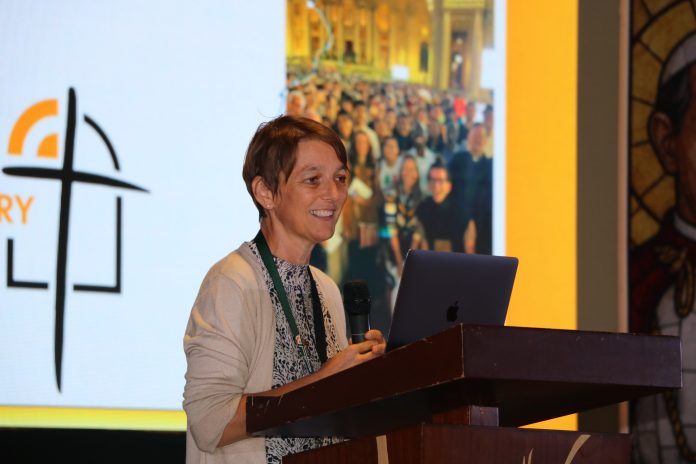
Govekar made the statement in a plenary address during the Asian Catholic Digital Missionary Assembly (ACDMA) 2026 in Manila on Sept. 11.
She said every Christian should be aware of his or her potential influence, regardless of the size of an online following, while responsibility grows as audiences expand. “Influence is a matter of responsibility,” Govekar said.
Govekar said digital evangelization should move away from individual-centered influence and toward communion, shared mission and witness.
Citing the Vatican document Towards Full Presence, she said Christians are called to learn together “as a community, and not as individuals,” describing synodality as “seeing others, walking on the same road, walking together, moving forward together.”
She also warned against treating Christian communication as a form of marketing, saying, “We are not advertising, but communicating to live the life that was given to us.”
Govekar said the purpose of Christian mission was not to build an audience but to communicate the Father’s love so others may have life.
She contrasted that approach with contemporary digital metrics, noting that “under the cross there were no likes, no earthly followers,” yet it remained “the greatest manifestation of God’s love.”
Govekar also called for greater discernment in the use of artificial intelligence, particularly in communication and formation.
She cited a recent Church document that calls for educating people to decide “when and for what purpose we ought not to use” AI.
The ease of obtaining answers and summaries, she said, should not replace the effort required for deeper understanding and personal formation. “How much of your self and how much of your effort is put into communication?” Govekar asked.
She said communicators should not avoid the effort and interior work involved in the process of communication.
Govekar also stressed that sophisticated tools cannot substitute for the interior disposition required of Christian communicators.
Quoting an earlier Church document on communications, she said, “No communication system, however sophisticated, can create a heart that gives itself.”
She said collaboration should also be central to digital mission, arguing that “the biggest achievements are not the result of a great individual genius, but rather the fruit of great friendship.”
Govekar presented an international formation program for 16 young communicators as an example of that approach.
The program combined online training, group work, consultations and projects with Catholic institutions, with participants learning through shared work rather than individual output.
Govekar said collaboration was more difficult than working alone but produced deeper results.
“The most important outcome of this project is not the final products, which were, by the way, very beautiful, but the process, the relationships, the mutual working,” she said.
She said similar approaches could be developed locally and internationally, including across Asia, with digital evangelization rooted in communion, shared responsibility and formation rather than individual visibility.