Catholic digital missionaries warned that young people turning to artificial intelligence for deeply personal conversations may reflect a wider “crisis of intimacy”.
They also raised concerns over the privacy of sensitive information shared with commercial technology platforms during the Asian Catholic Digital Missionary Assembly (ACDMA) 2026 in Manila on Sept. 11.
Father Ritchie Vincent of India said the growing appeal of AI chatbots should prompt the Church to examine why some young people may find it easier to confide in technology than in other people.
“Why are they not able to share their feelings openly with another human being? Because we have difficulty in accepting and listening to people without judging, without condemning them,” Vincent said.
“That’s why young people today are more comfortable talking with a chatbot like ChatGPT. They are able to pour out their hearts into ChatGPT,” he said.
Vincent said the trend also raised concerns over how personal information shared with generative AI systems could be used.
“I think the church should look into the future, where at least the data of Catholic young people will remain protected,” he said.
He added that the Church should consider what could happen to “the millions and millions of young people who are sharing their personal information with these so-called generative AI.”
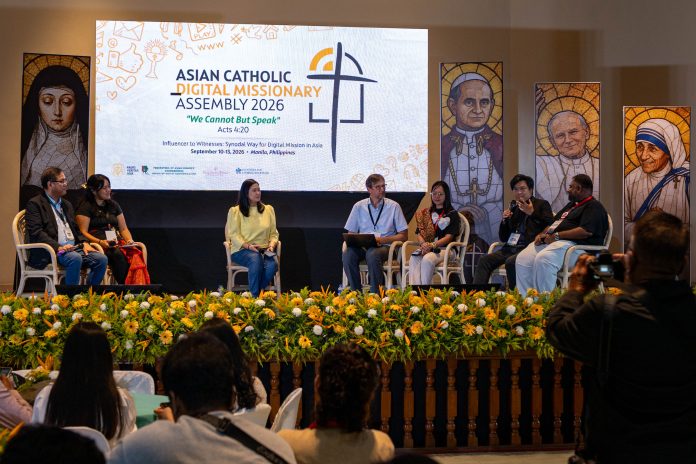
The remarks came during a panel discussion on artificial intelligence, digital influence and faith communities involving Catholic digital missionaries and facilitators from several countries.
Edwin Lopez of the Philippines, executive secretary of the Episcopal Commission on Social Communications of the Catholic Bishops’ Conference of the Philippines and international manager for the Asia-Pacific region of Eternal Word Television Network, said the deeper concern was not limited to misinformation or manipulation in digital spaces.
“There’s a deeper crisis that I think all of us should address when we leave this convention. If we ever hope to become authentic witnesses, this is the crisis. The crisis of intimacy,” he said.
Lopez said technology should remain a means toward communion rather than become the goal of digital ministry. “Technology is a powerful way to reach the end, and the end is always communion,” he said.
He also stressed the importance of physical presence in Catholic life. “God did not just send the message; He sent Himself in the flesh. That’s how important human connection is. That’s how important embodied presence is,” Lopez said.
“The sacraments cannot be digitized. The priest cannot be digitized,” he added.
Vincent said his group also discussed the idea of an “AI priest,” which participants initially rejected.
“The immediate response, the first response that most of us had in the room was that we don’t need an AI priest because an AI priest will never be able to replace a real priest,” he said.
He said AI could perform some functions but could not reproduce priestly identity. “It can never imitate the being of a priest,” Vincent said, adding that it may be able to help in imitating certain functions of a priest.
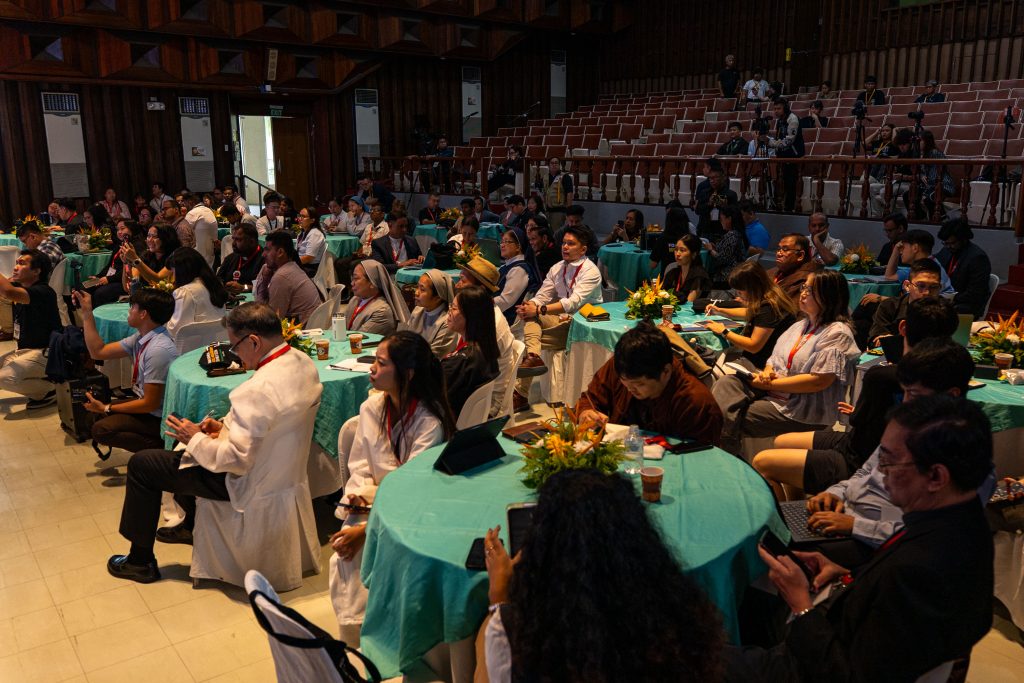
Peter Monthienvichienchai of Thailand, secretary general of SIGNIS, the World Catholic Association for Communication, facilitated the AI discussion and said participants distinguished between tools designed for specific functions and systems that could replace human agency.
“There was a lot of awareness of AI,” he said, adding that the room went into the “difference between using AI to do something functional versus doing something that may replace an agent.”
The panel also examined the pressures faced by Catholic digital influencers.
Sara Lea Tunas of Indonesia said tools originally intended to serve a mission could begin to reshape a person’s priorities when ego takes over.
“The tool starts to become religion when the ego starts to take everything up,” she said.
Tunas said online influence could become tied to “money, fame, popularity” and pressure to meet audience demands.
She urged digital missionaries to practice what her group described as “holy detachment.”
“Holy detachment means detached from the world and remember we are not the mission, but we are participating,” she said.
Lopez made a similar point, warning against treating visibility and popularity as ends in themselves. “Visibility, reach, monetization, impressions, popularity—they are just means,” he said.
“But once an influencer puts those means as the end, he loses both communion and the means,” he added.
Michael Unland of Germany, executive director of CAMECO, said digital platforms often favor individual personalities rather than community-building.
“You are basically struggling. You are fighting against a platform structure that is not necessarily promoting the content that is for communities,” he said.
Unland pointed to an African model in which about 200 young people collaborated through a digital platform and linked their online activity to feeding poor communities.
He said the example showed how coordinated online action could be connected with the Church’s extensive physical presence through parishes, dioceses, schools, youth centers and other institutions.
Karen Gajutos of the Philippines said digital evangelization must also include people who remain outside online spaces.
She cited rural communities where people still lack electricity, internet access, Wi-Fi and smartphones.
“How do we engage them with the message of Christ?” Gajutos said.
“To other people in the digital world, we always say that people are already in the digital world, but how about these people? Are they to be left behind, or to be viewed in our ecosystem, in our network?” she added.
Gajutos said digital ministry should also bridge generations rather than exclude older people.
“Do we say, ‘you’re not part of it because you’re an elder,’ or do we say, ‘you are part of this ecosystem and you are part of our network’?” she said.
She said young Catholics should not be viewed only as the Church’s future. “Young people are not just the future of our land, but they are the present of our church. They are the present movers,” Gajutos said.
Across the discussions, panelists returned to the need to keep digital tools rooted in human relationships, community and real-world engagement.
“The best way that they connect is through the human element,” Lopez said.