
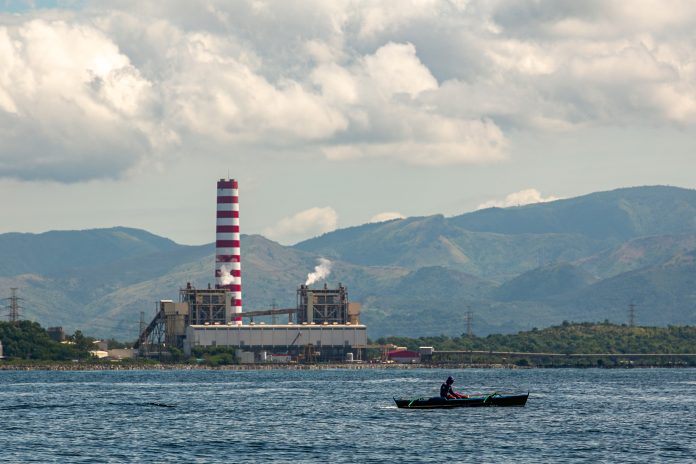
A Philippine climate group criticized the government’s 2026 nationally determined contribution for failing to include a concrete commitment to phase out fossil fuels as global temperatures move closer to breaching the 1.5-degree Celsius threshold.
The Center for Energy, Ecology, and Development (CEED) said the NDC lacks a fossil fuel phaseout commitment while retaining a 40% renewable energy target by 2030, unchanged from the Philippine Energy Plan.
“It is alarming that the Philippine government’s nationally determined contributions (NDC) do not include a concrete commitment to phase out fossil fuels,” CEED Executive Director Gerry Arances said in a Sept. 9 statement.
“This is a severe misalignment not only from international commitments to mitigate global temperature rise below 1.5℃, but also from the government’s duty to ensure the climate survival of Filipinos,” he said.
Arances cited a recent United Nations Environment Programme report that global temperatures are estimated to breach 1.5 C within the next few years, with the best-case scenario being a peak rise of 1.8 C.
His criticism came two days after UNEP and the Climate and Clean Air Coalition released a separate assessment showing that faster climate and clean-air action could deliver major economic, health and emissions benefits.
The report, Hidden assets: The economic and health case for climate and clean air action, assessed 25 measures across energy and fossil fuel systems, industry, transport, agriculture, household energy and waste management.
It found that immediate implementation of the measures could halve global carbon dioxide emissions by 2050, cut methane emissions by 60% and reduce black carbon and major air pollutants by about 70%.
The assessment also estimated that every dollar invested in the measures could generate about $15 in economic benefits.
UN Secretary-General António Guterres said accelerating the transition away from fossil fuels “is one of the fastest and most effective ways to clean the air while tackling the climate crisis.”
Arances said the Philippines’ exposure to typhoons and floods underscored the need to move away from fossil fuels.
“Typhoon after typhoon, flood after flood, we are reminded of our vulnerabilities to the climate crisis driven by fossil fuel use,” he said.
He said the government’s lack of a firm commitment to phase out fossil fuels showed insufficient action to protect communities and contribute to global climate efforts.
“The government’s refusal to quicken the pace of the energy transition, backdropped by a continued dependence on fossil fuels, serves only to exacerbate the ongoing energy crisis,” Arances said.
“So long as we continue depending on coal, gas, and diesel for energy, Filipinos will know only expensive, unreliable electricity amid strong typhoons and life-threatening floods.”
Arances called for a transition away from coal, gas, and diesel to reduce the impacts of fossil fuel dependence on disaster-prone communities.
“Now more than ever, it is critical to make the necessary transition away from coal, gas, and diesel to minimize the impacts these fossil fuels bring to our disaster-prone communities,” he said.
He said breaching the 1.5 C threshold should spur stronger efforts to cut greenhouse gas emissions rather than weaken climate action.
“Rather, it is an impetus to go all in to reduce greenhouse gas emissions; completely phase out all forms of fossil fuels, including natural gas; and ensure reliable protections of our communities against floods, typhoons, heat waves, and all manner of climate impacts,” he said.