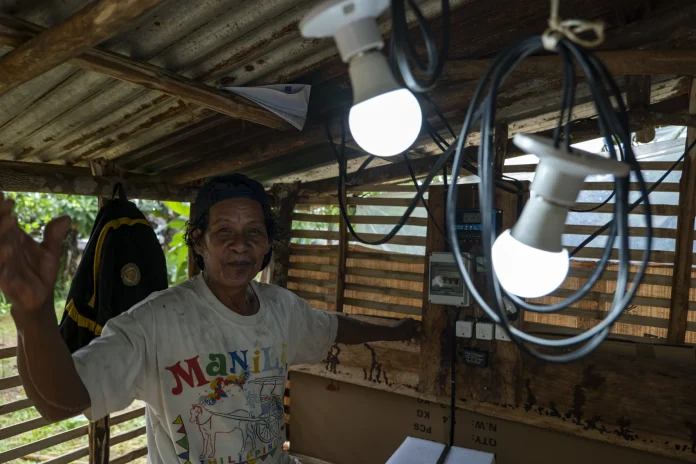
For many Mindoreños, the energy crisis is not an abstract issue but a daily burden. Recurring power outages, high electricity costs, and a system that often fails to meet the people’s needs have long shaped life on the island. This is not merely an inconvenience; it affects livelihoods and operations, disrupts education, compromises expenses for other basic necessities, and constrains local development.
As we enter the Season of Creation this year, we are invited to see this reality through a deeper lens. The challenge before us is not only technical or economic but also moral and spiritual. Caring for our common home calls us to examine the systems we rely on and to choose those that sustain life rather than harm it, all the more in ecologically diverse corridors such as the Verde Island Passage, along which Oriental Mindoro lies. This season invites us to reflect and act in stewardship of our shared home.
Hence, as a continuing response, the Diocese of Calapan, in partnership with the Local Government of Mansalay, launched the REnew Mindoro Caravan, beginning in Mansalay as its pilot municipality. This initiative seeks to bring renewable energy conversations and solutions directly to every town in the province, translating vision into practical solutions guided by a clear commitment: “abot-kamay at abot-kayang kuryente para sa Mindoreño.”
The diocese will also have the inauguration of solarization projects at the Bishop’s Residence and St. Augustine Seminary in Calapan, as our profound commitment to leading by example and embracing the transition toward clean, reliable, and just energy for all.
It is important to understand that the REnew Mindoro Caravan, more than an outreach effort, represents a decisive shift from high-level discussions to tangible action within communities. If the conversations of the past months have laid the groundwork for nationwide calls for renewable energy, the Caravan now brings these possibilities into the everyday lives of Mindoreños.
By directly connecting communities with renewable energy providers and financing institutions, solutions that once seemed distant are now becoming achievable for the solarization of households and livelihoods. In this way, energy is no longer just a service that people passively consume; it becomes something communities can actively manage and benefit from.
When a family installs a solar power system, they gain greater control over their electricity use and expenses. When schools, hospitals, clinics or parishes adopt solar, they become more resilient in the face of power interruptions. And when entire municipalities move together, they begin to build a model of development and become a beacon of hope that no longer depends on expensive, unreliable, and polluting sources.
This is the essence of “abot-kamay at abot-kayang kuryente para sa Mindoreño” — it is both a technical solution for expensive electricity and a step toward a more democratic and equitable energy system. With partner financing institutions such as banks and cooperatives exploring investments in and developing flexible financing options, solarization has now become more accessible than ever, even for small households.
At the same time, such transformation cannot happen without collective effort. Local governments play a crucial role in leading the way by solarizing public facilities and developing policies that make renewable energy more accessible to their constituents. For one, the Caravan pilot host, the Municipality of Mansalay, has already allotted a budget for the solarization of its municipal complex, public market, and fishing port. The neighboring Municipality of Roxas has just finished its first phase of solarization. Meanwhile, more municipalities in Oriental Mindoro are now exploring possibilities for solarizing their own establishments, mainly triggered by intermittent power supply.
The Church, for its part, remains a vital player not only in offering moral guidance but also in actively participating in this transition. Of the diocese’s 41 parishes and quasi-parishes, 18 churches have already installed solar power systems — halfway toward its three-year transition target. This does not include Catholic schools and diocesan establishments that are also in the pipeline, including the solarization of the households of diocesan workers. Through parishes and establishments, the call to care for creation becomes concrete, lived action within communities.
The REnew Mindoro Caravan is an invitation to every Mindoreño to be part of the solution. The light we seek is not far from us — it is already within our reach. Ultimately, the Season of Creation is a time for decision — whether we will remain within a system that has long failed to serve people well and continues to harm the environment, or whether we will choose a path that brings light not only to homes today but also to future generations. In this Season of Creation, may we choose not only to embrace this transition but to nurture it and ensure that it remains within reach for all.
Fr. Edwin Gariguez is the executive director of the Social Action Center of the Diocese of Calapan. A Catholic priest and environmental activist, he serves as convenor of REnew Mindoro and Protect the Verde Island Passage, advancing community-led efforts for a just and sustainable energy transition.
He is a former executive director of Caritas Philippines (CBCP-NASSA) and a recipient of the 2012 Goldman Environment Prize for his leadership in protecting Mindoro’s environment and Indigenous communities.